After the eight decisions
The apiary year, month by month
What a honey bee colony is doing, what its keeper does, and what is flowering in Central Europe, one month at a time.
Applies to: Honey bee colonies (Apis mellifera) in Central Europe (DE, CH, CZ, PL); dates shift with altitude, weather and climate Region: Central Europe
January
In the colony
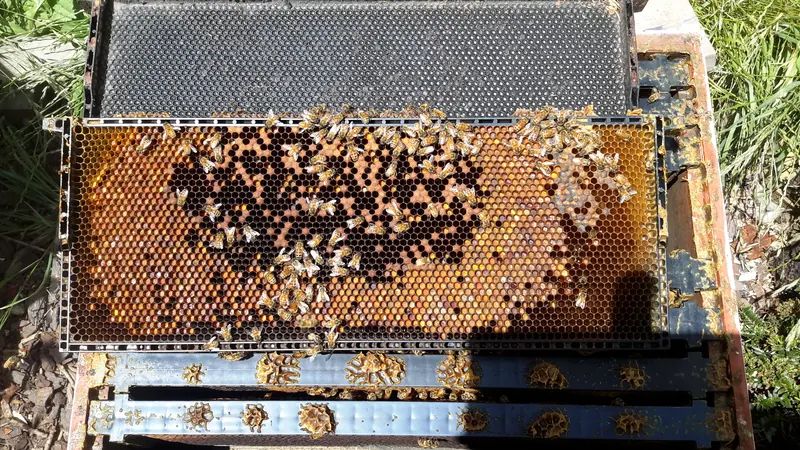
In January 2023 a state bee adviser in south-west Germany reported that colonies in mild areas kept rearing brood despite frosty nights.Observation, source obs. 1 German advisory figures: a brood-free colony uses just under 1 kg of winter stores a month, a colony rearing brood up to 3 kg.Statistical estimate, source est. 1
At the apiary
LWG Bayern's guide for schools says winter colonies should be disturbed as little as possible, because every disturbance costs them stores.Confirmed fact, source 2 In Bavaria the winter check is done from outside: has snow blown the entrance shut, and is the mouse guard still in place?Confirmed fact, source 2 The Czech bee research institute's January calendar has beekeepers prepare to collect winter hive debris so mite levels can be examined.Confirmed fact, source 3
In flower
In early January 2023 a mild spell of 10 to 15 °C in south-west Germany already brought hazel (Corylus avellana) into flower where it had not been killed by frost.Observation, source obs. 1
February
In the colony
In mid-February 2024 the Hohenheim bee institute (Baden-Wuerttemberg) reported that colonies were rearing brood and that their need for food was rising with it.Confirmed fact, source 4 Even when February turns cold again, the bees keep brooding and will not leave the brood nest.Confirmed fact, source 4
At the apiary
German institutes advise lifting every hive slightly to judge its weight, then looking closely at the lightest colony to check its food.Confirmed fact, source 4 A Baden-Württemberg adviser warns that the weeks between February and March can become critical for some colonies' stores.Confirmed fact, source 1 In Czechia, if the weather allows, beekeepers can look forward to the bees' spring cleansing flights in February.Confirmed fact, source 5
In flower
In mid-February 2024 near Stuttgart, alder (Alnus) and hazel (Corylus avellana) were flowering and snowdrops (Galanthus nivalis) and crocuses (Crocus) were emerging.Observation, source obs. 4
Flowering this month in our plant calendar: Corylus avellana
March
In the colony
Czech colonies are already rearing brood in March; by 19 March they should have laid down 10 to 20 square decimetres of brood.Confirmed fact, source 6 In March the winter generation is being replaced, and the strongest Czech colonies start drone brood at the end of the month.Confirmed fact, source 6 At the end of March 2024 German institutes reported many young bees emerging, all needing food, and brood nests growing rapidly.Observation, source obs. 7
At the apiary
In late March German institutes want at least 5 kg of food in each colony; lifting the hive at the back is enough to tell.Confirmed fact, source 7 A Pomeranian advisory brochure (2015) tells Polish beekeepers to start the water feeder as early as possible after the bees' first spring flight, whenever that falls, so they do not look for other water sources.Confirmed fact, source 8
In flower
In late March 2024 nectar from willow (Salix), cornelian cherry (Cornus mas) and other early flowers was being used up by colonies almost as it came in.Observation, source obs. 7
Flowering this month in our plant calendar: Corylus avellana, Crocus vernus, Erica carnea, Salix caprea
April
In the colony
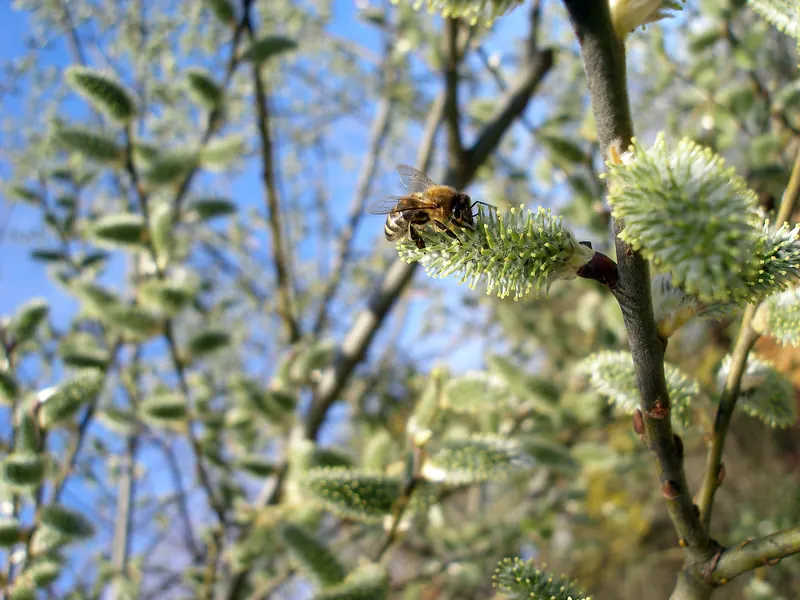
After eager brooding in March, the spaces between the combs fill up faster and faster in April, Hohenheim reported in 2024.Observation, source obs. 9 Hohenheim warns that swarm mood can already appear from the end of March in southern Germany.Confirmed fact, source 9 A Polish advisory brochure estimates a colony uses 80 to 100 kg of honey a season for itself, 20 to 25 kg of it in April and May.Statistical estimate, source est. 8
At the apiary
In Bavaria the start of cherry blossom is the signal to put another box of combs on the colonies so they have room to expand.Confirmed fact, source 2 The Czech bee research institute's April calendar is about the spring growth of colonies, above all giving them space and preventing swarming.Confirmed fact, source 10
In flower
In Czechia something is always flowering from the start of April: stone fruit (Prunus), pome fruit (Malus, Pyrus) and maples (Acer).Confirmed fact, source 10
Flowering this month in our plant calendar: Acer pseudoplatanus, Brassica napus, Corylus avellana, Crocus vernus, Erica carnea, Prunus avium, Prunus spinosa, Salix caprea, Taraxacum officinale aggr.
May
In the colony
In May, says the Czech calendar, nature offers a surplus of nectar and pollen and life in the colonies runs at full throttle.Confirmed fact, source 11 BienenSchweiz says the swarm urge can wake when wild cherry (Prunus avium) starts flowering and last through the lime (Tilia) flow.Confirmed fact, source 12
At the apiary
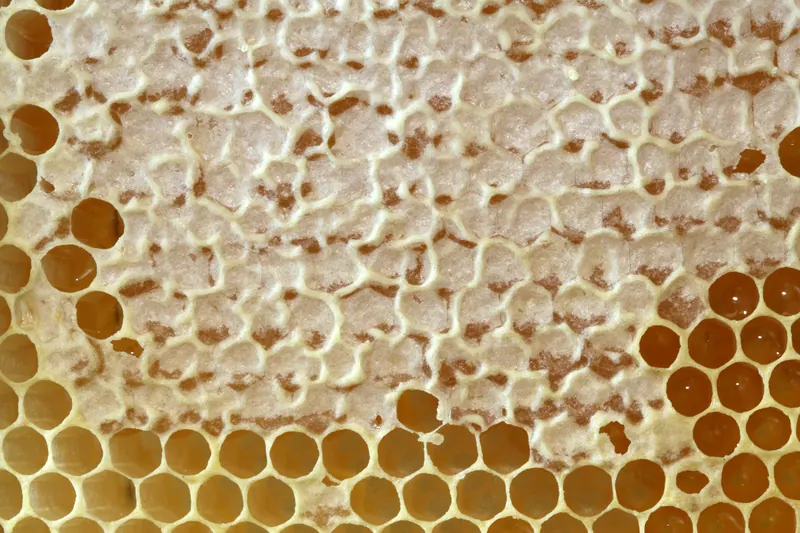
In early May the Kirchhain institute (Hesse) has colonies checked regularly every 7 to 9 days for swarm mood.Confirmed fact, source 13 For the spring harvest, Hohen Neuendorf notes that capping is the bees' own sign that honey is ripe; in doubt, wait until combs are fully capped.Confirmed fact, source 14
In flower
In Czechia rapeseed (Brassica napus) flowers at the start of May and is within flight range of most apiaries, except higher areas where it is not sown.Confirmed fact, source 11 At the end of May, black locust (Robinia pseudoacacia) begins to flower in the warmer parts of Czechia.Confirmed fact, source 11
Flowering this month in our plant calendar: Abies alba, Acer pseudoplatanus, Aesculus hippocastanum, Borago officinalis, Brassica napus, Campanula rotundifolia, Crataegus monogyna, Echium vulgare, Erica carnea, Knautia arvensis, Lotus corniculatus, Malus domestica, Phacelia tanacetifolia, Picea abies, Prunus avium, Robinia pseudoacacia, Rubus fruticosus agg., Rubus idaeus, Salix caprea, Salvia pratensis, Taraxacum officinale aggr., Trifolium pratense, Trifolium repens
June
In the colony
The Czech bee research institute calls June without doubt the peak of the beekeeping year.Confirmed fact, source 15 A Polish advisory brochure puts a colony's own honey use at 30 to 40 kg in June, 15 to 17 kg in July and 10 to 12 kg in August.Statistical estimate, source est. 8
At the apiary
LWG Bayern warns that extracting combs too early and too often risks a honey with too high a water content.Confirmed fact, source 16 In Switzerland the swarm urge can only be detected reliably by inspecting the colony weekly throughout the swarm season.Confirmed fact, source 12
In flower
In June, Czech fields carry flowering mustard (Sinapis) grown for seed, and sunflower (Helianthus annuus) is beginning to bloom.Confirmed fact, source 15 Honeydew appears in Czech forests in June: on spruce (Picea abies) from the scale insect Physokermes, on other trees from aphids.Confirmed fact, source 15
Flowering this month in our plant calendar: Borago officinalis, Campanula rotundifolia, Castanea sativa, Centaurea cyanus, Crataegus monogyna, Echium vulgare, Epilobium angustifolium, Erica carnea, Knautia arvensis, Lotus corniculatus, Lysimachia vulgaris, Melilotus officinalis, Phacelia tanacetifolia, Robinia pseudoacacia, Rubus fruticosus agg., Rubus idaeus, Salvia pratensis, Sinapis alba, Tilia cordata, Trifolium pratense, Trifolium repens
July
In the colony
In early July 2024 the Kirchhain institute (Hesse) described colonies as still strong, but with the brood volume now clearly shrinking.Confirmed fact, source 17 Without incoming nectar, colonies have little motivation to rear brood, the Hohen Neuendorf institute (Brandenburg) noted in late July 2024.Confirmed fact, source 18
At the apiary
The Czech calendar calls July the month when the beekeeper should start thinking about winter.Confirmed fact, source 19 When taking honey combs in July, Czech beekeepers are told to leave five or more kilograms of stores in the colony for its future.Confirmed fact, source 19
In flower
In July small-leaved lime (Tilia cordata) and sunflower (Helianthus annuus) are flowering or finishing in Czechia, with red clover (Trifolium pratense) in places.Confirmed fact, source 19 In mid-July 2023 the North Rhine-Westphalia chamber of agriculture reported the summer flow drawing to a close in many parts of Germany.Observation, source obs. 20
Flowering this month in our plant calendar: Borago officinalis, Campanula rotundifolia, Centaurea cyanus, Echium vulgare, Epilobium angustifolium, Fagopyrum esculentum, Helianthus annuus, Impatiens glandulifera, Knautia arvensis, Lotus corniculatus, Lysimachia vulgaris, Melilotus officinalis, Origanum vulgare, Phacelia tanacetifolia, Rubus fruticosus agg., Rubus idaeus, Salvia pratensis, Sinapis alba, Solidago canadensis, Tilia cordata, Trifolium pratense, Trifolium repens
August
In the colony
In mid-August 2023 the Kirchhain institute (Hesse) found colonies still strong, but the drones already driven out and the brood volume clearly shrinking.Confirmed fact, source 21 Kirchhain stresses that overwintering and the start of the new year depend on the bees reared in the weeks after mid-August.Confirmed fact, source 21
At the apiary
In August the Kirchhain institute (Hesse) tells beekeepers to keep mite infestation under watch whatever has been done against it so far, because mite numbers grow exponentially.Confirmed fact, source 21 A Pomeranian advisory brochure counts the apiary's autumn as starting at the beginning of August, when robbing becomes a particular danger in Poland.Confirmed fact, source 8 In North Rhine-Westphalia the rapid feeding-up for winter usually begins only at the end of August.Confirmed fact, source 20
In flower
In August, Czech bees still find nectar and pollen on white and yellow sweet clover (Melilotus albus, M. officinalis), mustard (Sinapis) and phacelia (Phacelia tanacetifolia) sown as green manure.Confirmed fact, source 22 Buckwheat (Fagopyrum esculentum) can help Czech colonies prepare well for winter, although its honey is not popular because of its taste and smell.Confirmed fact, source 22
Flowering this month in our plant calendar: Borago officinalis, Calluna vulgaris, Campanula rotundifolia, Centaurea cyanus, Echium vulgare, Epilobium angustifolium, Fagopyrum esculentum, Helianthus annuus, Impatiens glandulifera, Knautia arvensis, Lysimachia vulgaris, Melilotus officinalis, Origanum vulgare, Phacelia tanacetifolia, Rubus fruticosus agg., Salvia pratensis, Sinapis alba, Solidago canadensis, Trifolium pratense, Trifolium repens
September
In the colony
For the colony, says the Czech calendar, September is broadly the finale of its preparation for winter.Confirmed fact, source 23 Kirchhain (Hesse) wants a single-box colony to cover 9 to 10 comb gaps well in mid-September, and a double-box colony 16 to 18.Confirmed fact, source 24
At the apiary
In Hesse, colonies must be fed up by mid-September, and a weight check should be done by then at the latest.Confirmed fact, source 24 BienenSchweiz puts the winter food need of a Swiss production colony at about 20 kg, replaced with sugar syrup after the summer honey harvest.Statistical estimate, source est. 25 The Czech September calendar covers the last winter preparations, checking stores, and an ideal opportunity to replace queens.Confirmed fact, source 23
In flower
In September, Czech nature offers above all the pollen of wild herbs; where farmers sow green-manure crops, mustard (Sinapis) and phacelia (Phacelia tanacetifolia) are the most generous.Confirmed fact, source 23
Flowering this month in our plant calendar: Calluna vulgaris, Campanula rotundifolia, Centaurea cyanus, Echium vulgare, Fagopyrum esculentum, Hedera helix, Helianthus annuus, Impatiens glandulifera, Knautia arvensis, Melilotus officinalis, Origanum vulgare, Phacelia tanacetifolia, Sinapis alba, Solidago canadensis, Trifolium pratense, Trifolium repens
October
In the colony
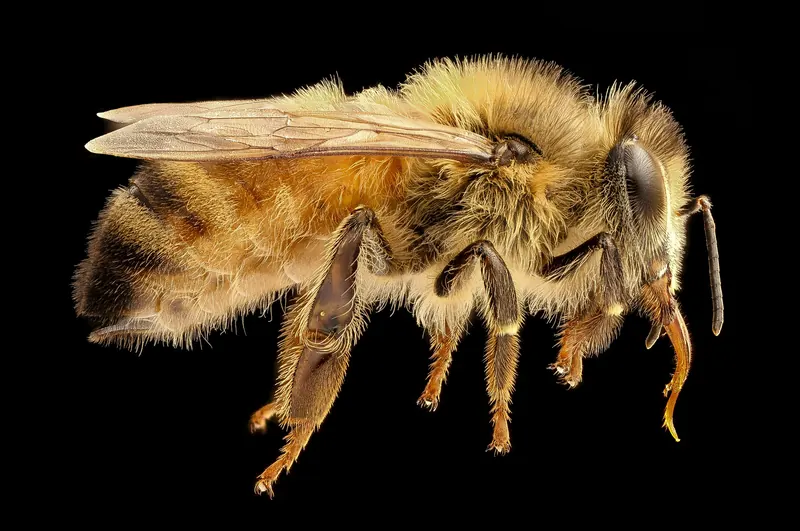
When temperatures fall below 10 °C in October, Czech colonies draw together into the winter cluster on the site of the last brood.Confirmed fact, source 26 Brood areas keep shrinking through October and approach zero by the end of the month, according to the Czech calendar.Confirmed fact, source 26 Hohen Neuendorf explains that hardly anything flowers naturally in October, so flights and brood rearing no longer pay and colonies form the winter cluster.Confirmed fact, source 27
At the apiary
In Brandenburg, Hohen Neuendorf suggests that at risky sites a strip laid in the entrance, narrowing it to 6 mm, keeps mice and shrews out.Confirmed fact, source 27 October comb hygiene in Brandenburg: combs brooded several times, and any built wavy or with holes, are melted down.Confirmed fact, source 27
In flower
Where ivy (Hedera helix) climbs trees, its October flowering feeds many insects, Hohen Neuendorf observed in 2024.Observation, source obs. 27
Flowering this month in our plant calendar: Calluna vulgaris, Centaurea cyanus, Echium vulgare, Hedera helix, Melilotus officinalis, Phacelia tanacetifolia, Sinapis alba, Trifolium pratense
November
In the colony
The Kirchhain institute (Hesse) recalls that colonies used to stop rearing brood by October at the latest.Confirmed fact, source 28 Kirchhain now observes more and more colonies still tending brood at the end of November, a change it attributes to climate change.Observation, source obs. 28 Czech bees sometimes still bring pollen loads in November before the first hard frosts, but this pollen no longer has a fundamental effect on wintering.Confirmed fact, source 29
At the apiary
LWG Bayern uses the quiet of November to remind beekeepers that hive record cards belong to beekeeping as much as the hive tool and smoker.Confirmed fact, source 30 In Germany a stock book documents treatments of the colonies, and a honey book documents honey harvest, extraction and marketing.Confirmed fact, source 31
December
In the colony
In its October advice on preparing winter rest, Hohen Neuendorf notes that winter losses can also be caused by disturbing the colony's winter rest, which applies through December.Confirmed fact, source 27
At the apiary
In Czechia, December is when beekeepers begin collecting winter hive debris so that mite levels can be examined.Confirmed fact, source 32 The Czech calendar says that by December, or at the latest early in the new year, beekeepers should be clear about next year's tasks.Confirmed fact, source 32 In mid-December 2023 the German institutes reviewed the year: the spring harvest came to 18.5 kg per colony and the summer harvest to 18.2 kg, above average for Germany.Reported by the farm, source reported 33
The chain of decisions
Sources
- Binder-Köllhofer, B. Futterkontrolle und Fortbildungen. Infobrief Bienen@Imkerei 02/2023, 27 January 2023, joint newsletter of the German state bee institutes (DLR Westerwald-Osteifel Mayen, LWK NRW, LWG Veitshöchheim, LLH Kirchhain, Hohenheim, Hohen Neuendorf). Link
- Bayerische Landesanstalt für Weinbau und Gartenbau (LWG), Fachzentrum Bienen, Veitshöchheim. Bienen in der Schule: Das Bienenjahr, Arbeiten an den Bienen (information sheet, undated). Link
- Výzkumný ústav včelařský, s.r.o., Dol (VÚVč). Včelařský rok podle Dr. Františka Kamlera: Leden (web page summarising Kalendárium, Včelařství 1/2020; page dated 13 January 2021). Link
- Traynor, K. (Landesanstalt für Bienenkunde Hohenheim). Futterkontrolle und Saisonvorbereitung. Infobrief Bienen@Imkerei 02/2024, 16 February 2024, joint newsletter of the German state bee institutes. Link
- Výzkumný ústav včelařský, s.r.o., Dol (VÚVč). Včelařský rok podle Dr. Františka Kamlera: Únor (web page summarising Kalendárium, Včelařství 2/2020). Link
- Výzkumný ústav včelařský, s.r.o., Dol (VÚVč). Včelařský rok podle Dr. Františka Kamlera: Březen (web page summarising Kalendárium, Včelařství 3/2020). Link
- Frühjahrsdurchsicht. Infobrief Bienen@Imkerei 04/2024, 28 March 2024, joint newsletter of the German state bee institutes (DLR Westerwald-Osteifel, LWK NRW, LWG Veitshöchheim, LLH Kirchhain, Hohenheim, Hohen Neuendorf). Link
- Pomorski Ośrodek Doradztwa Rolniczego w Gdańsku (ed. Cichocki, J.). Zakładamy pasiekę. Poradnik dla początkujących pszczelarzy. Lubań, 2015. Link
- Ernst, U. (Landesanstalt für Bienenkunde Hohenheim). Erweiterung. Infobrief Bienen@Imkerei 05/2024, 12 April 2024, joint newsletter of the German state bee institutes. Link
- Výzkumný ústav včelařský, s.r.o., Dol (VÚVč). Včelařský rok podle Dr. Františka Kamlera: Duben (web page summarising Kalendárium, Včelařství 4/2020). Link
- Výzkumný ústav včelařský, s.r.o., Dol (VÚVč). Včelařský rok podle Dr. Františka Kamlera: Květen (web page summarising Kalendárium, Včelařství 5/2020). Link
- BienenSchweiz / Bienengesundheitsdienst (BGD). Merkblatt 4.7.5 Umgang mit dem Schwarmtrieb, version V 2603. Link
- Petzoldt-Treibert, K. (LLH Bieneninstitut Kirchhain). Schwarmkontrolle. Infobrief Bienen@Imkerei 08/2024, 3 May 2024, joint newsletter of the German state bee institutes. Link
- Radtke, J. (Länderinstitut für Bienenkunde Hohen Neuendorf). Vorbereitung Honigernte. Infobrief Bienen@Imkerei 10/2024, 17 May 2024, joint newsletter of the German state bee institutes. Link
- Výzkumný ústav včelařský, s.r.o., Dol (VÚVč). Včelařský rok podle Dr. Františka Kamlera: Červen (web page summarising Kalendárium, Včelařství 6/2020). Link
- Fischer, J. (LWG Institut für Bienenkunde und Imkerei, Veitshöchheim). Honigtautracht. Infobrief Bienen@Imkerei 16/2023, 19 June 2023, joint newsletter of the German state bee institutes. Link
- Brunnemann-Stubbe, G. (LLH Bieneninstitut Kirchhain). Biotechnische Maßnahmen und Trachtverlauf. Infobrief Bienen@Imkerei 17/2024, 5 July 2024, joint newsletter of the German state bee institutes. Link
- Radtke, J. (Länderinstitut für Bienenkunde Hohen Neuendorf). Nachtrachtpflege, Grundstein für das nächste Jahr. Infobrief Bienen@Imkerei 20/2024, 26 July 2024, joint newsletter of the German state bee institutes. Link
- Výzkumný ústav včelařský, s.r.o., Dol (VÚVč). Včelařský rok podle Dr. Františka Kamlera: Červenec (web page summarising Kalendárium, Včelařství 7/2019). Link
- Poker, V. (Landwirtschaftskammer NRW, Bienenkunde Münster). Fütterung. Infobrief Bienen@Imkerei 20/2023, 14 July 2023, joint newsletter of the German state bee institutes. Link
- Brunnemann-Stubbe, G. (LLH Bieneninstitut Kirchhain) and Otten, C. (DLR Westerwald-Osteifel, Mayen). Varroakontrolle und Ergebnisse Frühtrachternte. Infobrief Bienen@Imkerei 22/2023, 11 August 2023. Link
- Výzkumný ústav včelařský, s.r.o., Dol (VÚVč). Včelařský rok podle Dr. Františka Kamlera: Srpen (web page summarising Kalendárium, Včelařství 8/2019). Link
- Výzkumný ústav včelařský, s.r.o., Dol (VÚVč). Včelařský rok podle Dr. Františka Kamlera: Září (web page summarising Kalendárium, Včelařství 9/2019). Link
- Petzoldt-Treibert, K. (LLH Bieneninstitut Kirchhain). Spätsommerpflege. Infobrief Bienen@Imkerei 24/2023, 15 September 2023, joint newsletter of the German state bee institutes. Link
- BienenSchweiz / Bienengesundheitsdienst (BGD). Merkblatt 4.2 Fütterung, version V 2604. Link
- Výzkumný ústav včelařský, s.r.o., Dol (VÚVč). Včelařský rok podle Dr. Františka Kamlera: Říjen (web page summarising Kalendárium, Včelařství 10/2019). Link
- Radtke, J. (Länderinstitut für Bienenkunde Hohen Neuendorf). Am Bienenstand: Winterruhe vorbereiten. Infobrief Bienen@Imkerei 25/2024, 11 October 2024, joint newsletter of the German state bee institutes. Link
- Brandt, A. (LLH Bieneninstitut Kirchhain). Klimawandel und Winterbehandlung. Infobrief Bienen@Imkerei 26/2024, 31 October 2024, joint newsletter of the German state bee institutes. Link
- Výzkumný ústav včelařský, s.r.o., Dol (VÚVč). Včelařský rok podle Dr. Františka Kamlera: Listopad (web page summarising Kalendárium, Včelařství 11/2019). Link
- Heidinger, I. (LWG Institut für Bienenkunde und Imkerei, Veitshöchheim). Dokumentation, Selektion, Stockkarten. Infobrief Bienen@Imkerei 27/2023, 17 November 2023, joint newsletter of the German state bee institutes. Link
- Harz, M. (LWK NRW, Münster) and Otten, C. (DLR Westerwald-Osteifel, Mayen). Dokumentation und Herbstverluste. Infobrief Bienen@Imkerei 27/2024, 22 November 2024, joint newsletter of the German state bee institutes. Link
- Výzkumný ústav včelařský, s.r.o., Dol (VÚVč). Včelařský rok podle Dr. Františka Kamlera: Prosinec (web page summarising Kalendárium, Včelařství 12/2019). Link
- Otten, C. (DLR Westerwald-Osteifel, Fachzentrum Bienen und Imkerei, Mayen). Jahresrückblick. Infobrief Bienen@Imkerei 28/2023, 15 December 2023, joint newsletter of the German state bee institutes. Link
Last checked: 30 October 2026. Every statement in this article was compared with the source it cites. Spotted an error? Report it.