Bee plant, Central Europe
Erica carnea
Winter heath, Spring heath, Schneeheide
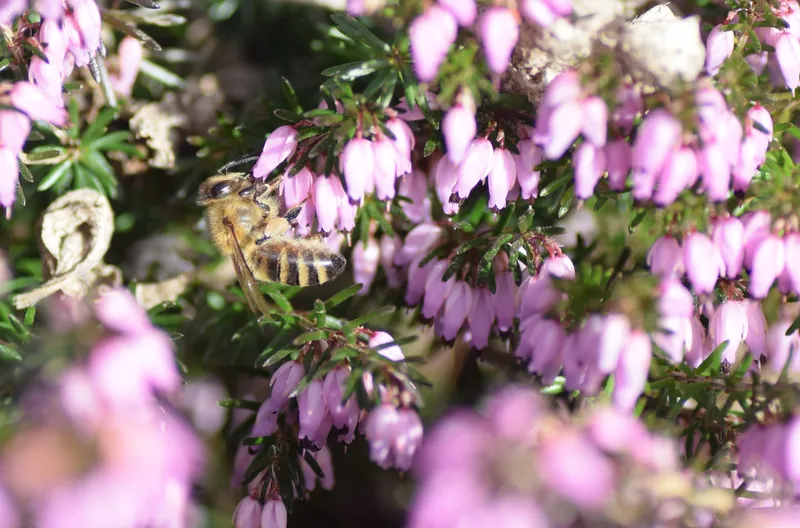
Winter heath is a native evergreen dwarf shrub of calcareous pine forests and dry slopes in and near the Alps. It flowers from late winter into early summer, mostly March to June, with pink bell shaped flowers that bees visit heavily in spring. Bee institutes list it among the first forage shrubs of the year.
What we know
How to recognise it
When it flowers
Info Flora gives the flowering period of winter heath in Switzerland as March to June, occasionally starting in January.
Confirmed fact[1]In the Alps the shrubs flower first on the steepest south facing slopes where snow melts earliest, turning into pink clouds of flowers in late winter.
Confirmed fact[3]
Where it grows
In Switzerland it grows in pine forests and on dry slopes on limestone, from the hill zone to the subalpine zone, in the Alps, near the Alps and in the Jura.
Confirmed fact[1]Info Flora lists the species as indigenous to Switzerland and not threatened nationally, but vulnerable in the Swiss Midlands.
Confirmed fact[1]The Zurich guide names pine forests, bilberry spruce forests, larch forest, rock ledges, dry slopes and dwarf shrub heaths on limestone as its habitats, and forest succession as the main threat.
Confirmed fact[2]
What it offers bees
The Canton of Zurich forest biodiversity guide records strong flower visitation by bees in spring.
Observation[2]The University of Potsdam botanical garden notes that mass stands of winter heath in the Alps are attractive to honey bees and that the plant grows mainly on calcareous ground.
Reported by the farm[3]
In the garden
The Bavarian institute LWG lists winter heath, with alder, among woody plants for the early spring bee forage phase from mid February to the end of March.
Confirmed fact[4]In the garden it accepts almost any soil but dislikes heavy fertilising, according to the Potsdam botanical garden.
Confirmed fact[3]The UK Royal Horticultural Society lists hardy heath species (Erica) in every seasonal section of its Plants for Pollinators garden plant list.
Confirmed fact[5]
Sources
- Info Flora. Erica carnea L. (Schneeheide). Online species page, Das nationale Daten- und Informationszentrum der Schweizer Flora (description from Flora Helvetica 2018). Link
- Kanton Zürich, Amt für Landschaft und Natur. Praxishilfe Waldbiodiversität: Heidekraut / Erika (Erica carnea). Link
- Botanischer Garten der Universität Potsdam (2014) Pflanze des Monats März 2014: Die Schnee-Heide (Erica carnea). Link
- Bayerische Landesanstalt für Weinbau und Gartenbau (LWG) (2021) Lebensräume für (Wild)Bienen - Garten & Balkon insektenfreundlich gestalten. Veitshöchheimer Berichte 191. Link
- Royal Horticultural Society. RHS Plants for Pollinators: Garden plants (list, reviewed 2025). Link
Last checked: 30 October 2026. Every statement on this page was compared with the source it cites.