Bee plant, Central Europe
Solidago canadensis
Canadian goldenrod, Kanadische Goldrute
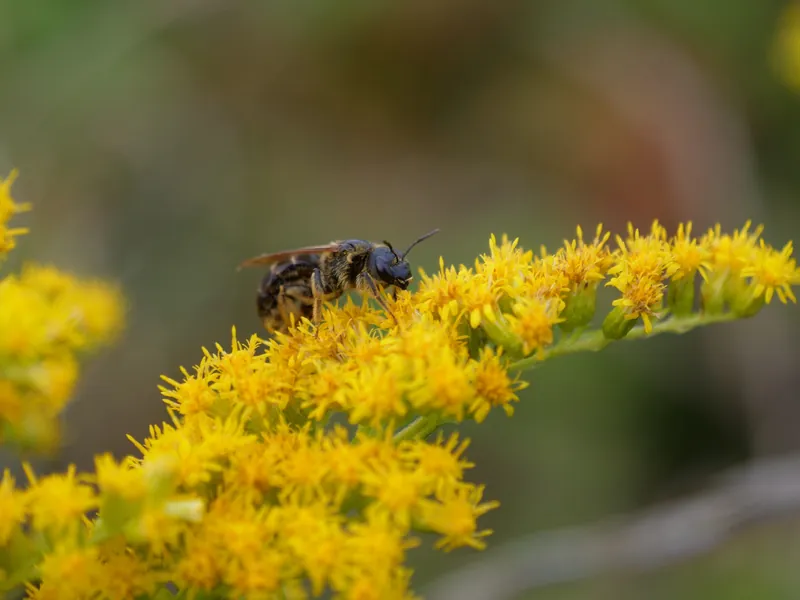
Canadian goldenrod is a North American perennial, 50 to 200 cm tall, that flowers yellow from July to September on waste ground, clearings and river banks. Bees and bumblebees pollinate it and it feeds many insects in late summer, but its rhizome stands crowd out native plants. It is a species with a handling ban in Switzerland, an invasive neophyte in Czechia and one of the most frequent neophytes in Germany, and it should not be planted.
Invasive in parts of the region
Switzerland: Info Flora list of invasive alien species, species with handling ban (FrSV Annex 2.1); Germany: BfN Neobiota handbook (Agriophyt, one of the most frequent neophytes); Czechia: invasive neophyte (Pyšek et al. 2022); Austria: University of Innsbruck Tyrol problem species list. Not found in the EU Union list update of 2017 (consolidated list not read). Clonal rhizomes form dense stands with up to 300 stems per square metre; one plant can produce more than 10,000 wind borne seeds. We do not recommend planting it.
Confirmed fact[2]What we know
How to recognise it
The plant is 50 to 200 cm tall, branched only in the inflorescence, with yellow flower heads 3 to 5 mm across in a one sided terminal panicle.
Confirmed fact[1]
When it flowers
Info Flora gives the flowering period in Switzerland as July to September.
Confirmed fact[1]
Where it grows
In Switzerland it is naturalised in forest clearings, river bank scrub and waste ground from the hill to the montane zone; it is originally North American.
Confirmed fact[1]
What it offers bees
The Info Flora sheet cites a 1979 Tyrolean study in which honey bees preferred Canadian goldenrod over the native European goldenrod Solidago virgaurea.
Reported by the farm[2]BfN states that the flowers are pollinated by bees and bumblebees and in late summer feed numerous wild bees, butterflies and hoverflies.
Confirmed fact[3]In wet meadows in the Vistula valley near Krakow, Poland, the abundance and species richness of bees and butterflies fell non linearly once invasive goldenrod (Solidago canadensis and S. gigantea) cover passed about 50 percent for bees and 30 to 40 percent for butterflies.
Confirmed fact[5]
In the garden
Info Flora advises cutting the flower heads before fruiting and not putting cuttings on garden compost; it notes the plant is very popular in gardens.
Confirmed fact[2]
Caution: invasive
The Info Flora sheet lists Canadian goldenrod as a species with a handling ban under Annex 2.1 of the Swiss Release Ordinance.
Confirmed fact[2]One plant can produce more than 10,000 wind dispersed seeds, and the rhizome system builds extremely dense stands with up to 300 stems per square metre.
Confirmed fact[2]BfN says the species has been known from England since 1645, was widely planted in gardens and as bee forage in the open landscape, and is among the most frequent neophytes in Germany.
Confirmed fact[3]Goldenrods form dense stands by clonal rhizome growth, and light loving plant species are displaced by their dominance stands.
Confirmed fact[3]Only repeated mowing pushes goldenrods back in the long term, according to BfN.
Confirmed fact[3]In Czechia Solidago canadensis is an invasive neophyte present in 82.2 percent of mapping grid cells, among the most widespread alien plants.
Confirmed fact[4]In Tyrol goldenrods have been present since about 1900; each inflorescence can form up to 20,000 winged seeds and the plant regenerates from the smallest rhizome pieces.
Confirmed fact[6]
Sources
- Info Flora. Solidago canadensis L. (Kanadische Goldrute). Online species page, Das nationale Daten- und Informationszentrum der Schweizer Flora (description from Flora Helvetica 2018). Link
- Info Flora (2025) Nordamerikanische Goldruten (Korbblütler): Solidago canadensis L., S. gigantea Aiton & S. graminifolia (L.) Salisb. (Asteraceae). Invasive Neophyten Infoblatt. Link
- Bundesamt für Naturschutz (BfN). Solidago canadensis. Neobiota.de Handbuch, Gefäßpflanzen, Artensteckbrief. Link
- Pyšek P, Sádlo J, Chrtek J Jr, Chytrý M, Kaplan Z, Pergl J et al. (2022) Catalogue of alien plants of the Czech Republic (3rd edition). Preslia 94: 447-577. doi:10.23855/preslia.2022.447. Table 6 and Results. Link
- Moroń D, Skórka P, Lenda M, Kajzer-Bonk J, Mielczarek Ł, Rożej-Pabijan E et al. (2019) Linear and non-linear effects of goldenrod invasions on native pollinator and plant populations. Biological Invasions 21(3): 947-960. doi:10.1007/s10530-018-1874-1 Link
- Universität Innsbruck, Institut für Botanik. Neophyten in Tirol, Problemarten Steckbrief: Goldruten-Arten (Solidago canadensis, S. gigantea). Link
Last checked: 30 October 2026. Every statement on this page was compared with the source it cites.