Bee plant, Central Europe
Brassica napus
Oilseed rape, Rapeseed
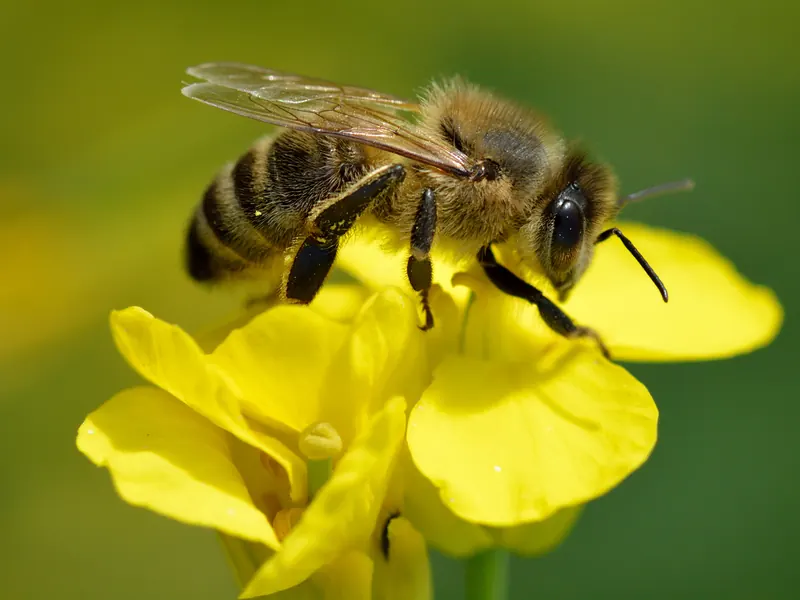
Oilseed rape is a field crop that flowers in April and May and sometimes escapes onto waste ground. Bee institutes value it for very good nectar and high quality pollen. Its honey has a high glucose share and crystallises within days, and large rape areas can temporarily dilute bumblebees away from nearby wild plants.
What we know
How to recognise it
Info Flora describes the sepals of oilseed rape as standing upright and spreading.
Confirmed fact[1]
When it flowers
Info Flora gives the flowering period of oilseed rape in Switzerland as April to May.
Confirmed fact[1]
Where it grows
Oilseed rape grows in arable fields and on waste ground; it is cultivated and occasionally escapes.
Confirmed fact[1]
What it offers bees
The Baden-Württemberg bee forage catalogue calls rapeseed the exception among main crops, offering very good nectar and high quality pollen.
Reported by the farm[2]A study near Göttingen states that the pollen and nectar of oilseed rape are highly attractive to bees.
Confirmed fact[3]In the same study, abundance of bumblebees, the main pollinators of cowslip, fell as the amount of oilseed rape in the landscape increased.
Confirmed fact[3]The Baden-Württemberg catalogue names rapeseed fields, like dandelion meadows, as examples of the mass flowering of many identical nectar rich flowers that large honey flows depend on.
Reported by the farm[2]
Honey
People
Info Flora classes oilseed rape as a neophyte, a plant that appeared in the region after the discovery of America (after 1500).
Confirmed fact[1]
Sources
- Info Flora. Brassica napus L.. Online species page, Das nationale Daten- und Informationszentrum der Schweizer Flora (text from Flora Helvetica 2018). Link
- Ministerium für Ländlichen Raum und Verbraucherschutz Baden-Württemberg. Bienenweidekatalog: Verbesserung der Bienenweide und des Artenreichtums. 6. aktualisierter Nachdruck, Stuttgart, Oktober 2019. Link
- Holzschuh A, Dormann CF, Tscharntke T, Steffan-Dewenter I. (2011) Expansion of mass-flowering crops leads to transient pollinator dilution and reduced wild plant pollination. Proceedings of the Royal Society B 278: 3444-3451. Link
- Odemer F, von der Ohe W. (2020) Kleine Honigkunde für Einsteiger: Hinweise über die Honiggewinnung und die Honigverarbeitung. LAVES Institut für Bienenkunde Celle. Link
Last checked: 20 October 2026. Every statement on this page was compared with the source it cites.