Bee plant, Central Europe
Tilia cordata
Small-leaved lime, Small-leaved linden
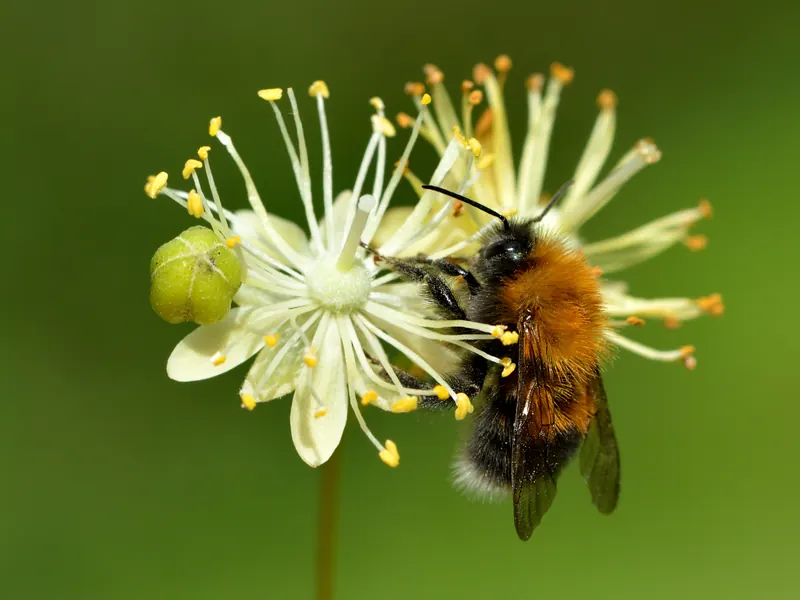
Small-leaved lime is a tree up to 30 m tall that flowers in June and July. Bees collect nectar, pollen and honeydew on limes, and the Bavarian LWG gives it the top nectar rating on its four-point scale. Lime honey is described as very aromatic.
What we know
How to recognise it
When it flowers
Where it grows
In Switzerland it grows in forests and on bushy slopes from the colline to montane belt, but most trees are planted.
Confirmed fact[1]
What it offers bees
Nectar is produced by nectaries made of hairs on the inner base of the sepals.
Confirmed fact[3]A Lublin study calls small-leaved lime a good food source for bees and names bees as the main pollinators of its flowers.
Reported by the farm[3]Lime flowers already offer nectar during their male phase.
Confirmed fact[2]The Bavarian LWG rates small-leaved lime and its cultivars N4 for nectar and P1 for pollen, on a literature-based scale where 4 is best.
Reported by the farm[4]
Honey
Besides nectar and pollen, bees also collect honeydew on lime trees.
Confirmed fact[2]Lime honey is very aromatic and contains honeydew as well as lime nectar.
Confirmed fact[2]The Celle bee institute describes lime honey as light to dark beige, with an intensely aromatic, menthol-like aroma.
Confirmed fact[5]
Sources
- Info Flora, das nationale Daten- und Informationszentrum der Schweizer Flora. Species page: Tilia cordata Mill.. Description text from Flora Helvetica (2018); habitat types from Delarze et al. (2015). Accessed 19 Oct 2026. Link
- Illies, I. Linden als Bienenweide. In: LWF Wissen 78 (Beitraege zur Winterlinde). Bayerische Landesanstalt fuer Wald und Forstwirtschaft, Freising. Link
- Konarska, A. (2013). Preliminary studies on the structure of sepals and trichomatous nectaries in flowers of Tilia cordata Mill. Acta Scientiarum Polonorum Hortorum Cultus 12(2): 63-74. Link
- Bayerische Landesanstalt fuer Weinbau und Gartenbau (LWG), Institut fuer Erwerbs- und Freizeitgartenbau (2019). Bienenbaeume. 1st edition, April 2019. Veitshoechheim. Link
- von der Ohe, W., Janke, M., Campbell, S. N. & von der Ohe, K. (2016). Was ist ein Sortenhonig? Das Bieneninstitut Celle informiert (44). LAVES Institut fuer Bienenkunde Celle. Link
Last checked: 20 October 2026. Every statement on this page was compared with the source it cites.