Bee plant, Central Europe
Lotus corniculatus
Common bird's-foot-trefoil, Gewöhnlicher Hornklee, Hornschotenklee
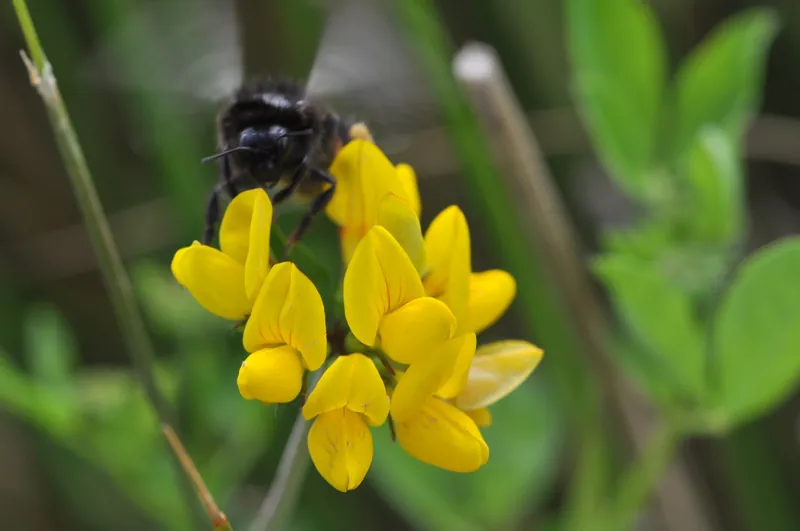
Bird's-foot-trefoil is a native perennial legume of meadows, pastures, dry grassland and roadsides, found from the lowlands to about 2300 m. Info Flora gives May to July as its flowering period. The Czech Pladias database records bumblebees and solitary bees as its main pollinator groups, with honeybees a minor visitor.
What we know
Bees linked to this plant
- Eucera longicornis
visits Lotus corniculatus among Fabaceae flowers
Confirmed fact[5] - Melitta leporina
visits Lotus corniculatus; prefers Trifolium repens
Confirmed fact[6] - Andrena wilkella
common bird's-foot-trefoil listed among flowers visited
Confirmed fact[8]
How to recognise it
Plants are 5 to 30 cm tall, ascending to erect, hairless to densely hairy, with 2 to 8 flowers per head and flowers 7 to 16 mm long.
Confirmed fact[1]The petals are yellow, often with a red-flushed standard; the keel curves upward and the leaves have five leaflets arranged three plus two.
Confirmed fact[2]
When it flowers
Info Flora gives May to July as the flowering period in Switzerland.
Confirmed fact[1]A University of Bayreuth field botany sheet gives May to September as the flowering period in Germany.
Confirmed fact[2]Pladias gives June to August as the flowering period in Czechia and records insect pollination.
Confirmed fact[3]
Where it grows
It grows in meadows, pastures, dry grassland, margins, along paths and on banks, on dry to fresh, nutrient-rich and mostly calcareous soils.
Confirmed fact[2]The Lotus corniculatus species group occurs from the lowlands up to 2300 m and is Eurasian to submediterranean in distribution.
Confirmed fact[2]
What it offers bees
The Czech Pladias database records bumblebees and solitary bees as its main pollinator groups, with honeybees among the groups below a 10 percent share.
Confirmed fact[3]In a UK study of sown urban meadows, bird's-foot-trefoil contributed under 1 percent of total nectar and pollen in the perennial mix.
Confirmed fact[4]According to the British recording society BWARS, the long-horned bee Eucera longicornis visits bird's-foot-trefoil in western Europe along with vetches, clovers and other legumes.
Observation[5]
People
Info Flora classes bird's-foot-trefoil as indigenous in Switzerland, with a Eurosiberian distribution and least concern Red List status.
Confirmed fact[1]German direct-payment rules list Lotus corniculatus among the pollen- and nectar-rich species allowed on fallow land used for honey plants.
Confirmed fact[7]
Sources
- Info Flora, das nationale Daten- und Informationszentrum der Schweizer Flora. Species page: Lotus corniculatus L. Description text from Flora Helvetica (2018). Accessed 29 Oct 2026. Link
- Marschner, R. Qualifizierung Feldbotanik Bronze: Lotus corniculatus agg., Gewöhnlicher Hornklee. Zertifizierung Artenkenntnis, BayCEER, Universität Bayreuth. Link
- Pladias, Database of the Czech Flora and Vegetation. Taxon data: Lotus corniculatus. Accessed 29 Oct 2026. Link
- Hicks, D. M., Ouvrard, P., Baldock, K. C. R., Baude, M., Goddard, M. A., Kunin, W. E., Mitschunas, N., Memmott, J., Morse, H., Nikolitsi, M., et al. (2016). Food for Pollinators: Quantifying the Nectar and Pollen Resources of Urban Flower Meadows. PLOS ONE 11(6): e0158117. Link
- Bees, Wasps and Ants Recording Society (BWARS). Eucera longicornis species account. Link
- Bees, Wasps and Ants Recording Society (BWARS). Melitta leporina species account. Link
- Direktzahlungen-Durchführungsverordnung (DirektZahlDurchfV), Anlage 5 (zu § 32a Absatz 2 Satz 1 und Absatz 3): Zulässige Arten auf für Honigpflanzen genutztem brachliegendem Land. Bundesministerium der Justiz, gesetze-im-internet.de. Fundstelle BAnz AT 29.03.2018 V1. Link
- Bees, Wasps and Ants Recording Society (BWARS). Andrena wilkella (Kirby, 1802) species account. Link
Last checked: 30 October 2026. Every statement on this page was compared with the source it cites.