Bee plant, Central Europe
Corylus avellana
Common hazel, Hazel
Hazel is a shrub of thickets and woodland edges that flowers from February to April, before its leaves. It is wind pollinated, and its catkins release large amounts of pollen. A Polish study describes hazel as an important source of fresh pollen for bees in early spring.
What we know
How to recognise it
The male flower clusters usually hang in groups of two to four, open before the leaves appear, and grow up to 10 cm long.
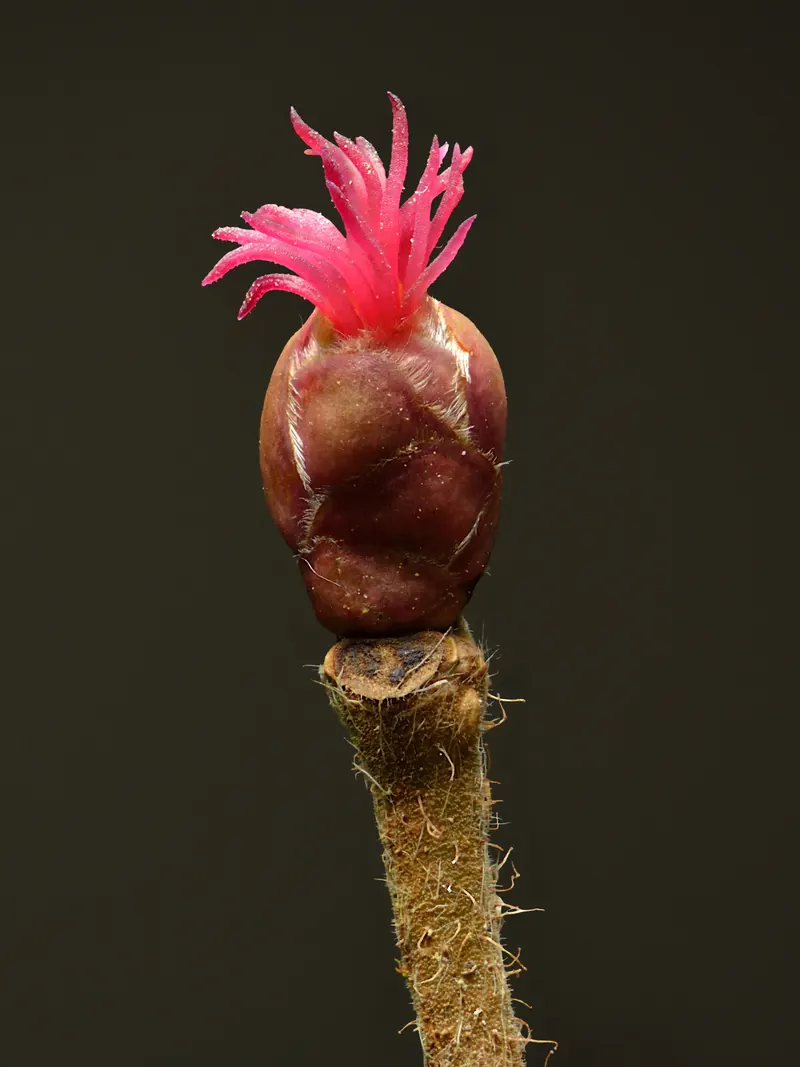
Confirmed fact[1]The female flowers stay enclosed in the bud, and only their red stigmas stick out.
Confirmed fact[1]Hazel is monoecious: male and female flowers grow on the same shrub.
Confirmed fact[2]
When it flowers
Info Flora gives the flowering period of hazel in Switzerland as February to April.
Confirmed fact[1]
Where it grows
In Switzerland hazel grows in thickets and at woodland edges, from the colline to the subalpine belt.
Confirmed fact[1]
What it offers bees
Hazel is wind pollinated: the wind carries the pollen through the still leafless branches.
Confirmed fact[2]The TU Dresden Botanical Garden states that a single catkin releases more than 8 million pollen grains, which troubles many people with allergies.
Reported by the farm[2]A study in Lublin, Poland, describes hazel as an important source of fresh pollen for bees in early spring; bees collect it as medium sized pollen loads.
Reported by the farm[3]
People
According to the TU Dresden Botanical Garden, the maker of a well known nougat spread buys a quarter of world hazelnut production each year.
Reported by the farm[2]
Sources
- Info Flora. Corylus avellana L.. Online species page, Das nationale Daten- und Informationszentrum der Schweizer Flora (text from Flora Helvetica 2018). Link
- Göhre A. Die Gewöhnliche Hasel (Corylus avellana). Pflanze der Woche, Botanischer Garten der Technischen Universität Dresden (last updated 10.03.2017). Link
- Piotrowska K. (2008) Ecological features of flowers and the amount of pollen released in Corylus avellana (L.) and Alnus glutinosa (L.) Gaertn. Acta Agrobotanica 61(1): 33-39. Link
Last checked: 20 October 2026. Every statement on this page was compared with the source it cites.