Bee plant, Central Europe
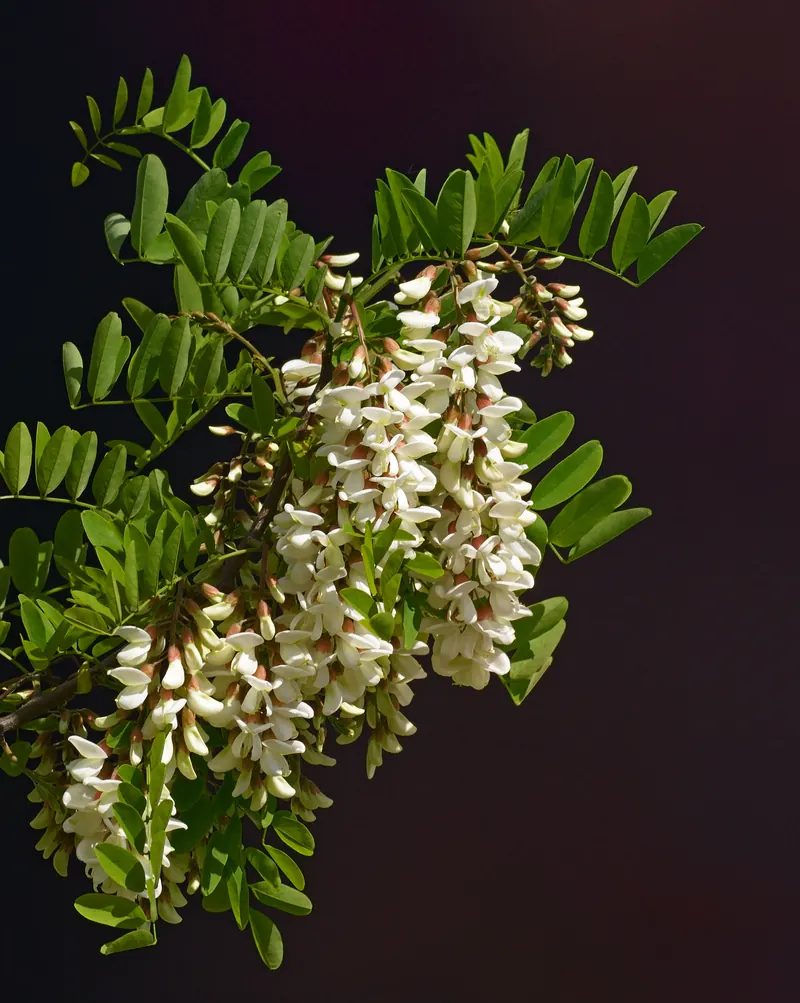
Robinia pseudoacacia
Black locust, False acacia
Black locust is a North American tree, brought to Europe in the 17th century, that flowers in May and June. Its nectar rich white flowers give a liquid honey that may be sold as acacia honey. It fixes nitrogen and invades dry, nutrient poor grasslands, and is assessed as invasive in Germany, Austria, Switzerland and Poland.
Invasive in parts of the region
Germany (assessed invasive, BfN Managementliste, Nehring et al. 2013); Switzerland (Info Flora list of invasive alien species); Austria (Umweltbundesamt, Essl and Rabitsch 2002, one of 17 invasive neophytes); Poland (GDOŚ: moderately invasive alien species). Not on the EU Union list. Fixes nitrogen and enriches nutrient poor open habitats such as dry and lean grasslands; spreads by root suckers. Do not recommend planting.
Confirmed fact[3]What we know
How to recognise it
The leaf stipules of black locust turn into strong spines that persist for several years.
Confirmed fact[4]
When it flowers
Info Flora gives the flowering period of black locust in Switzerland as May to June.
Confirmed fact[1]
What it offers bees
According to the Bavarian forestry institute LWF, black locust flowers produce large amounts of nectar, on average 1.7 to 2.9 mg in 24 hours (the text does not state the unit of measurement, such as per flower).
Confirmed fact[5]A Berlin study cited by LWF used net catches to record 20 wild bee species collecting at black locust, including several bumblebees.
Observation[5]
Honey
Caution: invasive
In Germany black locust was assessed as invasive and placed on the BfN management list of widespread species with clearly documented harm to biodiversity.
Confirmed fact[3]It fixes atmospheric nitrogen, enriches nutrient poor soils and displaces threatened species of dry and lean grasslands.
Confirmed fact[3]Info Flora lists black locust as an invasive alien species in Switzerland, with a duty to inform under the Release Ordinance.
Confirmed fact[4]The Austrian Environment Agency (Umweltbundesamt) lists black locust among the 17 alien plant species considered invasive in Austria because they threaten conservation.
Reported by the farm[6]It spreads by thorny root suckers that emerge at a distance from the trunk.
Confirmed fact[4]
People
Black locust, native to North America, reached Europe in the first third of the 17th century.
Confirmed fact[2]
Sources
- Info Flora. Robinia pseudoacacia L.. Online species page, Das nationale Daten- und Informationszentrum der Schweizer Flora (text from Flora Helvetica 2018). Link
- Bundesamt für Naturschutz (BfN). Robinia pseudoacacia. Neobiota.de Handbuch, Gefäßpflanzen. Link
- Skowronek S. Die Robinie als invasive Problemart im Naturschutz. In: LWF Wissen 84, Bayerische Landesanstalt für Wald und Forstwirtschaft (hosted by LfL Bayern). Link
- Info Flora (2020) Robinier (Robinia pseudoacacia L.). Néophyte envahissante: fiche d'information. Info Flora, Suisse. Link
- Illies I. Robinie: Nahrungsquelle für Bienen und andere Blütenbesucher. In: LWF Wissen 84, pp. 47-50, Bayerische Landesanstalt für Wald und Forstwirtschaft. Link
- Essl F, Rabitsch W. (2002) Neobiota in Österreich. Umweltbundesamt, Wien. Link
Last checked: 20 October 2026. Every statement on this page was compared with the source it cites.