Bee plant, Central Europe
Borago officinalis
Borage, Starflower, Borretsch
Borage is a bristly annual herb of Mediterranean and West Asian origin, grown in Central European gardens and flower mixes and occasionally escaping. Info Flora gives May to August as its flowering period. A Polish field study measured about 1.2 mg of nectar sugar and 1.1 mg of pollen per flower, and bees made 73 percent of visits.
What we know
How to recognise it
Borage is 20 to 70 cm tall with stiff prickly hairs and fleshy stems; the lanceolate leaves have wavy, irregularly toothed margins.
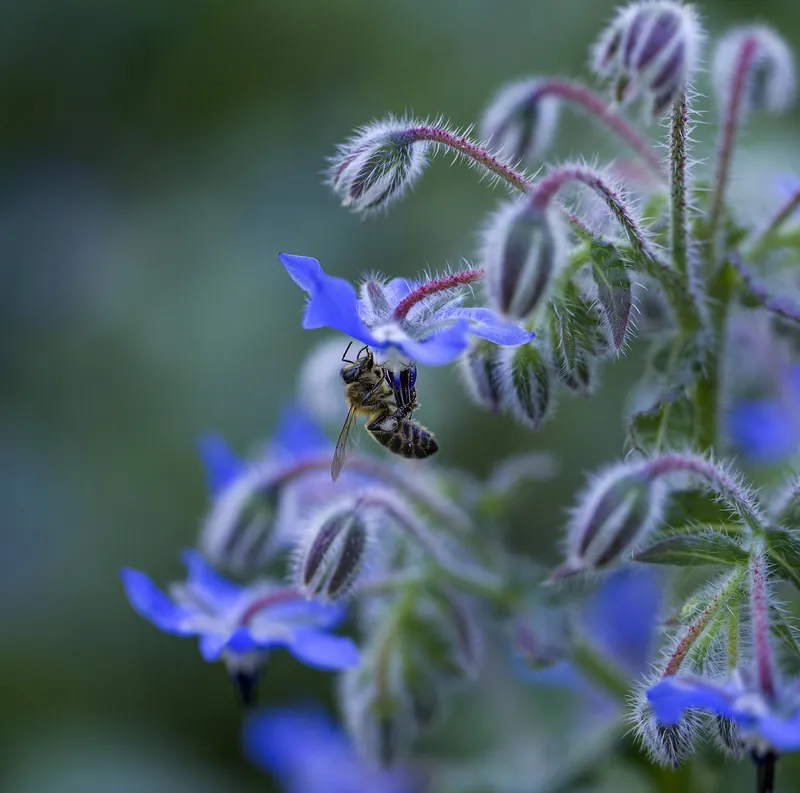
Confirmed fact[1]The sky-blue, rarely lilac, flowers are 2 to 3 cm across, with a short tube, five flat pointed lobes and protruding white throat scales.
Confirmed fact[1]
When it flowers
Where it grows
In Switzerland it occurs in vineyards, on waste ground and in sown flower fallows, cultivated and occasionally escaped, in the colline to montane zone.
Confirmed fact[1]
What it offers bees
In a three-year trial in Lublin, Poland, a borage flower produced on average 4.0 mg of nectar at 31.5 percent sugar, or about 1.2 mg of sugar.
Confirmed fact[3]The same study measured about 1.1 mg of pollen per flower, and estimated that a square metre of crop yields about 5.2 g each of nectar sugar and pollen.
Statistical estimate[3]Bees made up 73 percent of all insect visits to borage flowers in the Polish trial, and pollinators raised fruit set by 43 percent.
Confirmed fact[3]
Honey
LWG Bayern notes that borage nectar and pollen contain pyrrolizidine alkaloids, but its small share and late flowering in mixes only rarely gave positive findings in honey.
Reported by the farm[4]
In the garden
LWG Bayern describes borage and pot marigold as good bee forage plants in the first year of a sown wildflower strip.
Reported by the farm[4]
People
Sources
- Info Flora, das nationale Daten- und Informationszentrum der Schweizer Flora. Species page: Borago officinalis L. Description text from Flora Helvetica (2018). Accessed 29 Oct 2026. Link
- Pladias, Database of the Czech Flora and Vegetation. Taxon data: Borago officinalis. Accessed 29 Oct 2026. Link
- Stawiarz, E., Wróblewska, A., Masierowska, M. & Sadowska, D. (2020). Flowering, Forage Value, and Insect Pollination in Borage (Borago officinalis L.) Cultivated in SE Poland. Journal of Apicultural Science 64(1): 77-89. doi:10.2478/jas-2020-0005. Abstract read via DOAJ. Link
- Marzini, K. & Illies, I. (2019). Veitshöchheimer Bienenweide auf ökologischen Vorrangflächen im Greening. LWG aktuell. Bayerische Landesanstalt für Weinbau und Gartenbau (LWG), Veitshöchheim. Link
- Direktzahlungen-Durchführungsverordnung (DirektZahlDurchfV), Anlage 5 (zu § 32a Absatz 2 Satz 1 und Absatz 3): Zulässige Arten auf für Honigpflanzen genutztem brachliegendem Land. Bundesministerium der Justiz, gesetze-im-internet.de. Fundstelle BAnz AT 29.03.2018 V1. Link
Last checked: 30 October 2026. Every statement on this page was compared with the source it cites.