Bee plant, Central Europe
Malus domestica
Apple, Kulturapfel, Apfelbaum
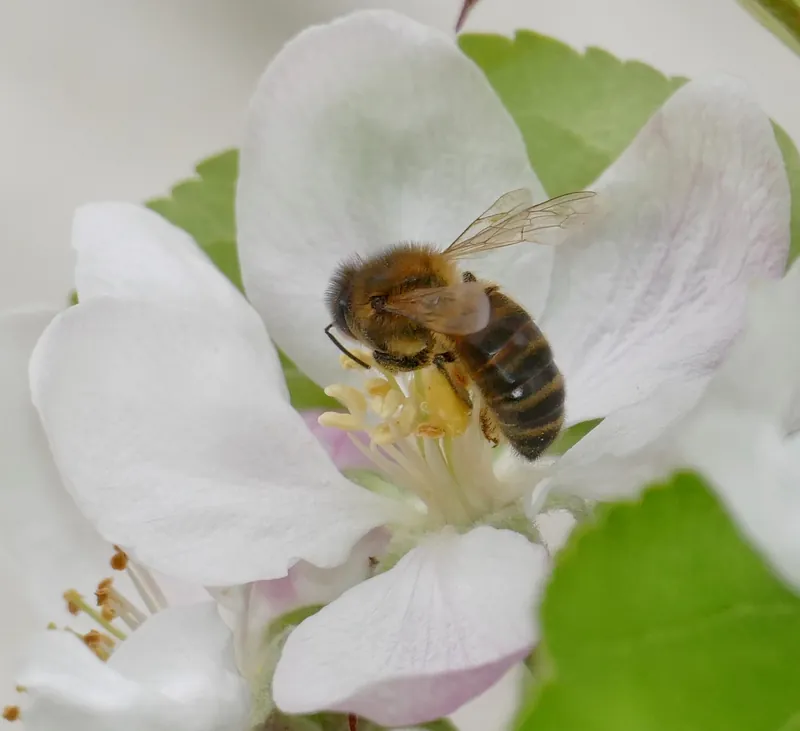
The cultivated apple is grown in many varieties and often escapes; in Switzerland it flowers in May. In orchards near Freiburg nine of ten flower visitors were honey bees, with bumblebees, Andrena, Osmia and Lasioglossum among the wild bees. In Saxony-Anhalt apple bloom now starts significantly earlier than in past decades.
What we know
Bees linked to this plant
- Osmia bicornis
managed red mason bee recommended by FiBL for pollinating apple and other mid-early to late flowering fruit
Confirmed fact[4] - Osmia cornuta
managed horned mason bee, active from 4 degrees C, suited to early flowering fruit
Confirmed fact[4]
How to recognise it
It resembles the wild crab apple but has thornless twigs, leaves densely felted beneath even in summer, and larger fruits; it cannot be sharply separated from Malus sylvestris.
Confirmed fact[1]
When it flowers
Info Flora gives the flowering time of the cultivated apple in Switzerland as May.
Confirmed fact[1]The Czech Pladias database gives May as the flowering month, white flowers and insect pollination for the cultivated apple.
Confirmed fact[2]In Saxony-Anhalt, Germany, the start of apple bloom has moved markedly and statistically significantly earlier in recent decades.
Confirmed fact[6]
Where it grows
What it offers bees
In 16 apple orchards within 20 km of Freiburg, observed in spring 2014, nine of ten flower visitors were honey bees.
Confirmed fact[3]In the same Freiburg orchards the most frequent wild bees were bumblebees, followed by Andrena mining bees, Osmia mason bees and Lasioglossum sweat bees.
Confirmed fact[3]The Freiburg study concludes that wild bee species with different tongue lengths, sizes and flight times complement each other in pollination and so contribute to reliable fruit set.
Confirmed fact[3]The Swiss research institute FiBL describes the red mason bee Osmia bicornis as particularly well suited to pollinating mid-early to late flowering fruit such as apple, pear and berries.
Confirmed fact[4]FiBL notes that the horned mason bee Osmia cornuta is active from 4 degrees C, whereas the honey bee flies only from about 10 degrees C.
Confirmed fact[4]
People
A UK study in Kent concluded that insects are essential to the production of Cox and Gala apples and valued their pollination of these two varieties at 36.7 million pounds per year.
Confirmed fact[5]
Sources
- Info Flora. Malus domestica Borkh.. Online species page, Das nationale Daten- und Informationszentrum der Schweizer Flora (text from Flora Helvetica). Link
- Pladias: Database of the Czech Flora and Vegetation. Malus domestica, taxon data page. Link
- Durocher L. (2015) Apfelplantagen in der Rheinebene: Bestäuber und Fruchterfolg. Summary leaflet, Professur für Naturschutz und Landschaftsökologie, Albert-Ludwigs-Universität Freiburg. Link
- Stefani P, Häseli A, Gurten S. (2022) Mauerbienen züchten: Bestäubung in Obstkulturen stärken. FiBL Merkblatt Nr. 2518, Forschungsinstitut für biologischen Landbau, Frick, Switzerland. Link
- Garratt MPD, Breeze TD, Jenner N, Polce C, Biesmeijer JC, Potts SG. (2014) Avoiding a bad apple: Insect pollination enhances fruit quality and economic value. Agriculture, Ecosystems and Environment 184: 34-40. doi:10.1016/j.agee.2013.10.032 Link
- Landesamt für Umweltschutz Sachsen-Anhalt. (2024) Indikatorkennblatt Klimafolgenindikatoren Sachsen-Anhalt, Indikator A7: Blühbeginn Apfel. Bearbeitungsstand 29.02.2024, data from the Deutscher Wetterdienst phenological network 1961-2023. Link
Last checked: 30 October 2026. Every statement on this page was compared with the source it cites.