Bee plant, Central Europe
Castanea sativa
Sweet chestnut, Edelkastanie, Esskastanie
Sweet chestnut is a tree up to 35 m that flowers late, in June, north of the Alps. It is an archaeophyte in Switzerland and naturalised in Germany since Roman times. Its male catkins give nectar and pollen, honey bees also collect honeydew on it, and chestnut honey is slow to crystallise and bitter.
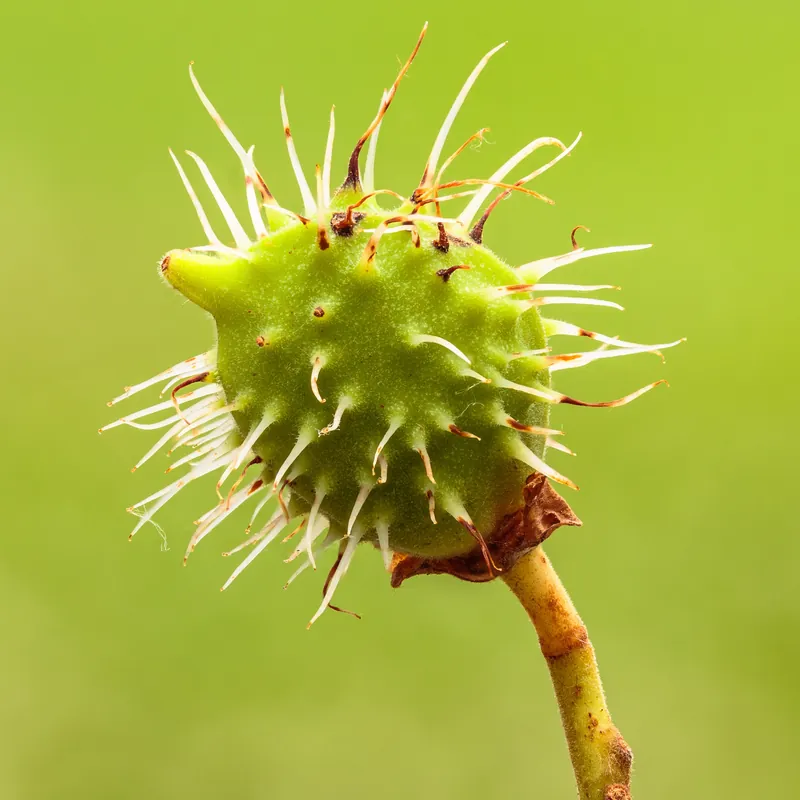
What we know
How to recognise it
It is a tree up to 35 m tall with deeply fissured brown bark and lanceolate, spiny-toothed leaves 10 to 25 cm long.
Confirmed fact[1]
When it flowers
Where it grows
What it offers bees
LWF states that the pollinators of sweet chestnut are insects, above all bees, but also beetles.
Confirmed fact[2]The male flowers supply both pollen and nectar, with the nectaries located at the base of the flower.
Confirmed fact[3]A French study with pollinator exclusion found a predominant role of insects in chestnut pollination.
Confirmed fact[4]
Honey
Besides flower nectar, honey bees also collect honeydew on sweet chestnut.
Confirmed fact[3]Unifloral chestnut honey can be harvested regularly in German regions with dense stands, for example the Pfälzerwald and the Taunus.
Confirmed fact[3]Chestnut honey has a clearly bitter component, which makes it a particular speciality, and it crystallises only very slowly because of its high fructose share.
Confirmed fact[3]
People
In Germany the sweet chestnut has been naturalised since Roman times, according to the Bavarian forestry institute LWF.
Confirmed fact[2]
Sources
- Info Flora. Castanea sativa Mill.. Online species page, Das nationale Daten- und Informationszentrum der Schweizer Flora (text from Flora Helvetica). Link
- Aas G. (2018) Die Esskastanie (Castanea sativa): Verwandtschaft, Morphologie und Ökologie. LWF Wissen 81, Bayerische Landesanstalt für Wald und Forstwirtschaft; copy on the University of Bayreuth repository. Link
- Illies I. (2018) Edelkastanienhonig: ein besonderer Sortenhonig. LWF Wissen 81, p. 54, Bayerische Landesanstalt für Wald und Forstwirtschaft (author at the LWG bee institute, Veitshöchheim). Link
- Larue C, Austruy E, Basset G, Petit RJ. (2021) Revisiting pollination mode in chestnut (Castanea spp.): an integrated approach. Botany Letters. doi:10.1080/23818107.2021.1872041. Abstract read on the University of Bordeaux repository. Link
Last checked: 30 October 2026. Every statement on this page was compared with the source it cites.