Bee plant, Central Europe
Campanula rotundifolia
Harebell, Round-leaved bellflower
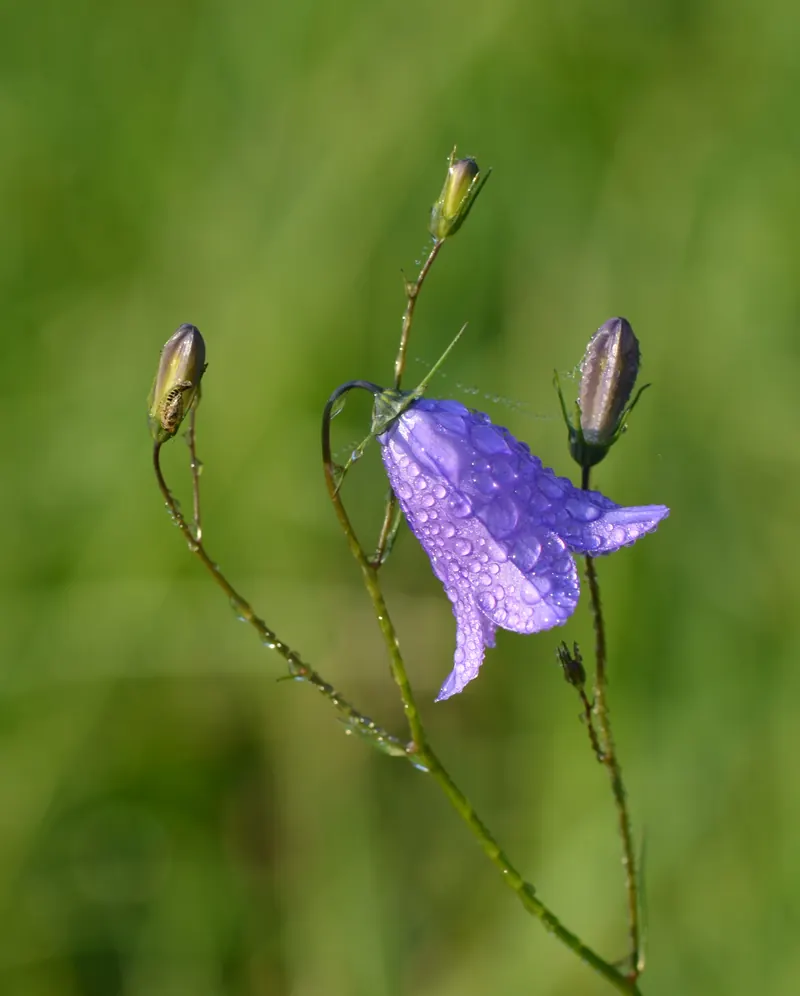
Harebell is a slender bellflower 10 to 40 cm tall with single blue bells, flowering from May to September in Switzerland. Bumblebees and solitary bees are its main pollinators. The bellflower specialist Chelostoma campanularum collects Campanula pollen, and in Britain Melitta haemorrhoidalis visits harebell and probably uses bellflowers as pollen sources.
What we know
Bees linked to this plant
- Chelostoma campanularum
oligolectic on Campanula and closely related Campanulaceae genera; info fauna notes that the pollen of seven Campanula rotundifolia flowers is enough for one brood cell
Confirmed fact[3] - Melitta haemorrhoidalis
harebell listed among flowers visited; bellflowers probably its pollen sources (UK)
Confirmed fact[4]
How to recognise it
Plants are 10 to 40 cm tall and have sterile leaf rosettes.
Confirmed fact[1]The basal leaves, which give the plant its name, are long-stalked, roundish to heart-shaped and toothed.
Confirmed fact[1]Stem leaves are oblong-ovate to narrowly lance-shaped and more or less untoothed.
Confirmed fact[1]Flowers hang singly on thin stalks; the corolla is blue to violet-blue, bell-shaped and 1 to 2 cm long.
Confirmed fact[1]Flower buds are mostly upright, while the fruit nods.
Confirmed fact[1]
When it flowers
Where it grows
In Switzerland it grows in meadows and on rocks, from the colline to the subalpine belt, sometimes alpine.
Confirmed fact[1]
What it offers bees
Pladias names bumblebees and solitary bees as the main pollinator groups.
Reported by the farm[2]The Swiss fauna data centre states that Chelostoma campanularum is oligolectic on Campanula and closely related genera.
Confirmed fact[3]In Britain, harebell is listed among flowers visited by Melitta haemorrhoidalis, and the bellflowers are probably its pollen sources.
Reported by the farm[4]Melitta bees generally have very narrow pollen preferences, visiting one species or a group of closely related species.
Reported by the farm[4]
Sources
- Info Flora, das nationale Daten- und Informationszentrum der Schweizer Flora. Species page: Campanula rotundifolia L.. Description text from Flora Helvetica (2018); habitat types from Delarze et al. (2015). Accessed 19 Oct 2026. Link
- Pladias, Database of the Czech Flora and Vegetation. Taxon data: Campanula rotundifolia. Accessed 19 Oct 2026. Link
- info fauna, Centre Suisse de Cartographie de la Faune (CSCF). Chelostoma campanularum (Kirby, 1802). Species page. Link
- Else, G. R. Melitta haemorrhoidalis (Fabricius, 1775). Species account, Bees, Wasps and Ants Recording Society (BWARS). Link
Last checked: 20 October 2026. Every statement on this page was compared with the source it cites.