Bee plant, Central Europe
Phacelia tanacetifolia
Phacelia, Lacy phacelia
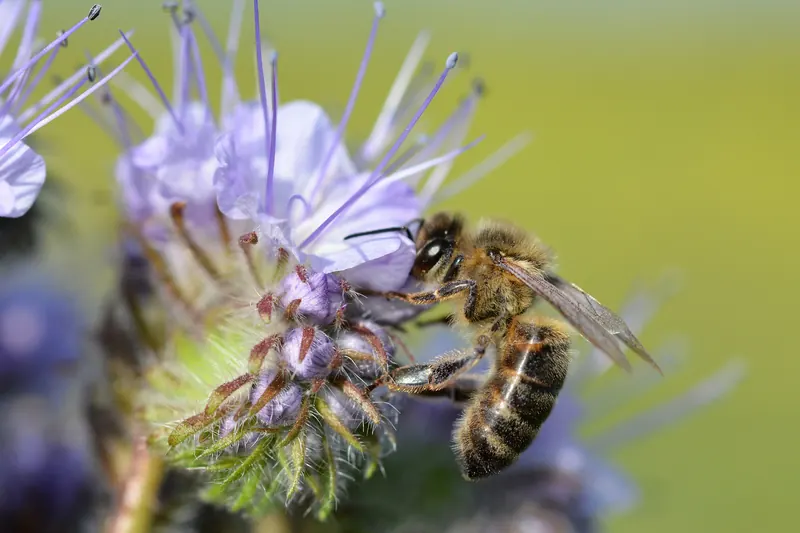
Phacelia is a non-native annual from California and Arizona, sown in Central Europe as green manure, catch crop and bee forage. It starts flowering 6 to 8 weeks after sowing. The Celle bee institute rates its nectar production as usually very good and describes its honey as mild.
What we know
How to recognise it
When it flowers
Where it grows
In Switzerland it occurs on fields, in vineyards and on waste ground, and is now often grown as green manure and escapes.
Confirmed fact[1]
What it offers bees
The Celle bee institute describes phacelia nectar production as usually very good.
Reported by the farm[2]Although honeybee pollen loads from phacelia are fairly small, the pollen yield from a phacelia flow is very good.
Reported by the farm[2]Besides the honeybee, many other insects visit phacelia flowers.
Observation[2]
Honey
Phacelia honey has a mild, distinctive aroma; once crystallised it is light beige to almost white.
Confirmed fact[2]
People
Phacelia tanacetifolia originates from the US states of California and Arizona.
Confirmed fact[2]Info Flora classes it as a neophyte, a plant that appeared in the region after 1500.
Confirmed fact[1]Its value as a fodder plant and as a catch crop between main crops was recognised later.
Confirmed fact[2]
Sources
- Info Flora, das nationale Daten- und Informationszentrum der Schweizer Flora. Species page: Phacelia tanacetifolia Benth.. Description text from Flora Helvetica (2018); habitat types from Delarze et al. (2015). Accessed 19 Oct 2026. Link
- von der Ohe, W. & von der Ohe, K. (1999). Phaceliahonig. Das Bieneninstitut Celle informiert (9). Niedersächsisches Landesinstitut für Bienenkunde, Celle (now LAVES Institut für Bienenkunde Celle). Link
Last checked: 20 October 2026. Every statement on this page was compared with the source it cites.