Bee plant, Central Europe
Crocus vernus
Spring crocus, Frühlings-Krokus
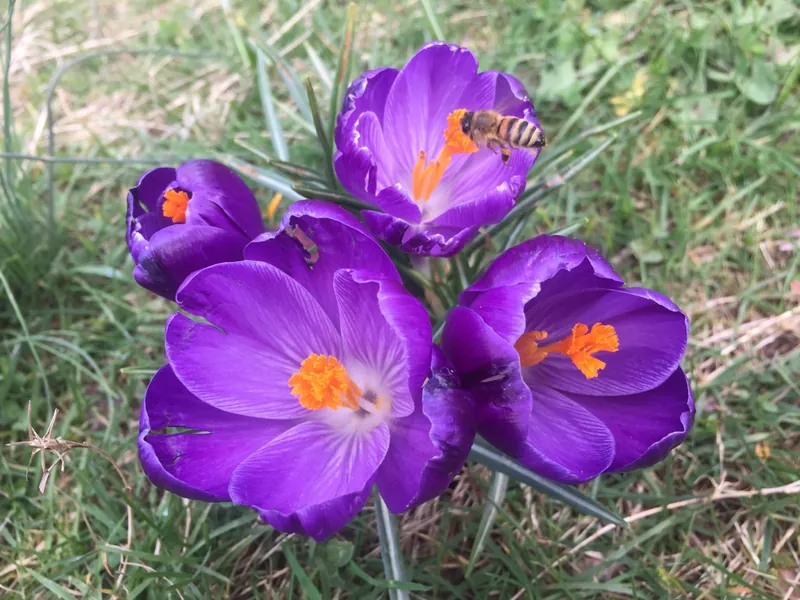
Spring crocus is a native geophyte of mountain meadows and pastures that flowers in March and April. Its flowers last three to four days and hold nectar in the perianth tube. It is a parent of the large garden crocuses and is listed among early spring plants that feed bees in gardens.
What we know
How to recognise it
When it flowers
Where it grows
The Berlin natural history museum describes spring crocus as a plant of mountain meadows and pastures that is also often planted in gardens and parks.
Confirmed fact[3]
What it offers bees
The nectar collects in a narrow space between the style and the long perianth tube that surrounds it.
Confirmed fact[2]The spherical pollen grains have no apertures and are coated with many droplets of pollenkitt.
Confirmed fact[2]A University of Würzburg bee project notes that crocuses are not native in the region except Crocus vernus, which now also occurs as a wild form, and that wild forms feed insects.
Reported by the farm[6]
In the garden
The Bavarian institute LWG lists spring crocus species among bed and container plants for the early spring forage phase from mid February to the end of March.
Confirmed fact[5]The UK Royal Horticultural Society lists spring flowering crocus species in the spring (March to May) section of its Plants for Pollinators garden plant list.
Confirmed fact[7]
People
Sources
- Pladias: Database of the Czech Flora and Vegetation. Crocus vernus (šafrán bělokvětý), taxon data page. Link
- Weryszko-Chmielewska E, Chwil M (2011) Structure of the floral parts of Crocus vernus (L.) Hill. Acta Agrobotanica 64(4). doi:10.5586/aa.2011.044 Link
- Museum für Naturkunde Berlin. Naturblick species portrait: Crocus vernus (Spring crocus). Link
- Knickmann B (2013) Krokusse - nicht nur im Frühjahr. Infoblatt Pflanzenlexikon, Botanischer Garten der Universität Wien. Link
- Bayerische Landesanstalt für Weinbau und Gartenbau (LWG) (2021) Lebensräume für (Wild)Bienen - Garten & Balkon insektenfreundlich gestalten. Veitshöchheimer Berichte 191. Link
- Projekt Summende Dörfer, Biozentrum der Universität Würzburg. Heimische Zwiebeln & Frühblüher (information sheet). Link
- Royal Horticultural Society. RHS Plants for Pollinators: Garden plants (list, reviewed 2025). Link
Last checked: 30 October 2026. Every statement on this page was compared with the source it cites.