Bee plant, Central Europe
Impatiens glandulifera
Himalayan balsam, Indian balsam, Drüsiges Springkraut
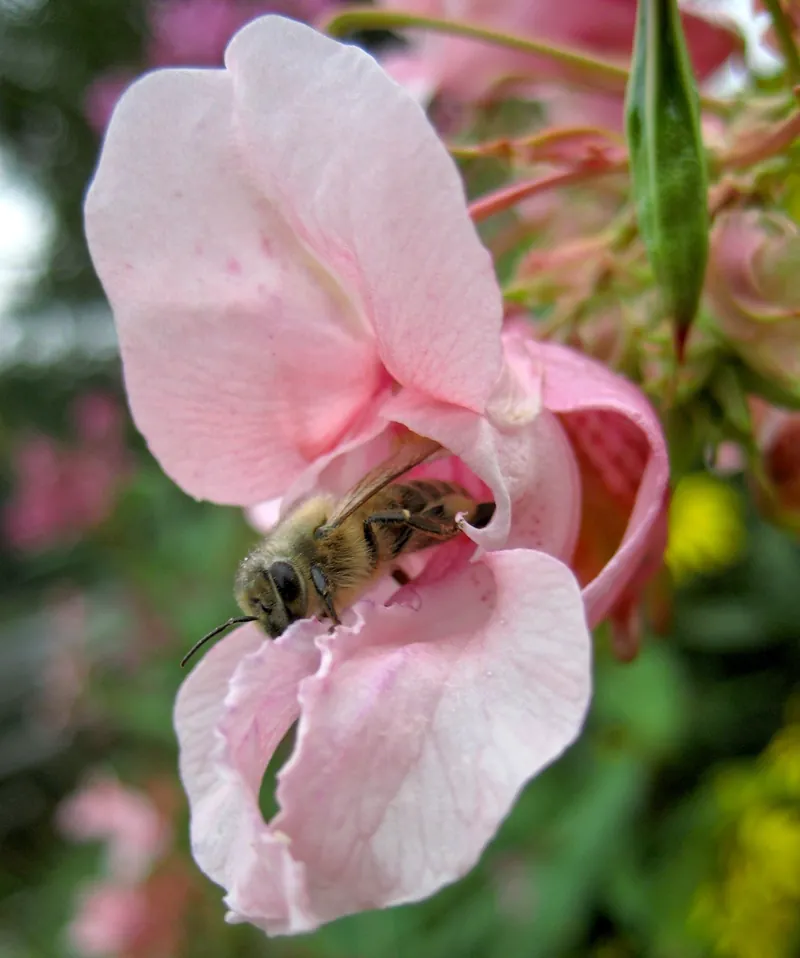
Himalayan balsam is an annual from the western Himalaya, up to 2 m tall, that flowers pink from July to September along streams and in floodplain woods. Its rich nectar draws bees and bumblebees, but it is on the EU list of invasive alien species of Union concern and is banned in Switzerland, so it must not be planted or sown.
Invasive in parts of the region
EU Union list of invasive alien species of Union concern (Commission Implementing Regulation (EU) 2017/1263), so binding in Germany, Austria, Czechia and Poland; Switzerland: Schwarze Liste and banned organism under the Release Ordinance (FrSV); Czechia: invasive neophyte (Pyšek et al. 2022); Germany: BfN Neobiota handbook (Agriophyt; Union list species). Dense annual stands along rivers displace native bank vegetation; after the stems die in autumn, open soil without living roots is left and erodes; seeds are flung up to 7 m. BfN says beekeeper sowings outside settlements should stop. We do not recommend planting it.
Confirmed fact[3]What we know
How to recognise it
The plant grows up to 2 m tall, usually unbranched and hairless, with bright pink flowers in upright racemes of 5 to 20 and a curved spur.
Confirmed fact[1]
When it flowers
Info Flora gives the flowering period in Switzerland as July to September.
Confirmed fact[1]
Where it grows
In Switzerland it grows on stream banks and in floodplain forests, has been naturalised since about 1920 and is still spreading; it comes from the Himalaya.
Confirmed fact[1]
What it offers bees
BfN describes its rich nectar supply as the reason it attracts flower visitors, above all bees and bumblebees.
Confirmed fact[2]In an Irish riverside study, Himalayan balsam secreted nectar faster and with higher sugar concentration than native hairy willowherb and marsh woundwort, and long tongued bumblebees such as Bombus hortorum chiefly visited it.
Observation[5]In Austrian citizen science pollen traps, Impatiens pollen ranked fifth among pollen types collected by honey bees in August and September, at 6.1 percent of grains.
Observation[6]
Honey
In a Bavarian LWG trial on late forage, colonies placed at a Himalayan balsam site collected mostly Phacelia pollen; balsam family pollen averaged only four percent.
Observation[7]
Caution: invasive
Since 2017 Impatiens glandulifera is on the EU list of invasive alien species of Union concern, added by Commission Implementing Regulation (EU) 2017/1263.
Confirmed fact[3]In Switzerland it is a Black List species and stands on the list of banned organisms of the Release Ordinance.
Confirmed fact[4]Along watercourses it displaces native bank vegetation; one plant makes up to 2,500 seeds and the exploding capsules throw them up to 7 m.
Confirmed fact[4]The German BfN handbook says the species was often spread deliberately as a bee forage plant and is now widespread and common in Germany.
Confirmed fact[2]BfN advises that beekeepers should not sow the plant outside settlements and that control should aim to prevent seed set, starting when the first flowers appear in late July.
Confirmed fact[2]In Czechia it is an invasive neophyte recorded in 531 grid cells, among the twenty most widespread invasive taxa.
Confirmed fact[8]The University of Innsbruck notes that the plant reached Europe in 1839 as an ornamental and bee forage plant, now climbs to about 1600 m in Tyrol, and that its mass stands reduce diversity and raise erosion risk.
Confirmed fact[9]
Sources
- Info Flora. Impatiens glandulifera Royle (Drüsiges Springkraut). Online species page, Das nationale Daten- und Informationszentrum der Schweizer Flora (description from Flora Helvetica 2018). Link
- Bundesamt für Naturschutz (BfN). Impatiens glandulifera. Neobiota.de Handbuch, Gefäßpflanzen, Artensteckbrief. Link
- Commission Implementing Regulation (EU) 2017/1263 of 12 July 2017 updating the list of invasive alien species of Union concern established by Implementing Regulation (EU) 2016/1141 pursuant to Regulation (EU) No 1143/2014. Annex. Link
- Schweizerische Kommission für die Erhaltung von Wildpflanzen (SKEW, now Info Flora) (2009) Impatiens glandulifera, Infoblatt (Drüsiges Springkraut). Copy hosted by bioaktuell.ch (FiBL). Link
- Nienhuis CM, Dietzsch AC, Stout JC (2009) The impacts of an invasive alien plant and its removal on native bees. Apidologie 40(4): 450-463. doi:10.1051/apido/2009005 Link
- Brodschneider R, Gratzer K, Kalcher-Sommersguter E, Heigl H, Auer W, Moosbeckhofer R, Crailsheim K (2019) A citizen science supported study on seasonal diversity and monoflorality of pollen collected by honey bees in Austria. Scientific Reports 9: 16633. doi:10.1038/s41598-019-53016-5 Link
- Illies I, Heidinger I (2022) Auswirkungen von Spättrachten auf die Ein- und Überwinterung von Bienenvölkern (Späte Trachten). Abschlussbericht, Bayerische Landesanstalt für Weinbau und Gartenbau, Institut für Bienenkunde und Imkerei. Link
- Pyšek P, Sádlo J, Chrtek J Jr, Chytrý M, Kaplan Z, Pergl J et al. (2022) Catalogue of alien plants of the Czech Republic (3rd edition). Preslia 94: 447-577. doi:10.23855/preslia.2022.447. Table 6. Link
- Universität Innsbruck, Institut für Botanik. Neophyten in Tirol, Problemarten Steckbrief: Drüsiges Springkraut (Impatiens glandulifera). Link
Last checked: 30 October 2026. Every statement on this page was compared with the source it cites.