Bee plant, Central Europe
Hedera helix
Ivy, Common ivy
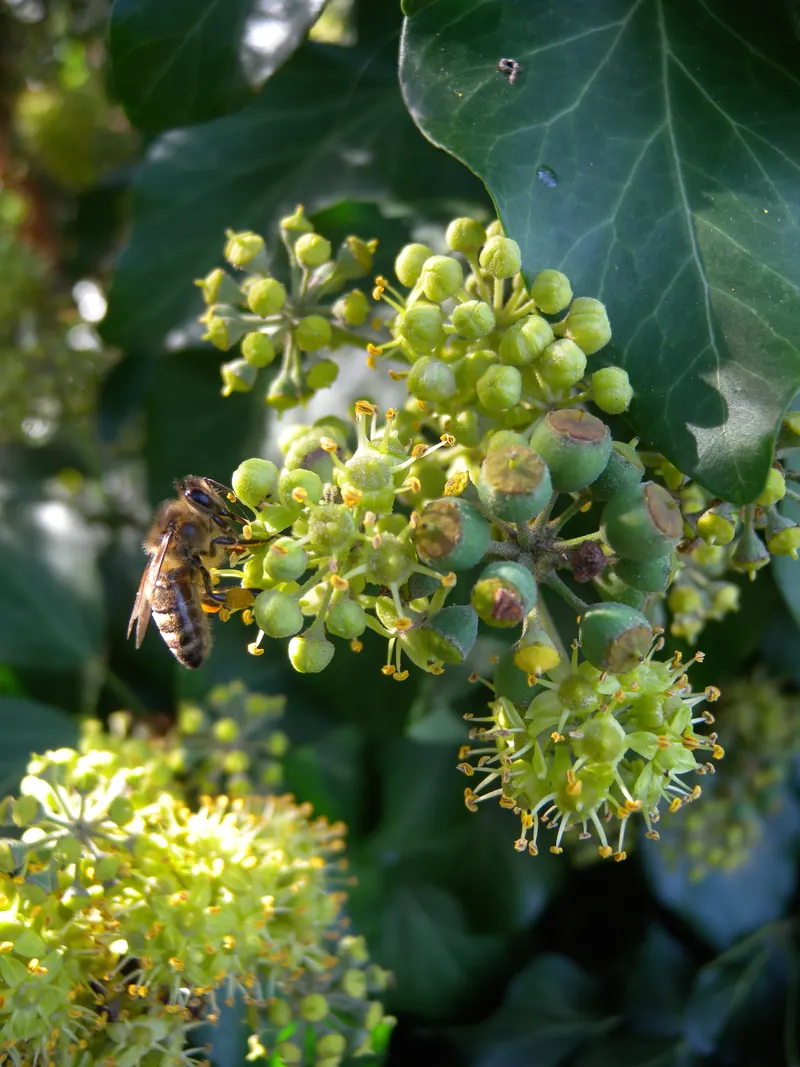
Ivy is an evergreen climber that flowers late, in September and October. A UK study found that most autumn honeybee pollen loads came from ivy and that its nectar is sugar-rich. The ivy bee Colletes hederae collects its pollen preferentially on ivy.
What we know
Bees linked to this plant
- Colletes hederae
polylectic but collects pollen preferentially on Hedera; main flight period in Switzerland from early August to much of October
Confirmed fact[4]
How to recognise it
An evergreen shrub that climbs up to 20 m, holding on with clinging roots, or grows free.
Confirmed fact[1]Leaves are leathery and glossy: angular and 3 to 5 lobed on non-flowering shoots, but undivided on flowering shoots.
Confirmed fact[1]The yellowish-green flowers are 3 to 4 mm long and grow in many-flowered, rounded umbels.
Confirmed fact[1]
When it flowers
Info Flora gives September to October as the flowering period in Switzerland.
Confirmed fact[1]
Where it grows
In Switzerland it grows on trees, rocks and walls, from the colline to the montane belt.
Confirmed fact[1]
What it offers bees
The Bavarian LWG notes that ivy is visited enormously by bees on sunny days when it flowers in September and October.
Observation[2]In a UK study, on average 89 percent of pollen loads collected by honeybees in autumn came from ivy.
Observation[3]Ivy nectar was an even bigger draw than pollen: 80 percent of honeybee foragers on ivy collected only nectar.
Observation[3]The same study measured ivy nectar as rich in sugar, at 49 percent by weight.
Observation[3]The ivy bee Colletes hederae collects pollen from several plants but preferentially from ivy.
Confirmed fact[4]In Switzerland the main flight period of the ivy bee runs from early August through much of October.
Confirmed fact[4]The ivy bee has since spread strongly in Switzerland, from the southwest towards the north.
Confirmed fact[4]
Sources
- Info Flora, das nationale Daten- und Informationszentrum der Schweizer Flora. Species page: Hedera helix L.. Description text from Flora Helvetica (2018); habitat types from Delarze et al. (2015). Accessed 19 Oct 2026. Link
- Bayerische Landesanstalt fuer Weinbau und Gartenbau (LWG), Institut fuer Erwerbs- und Freizeitgartenbau (2019). Bienenbaeume. 1st edition, April 2019. Veitshoechheim. Link
- Garbuzov, M. & Ratnieks, F. L. W. (2014). Ivy: an underappreciated key resource to flower-visiting insects in autumn. Insect Conservation and Diversity 7(1): 91-102. Link
- info fauna, Centre Suisse de Cartographie de la Faune (CSCF). Colletes hederae Schmidt & Westrich, 1993. Species page. Link
Last checked: 20 October 2026. Every statement on this page was compared with the source it cites.