Bee plant, Central Europe
Trifolium pratense
Red clover, Rotklee, Wiesen-Klee
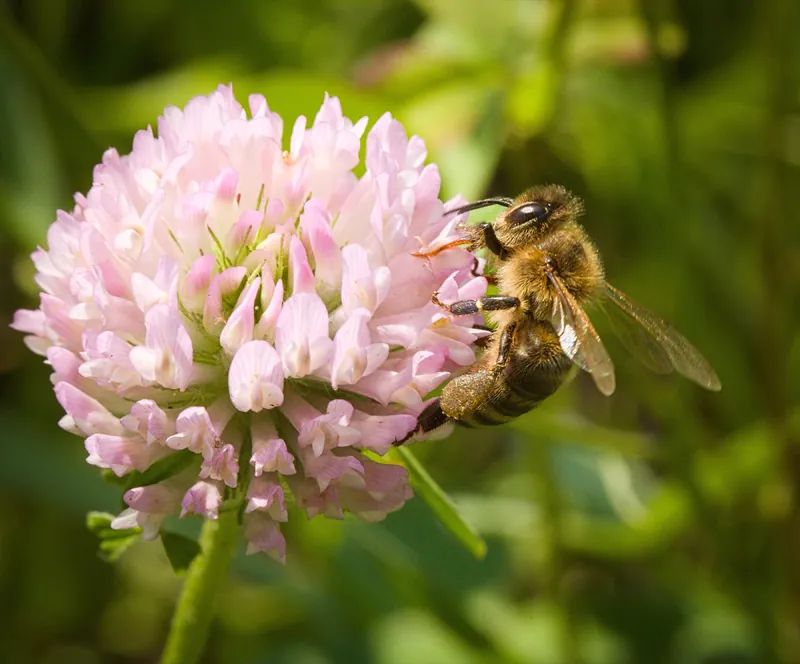
Red clover is a native legume of meadows and open woods that flowers from May to October. Its red flower heads are visited mainly by bumblebees; the long-tongued Bombus hortorum shows a marked preference for it, while honey bees reach only about 7 mm into the florets. Seed set depends entirely on insect pollination.
What we know
Bees linked to this plant
- Bombus hortorum
long-tongued bumblebee with a very marked preference for red clover flowers
Confirmed fact[4] - Eucera longicornis
visits red clover among other Fabaceae such as vetches, peas and white clover
Confirmed fact[5]
How to recognise it
The plant is 15 to 40 cm tall with three-parted leaves, and the flower heads are globular to egg-shaped, 1.5 to 3 cm across, sitting almost unstalked and wrapped by the uppermost leaves.
Confirmed fact[2]The flowers of subsp. pratense are red, and the stem and calyx are only slightly hairy.
Confirmed fact[1]
When it flowers
Info Flora gives the flowering time of red clover (subsp. pratense) in Switzerland as May to October.
Confirmed fact[1]
Where it grows
Info Flora lists red clover as indigenous in Switzerland, growing in meadows and open woods from the hill to the subalpine and occasionally alpine zone.
Confirmed fact[1]Its typical habitats in Switzerland are fertile meadows and pastures, including lowland oat-grass meadows and montane golden-oat meadows.
Confirmed fact[1]
What it offers bees
The Czech Pladias database gives a flowering period of May to October and lists bumblebees first in the pollinator spectrum, followed by honeybee, solitary bees and other insects.
Confirmed fact[3]The British recording society BWARS states that the long-tongued bumblebee Bombus hortorum has a very marked preference for red clover flowers when they are available.
Observation[4]The British recording society BWARS lists red clover among the flowers visited in western Europe by the long-horned bee Eucera longicornis, together with vetches, peas and white clover.
Observation[5]A Swedish study states that seed set in red clover is entirely dependent on pollination by insects, mainly bumblebees.
Confirmed fact[6]In Swedish red clover fields two short-tongued bumblebee species rose from 40 percent of the bumblebee community in the 1940s to 89 percent in present communities.
Confirmed fact[6]A 1969 British study found that red clover florets are generally longer than a honey bee's tongue and that honey bees can reach to a depth of 7 mm into the corolla tube.
Confirmed fact[7]
Honey
Red clover is listed among the botanical species giving unifloral honey in Europe, with Germany among the producing countries.
Confirmed fact[8]
Sources
- Info Flora. Trifolium pratense L. subsp. pratense. Online species page, Das nationale Daten- und Informationszentrum der Schweizer Flora (text from Flora Helvetica). Link
- Info Flora. Trifolium pratense L. (aggregate). Online species page, Das nationale Daten- und Informationszentrum der Schweizer Flora (text from Flora Helvetica). Link
- Pladias: Database of the Czech Flora and Vegetation. Trifolium pratense, taxon data page. Link
- Bees, Wasps and Ants Recording Society (BWARS). Bombus hortorum species account. Link
- Bees, Wasps and Ants Recording Society (BWARS). Eucera longicornis species account. Link
- Bommarco R, Lundin O, Smith HG, Rundlöf M. (2012) Drastic historic shifts in bumble-bee community composition in Sweden. Proceedings of the Royal Society B 279(1727): 309-315. doi:10.1098/rspb.2011.0647 Link
- Hawkins RP. (1969) Length of tongue in a honey bee in relation to the pollination of red clover. Journal of Agricultural Science, Cambridge 73: 489-493. Summary read on the Cambridge University Press page. Link
- Persano Oddo L, Piana L, Bogdanov S, et al. (2004) Botanical species giving unifloral honey in Europe. Apidologie 35 (Suppl. 1): S82-S93. Link
Last checked: 30 October 2026. Every statement on this page was compared with the source it cites.