Bee plant, Central Europe
Fagopyrum esculentum
Buckwheat, Common buckwheat
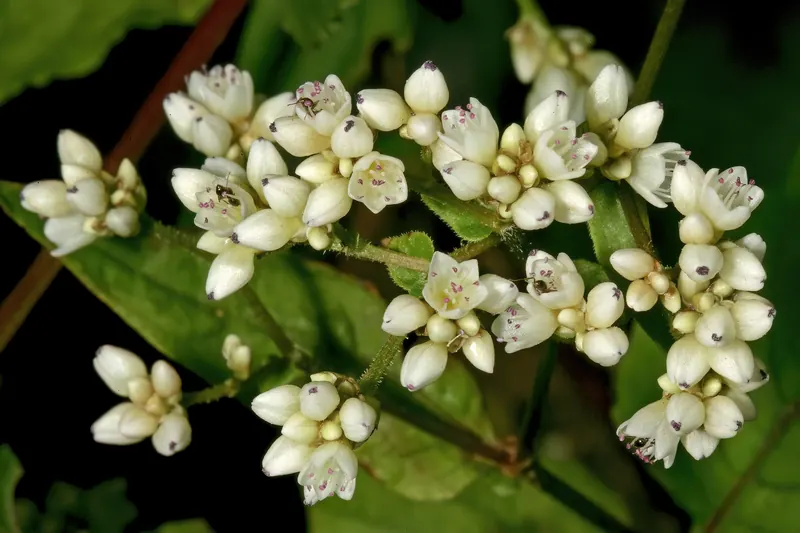
Buckwheat is an old crop from Central Asia with white to pale red flowers, flowering from July to September in Switzerland. Honeybees prefer its short-styled flowers, which secrete more nectar. Polish buckwheat honey is dark, tea-coloured and sharp in flavour, and dark honeys like it are rich in phenolics.
What we know
How to recognise it
When it flowers
Where it grows
Outside cultivation it occurs on fields and roadsides as an escape, from the colline to the montane belt.
Confirmed fact[1]
What it offers bees
Honey
A Polish study describes buckwheat honey as dark and tea-like in colour, with a sharp, tickly and sweet flavour.
Confirmed fact[4]All commercial Polish buckwheat honeys tested contained at least 45 percent buckwheat pollen.
Observation[4]In a Polish comparison, dark honeys such as buckwheat, honeydew and heather honey had the highest phenolic content and antioxidant activity.
Observation[5]
People
Buckwheat comes from Central Asia; Info Flora records it as a cultivated plant that appeared in Switzerland before 1500.
Confirmed fact[1]
Sources
- Info Flora, das nationale Daten- und Informationszentrum der Schweizer Flora. Species page: Fagopyrum esculentum Moench. Description text from Flora Helvetica (2018); habitat types from Delarze et al. (2015). Accessed 19 Oct 2026. Link
- Pladias, Database of the Czech Flora and Vegetation. Taxon data: Fagopyrum esculentum. Accessed 19 Oct 2026. Link
- Cawoy, V., Deblauwe, V., Halbrecq, B., Ledent, J.-F., Kinet, J.-M. & Jacquemart, A.-L. (2006). Morph differences and honeybee morph preference in the distylous species Fagopyrum esculentum Moench. International Journal of Plant Sciences 167(4): 853-861. https://doi.org/10.1086/504924 Link
- Bryś, M., Kunat, M., Stawiarz, E. & Ptaszyńska, A. (2021). Physicochemical characteristics and melissopalynological analysis of commercial buckwheat honeys from Poland. Journal of Experimental Biology and Agricultural Sciences 9(2): 200-205. https://doi.org/10.18006/2021.9(2).200.205 Link
- Wilczyńska, A. (2010). Phenolic content and antioxidant activity of different types of Polish honey: a short report. Polish Journal of Food and Nutrition Sciences 60(4): 309-313. Link
Last checked: 20 October 2026. Every statement on this page was compared with the source it cites.