Bee plant, Central Europe
Echium vulgare
Viper's bugloss
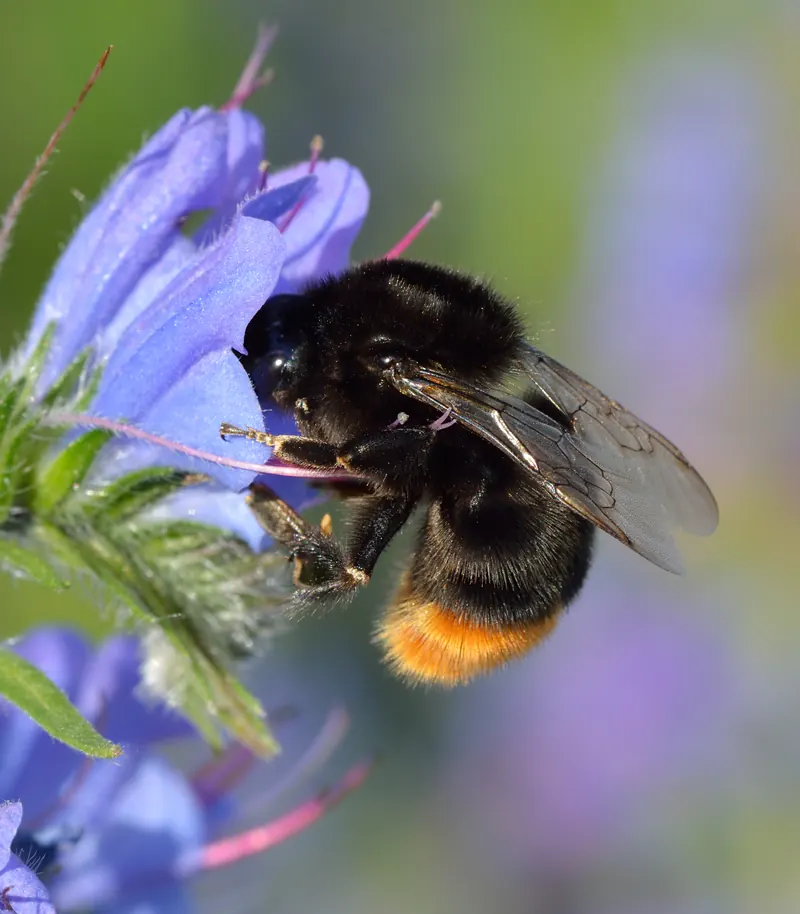
Viper's bugloss is a plant of gravel pits, path edges and waste ground with long spikes of violet blue flowers from May to October. A UK study found its flowers rich in nectar sugar, and the mason bee Hoplitis adunca collects pollen only from Echium. In an international survey of honeys and pollen products, pyrrolizidine alkaloids were traced mostly to pollen of Echium species.
What we know
Bees linked to this plant
- Hoplitis adunca
oligolectic; collects pollen exclusively on Echium
Confirmed fact[3]
How to recognise it
When it flowers
Info Flora gives the flowering period of viper's bugloss in Switzerland as May to October.
Confirmed fact[1]
Where it grows
What it offers bees
In a UK study of sown urban meadows, viper's bugloss was one of the three top ranked perennial seed mix species for nectar sugar, at an estimated 688 micrograms per flower per 24 hours.
Confirmed fact[2]The mason bee Hoplitis adunca collects pollen exclusively from Echium flowers.
Confirmed fact[3]The Baden-Württemberg bee forage catalogue names viper's bugloss mason bees among species that depend on a single plant for pollen.
Reported by the farm[4]In feeding trials, Echium pollen failed to support larval development of a bee that specialises on bellflowers.
Confirmed fact[5]
Honey
In an analysis of 216 honeys and 55 pollen products from Europe, the Americas, Australia and New Zealand, all samples containing pyrrolizidine alkaloids held pollen of alkaloid producing plants, mostly Echium species in general rather than viper's bugloss specifically.
Reported by the farm[6]
Sources
- Info Flora. Echium vulgare L.. Online species page, Das nationale Daten- und Informationszentrum der Schweizer Flora (text from Flora Helvetica 2018). Link
- Hicks DM, Ouvrard P, Baldock KCR, Baude M, Goddard MA, Kunin WE, et al. (2016) Food for Pollinators: Quantifying the Nectar and Pollen Resources of Urban Flower Meadows. PLOS ONE 11(6): e0158117. Link
- Burger H, Dötterl S, Ayasse M. (2010) Host-plant finding and recognition by visual and olfactory floral cues in an oligolectic bee. Functional Ecology 24(6): 1234-1240. Link
- Ministerium für Ländlichen Raum und Verbraucherschutz Baden-Württemberg. Bienenweidekatalog: Verbesserung der Bienenweide und des Artenreichtums. 6. aktualisierter Nachdruck, Stuttgart, Oktober 2019. Link
- Praz CJ, Müller A, Dorn S. (2008) Specialized bees fail to develop on non-host pollen: do plants chemically protect their pollen? Ecology 89(3): 795-804. Link
- Kempf M, Schreier P, Reinhard A, Beuerle T. Pyrrolizidin-Alkaloide (PA) in Honig und Pollen. Presentation, Universität Würzburg and TU Braunschweig, hosted by LAVES Niedersachsen. Link
Last checked: 20 October 2026. Every statement on this page was compared with the source it cites.