Bee plant, Central Europe
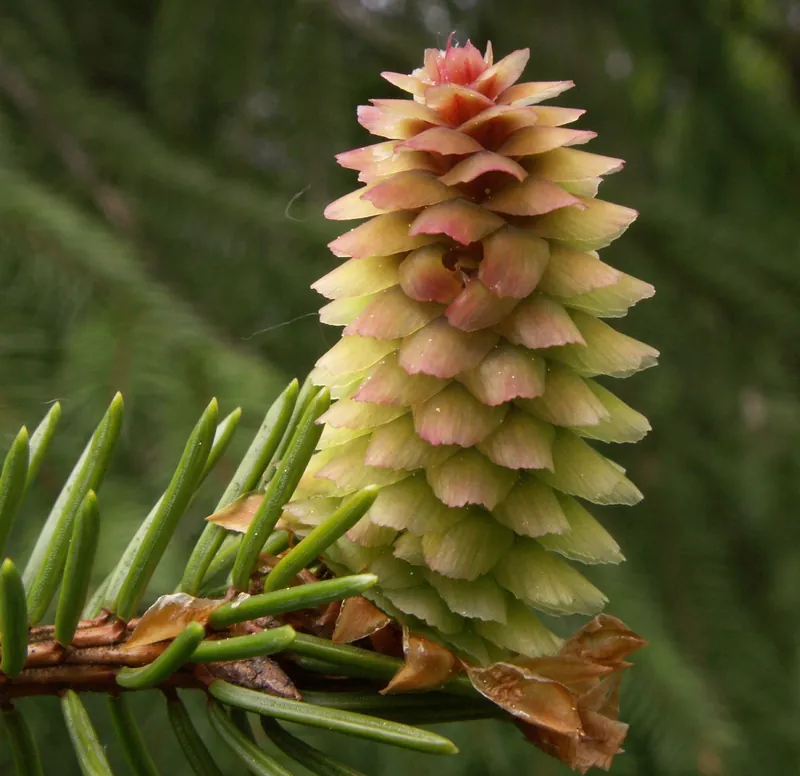
Picea abies
Norway spruce, Common spruce
Norway spruce is a wind pollinated conifer of acid soil forests that flowers in May and gives bees no nectar. Its value is honeydew: bud scale insects (Physokermes) and bark aphids (Cinara) excrete sugar rich honeydew that honeybees collect for forest honey, often in the lean second half of summer. Melezitose rich flows can set as unextractable cement honey.
What we know
Bees linked to this plant
- Apis mellifera
collects honeydew of the spruce bud scale insect Physokermes piceae; raw material of forest honey
Confirmed fact[4]
How to recognise it
When it flowers
Info Flora gives the flowering month of Norway spruce in Switzerland as May.
Confirmed fact[1]
Where it grows
In Switzerland it grows in forests on acid soil from the colline to the subalpine belt, but it is not original in the lower parts of the Central Plateau.
Confirmed fact[1]
What it offers bees
According to the German bee institutes' newsletter, two bud scale insect species and five bark aphid species occur on spruce.
Confirmed fact[3]The two spruce bud scale insects, also called Lecanien (Physokermes), often start producing honeydew as early as May.
Confirmed fact[3]The Swiss forest protection service WSL states in its leaflet on Physokermes piceae that bees collect the honeydew of spruce bud scale insects and that it is an important raw material for forest honey.
Confirmed fact[4]
Honey
The Baden-Wuerttemberg bee forage catalogue names spruces and firs as the main pure honeydew suppliers, with pollen free flows that often fall in the otherwise lean second half of summer.
Confirmed fact[2]Honeydew is produced by plant sucking insects that take plant sap, filter out the protein they need and excrete the surplus, mostly sugar and water.
Confirmed fact[2]A PLOS ONE study in Baden-Wuerttemberg sampled honeydew on spruce from the scale insects Physokermes piceae and P. hemicryphus and the aphids Cinara pilicornis and Cinara piceae.
Confirmed fact[5]In that study the honeydew of the spruce aphid Cinara piceae had the highest share of the trisaccharide melezitose, while Physokermes honeydew on spruce had much lower proportions.
Confirmed fact[5]Melezitose rich honeydew gives the so called cement honey, which crystallises hard and light grey in the combs and cannot be extracted.
Confirmed fact[6]
Sources
- Info Flora (2018+). Picea abies (L.) H. Karst.. Online flora of Switzerland (descriptions from Flora Helvetica 2018). Info Flora, Geneva/Bern. Link
- Ministerium fuer Laendlichen Raum und Verbraucherschutz Baden-Wuerttemberg (2019). Bienenweidekatalog. 6. aktualisierter Nachdruck, Oktober 2019 (Drucknummer 14-2019-24). Stuttgart. Link
- Fischer, J. (2023). Am Bienenstand: Honigtautracht. Bienen@Imkerei 16/2023, 19.06.2023. Joint newsletter of the German bee institutes (DLR Fachzentrum Bienen und Imkerei Mayen, LWG Institut fuer Bienenkunde und Imkerei Veitshoechheim, LLH Bieneninstitut Kirchhain, Landesanstalt fuer Bienenkunde Hohenheim, Laenderinstitut fuer Bienenkunde Hohen Neuendorf, LWK NRW). Link
- Waldschutz Schweiz, Eidg. Forschungsanstalt WSL. Diagnose online, Merkblatt 186: Grosse Fichtenquirlschildlaus (Physokermes piceae). Link
- Shaaban, B., Seeburger, V., Schroeder, A., Lohaus, G. (2020). Sugar, amino acid and inorganic ion profiling of the honeydew from different hemipteran species feeding on Abies alba and Picea abies. PLoS ONE 15(1): e0228171. doi:10.1371/journal.pone.0228171 Link
- Binder-Koellhofer, B. (2022). Waldhonig - etwas ganz Besonderes. Bienen@Imkerei 16/2022, 17.06.2022. Joint newsletter of the German bee institutes (DLR Fachzentrum Bienen und Imkerei Mayen, LWG Veitshoechheim, LLH Bieneninstitut Kirchhain, Landesanstalt fuer Bienenkunde Hohenheim, Laenderinstitut fuer Bienenkunde Hohen Neuendorf, LWK NRW). Link
- Pladias: Database of the Czech Flora and Vegetation. Taxon data for Picea abies. Masaryk University Brno et al. Link
Last checked: 30 October 2026. Every statement on this page was compared with the source it cites.