Bee plant, Central Europe
Taraxacum officinale aggr.
Dandelion, Common dandelion
Taraxacum officinale is treated here as an aggregate of many hard to separate dandelions, including sexual diploids and apomictic triploids. It flowers mainly in April and May in meadows, path edges and fields. A UK study found its flower heads among the richest weeds for nectar sugar and pollen, and German bee institutes name dandelion meadows as a mass flowering source whose honey crystallises.
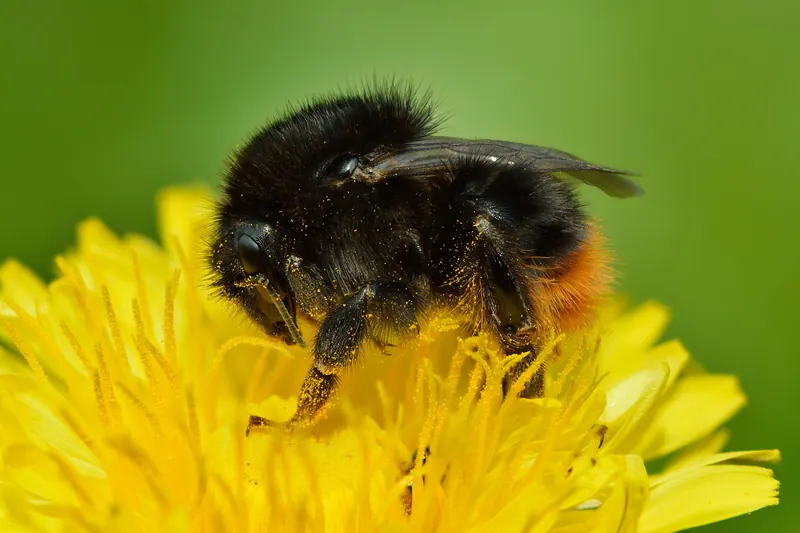
What we know
Bees linked to this plant
- Colletes cunicularius
both sexes observed visiting dandelion (Taraxacum sp.), presumably only for nectar (record from South Glamorgan, Wales)
Confirmed fact[6]
How to recognise it
When it flowers
Info Flora gives the main flowering period as April to May, with some flowering continuing until October.
Confirmed fact[1]
Where it grows
In Switzerland dandelions grow in fertile meadows, at path edges and in arable fields, up to the subalpine or alpine belt.
Confirmed fact[1]
What it offers bees
In a UK study of sown urban meadows in four cities, Taraxacum agg. was one of the top weed species for nectar sugar, at an estimated 2137 micrograms per flower head per 24 hours, more than any sown species.
Confirmed fact[3]The same UK study estimated 2.8 microlitres of pollen per Taraxacum agg. flower head per 24 hours, among the highest values for unsown species.
Confirmed fact[3]The UK authors included weeds in their surveys because, as they note, weed species such as dandelions can provide significant resources to pollinators.
Confirmed fact[3]BWARS reports a record from South Glamorgan, Wales, of both sexes of the plasterer bee Colletes cunicularius visiting dandelion flowers, presumably only for nectar.
Observation[6]
Honey
The Baden-Württemberg bee forage catalogue names dandelion meadows as an example of the mass flowering of many identical nectar rich flowers that large honey flows depend on.
Reported by the farm[4]The LAVES bee institute lists dandelion honey among blossom honeys whose high glucose content makes them crystallise.
Confirmed fact[5]
People
Apomictic dandelions produce seed offspring of the mother's genotype without needing pollination.
Confirmed fact[2]
Sources
- Info Flora. Taraxacum officinale aggr.. Online species page, Das nationale Daten- und Informationszentrum der Schweizer Flora (text from Flora Helvetica 2018). Link
- Mártonfiová L. (2015) Hybridization in natural mixed populations of sexual diploid and apomictic triploid dandelions (Taraxacum sect. Taraxacum): why are the diploid sexuals not forced out? Folia Geobotanica 50: 339-348. doi:10.1007/s12224-015-9231-y Link
- Hicks DM, Ouvrard P, Baldock KCR, Baude M, Goddard MA, Kunin WE, et al. (2016) Food for Pollinators: Quantifying the Nectar and Pollen Resources of Urban Flower Meadows. PLOS ONE 11(6): e0158117. Link
- Ministerium für Ländlichen Raum und Verbraucherschutz Baden-Württemberg. Bienenweidekatalog: Verbesserung der Bienenweide und des Artenreichtums. 6. aktualisierter Nachdruck, Stuttgart, Oktober 2019. Link
- von der Ohe W. (2005) Honig-Kristallisation. Das Bieneninstitut Celle informiert Nr. 43. LAVES Institut für Bienenkunde Celle. Link
- Bees, Wasps and Ants Recording Society (BWARS). Colletes cunicularius species account. Link
Last checked: 20 October 2026. Every statement on this page was compared with the source it cites.