Bee plant, Central Europe
Centaurea cyanus
Cornflower, Bachelor's button, Kornblume
Cornflower is an annual arable weed of eastern Mediterranean origin that arrived with early farming. Info Flora gives June to October as its flowering period in Switzerland, where it is near threatened. In a UK meadow study it gave the highest nectar sugar per flower head of any annual, about 896 micrograms in 24 hours.
What we know
How to recognise it
Plants are 20 to 70 cm tall and white-felted, with linear-lanceolate leaves; the lower leaves are usually dried up by flowering time.
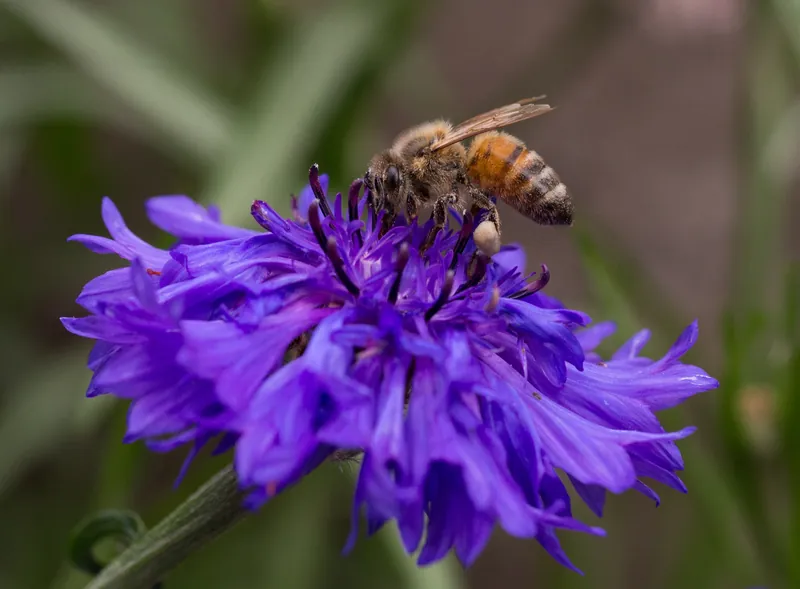
Confirmed fact[1]Flower heads are solitary, with green bracts bearing a black fringed appendage; the florets are blue and the outer ones strongly enlarged.
Confirmed fact[1]
When it flowers
Where it grows
In Switzerland it grows in cereal fields and on waste ground from the colline to the montane, occasionally subalpine, zone.
Confirmed fact[1]
What it offers bees
In a UK study of sown urban meadows, cornflower produced the most nectar sugar of any annual, about 896 micrograms per floral unit in 24 hours.
Confirmed fact[4]In the same study cornflower made the greatest single contribution to the nectar of the annual meadows, about a third of the total.
Confirmed fact[4]
Honey
The Celle bee institute names Kornblumenhonig (cornflower honey) as an example of a varietal honey, which must come wholly or mainly from the named plant.
Confirmed fact[5]
In the garden
The Celle bee institute lists cornflower among bee-friendly flowers suitable for almost any garden.
Reported by the farm[6]
People
According to a species sheet by Bischoff and Schönhofer published by Agrarumwelt Rheinland-Pfalz, cornflower was introduced about 7000 years ago together with arable farming; Info Flora gives its origin as the eastern Mediterranean.
Confirmed fact[3]In Switzerland cornflower is classed as near threatened (NT) on the national Red List.
Confirmed fact[1]German direct-payment rules list Centaurea cyanus among the pollen- and nectar-rich species allowed on fallow land used for honey plants.
Confirmed fact[7]
Sources
- Info Flora, das nationale Daten- und Informationszentrum der Schweizer Flora. Species page: Centaurea cyanus L. Description text from Flora Helvetica (2018). Accessed 29 Oct 2026. Link
- Pladias, Database of the Czech Flora and Vegetation. Taxon data: Centaurea cyanus. Accessed 29 Oct 2026. Link
- Bischoff, A. & Schönhofer, A. (n.d.). Steckbrief: Kornblume (Centaurea cyanus). Technische Hochschule Bingen, Landschaftsökologie und Biodiversität; published by Agrarumwelt Rheinland-Pfalz. Link
- Hicks, D. M., Ouvrard, P., Baldock, K. C. R., Baude, M., Goddard, M. A., Kunin, W. E., Mitschunas, N., Memmott, J., Morse, H., Nikolitsi, M., et al. (2016). Food for Pollinators: Quantifying the Nectar and Pollen Resources of Urban Flower Meadows. PLOS ONE 11(6): e0158117. Link
- LAVES Institut für Bienenkunde Celle (2016). Was ist ein Sortenhonig? Das Bieneninstitut Celle informiert (44). Link
- Boecking, O. (2010). Aktiver Bienenschutz: Verbesserung des Nahrungsangebotes für Bienen. LAVES Institut für Bienenkunde Celle. Link
- Direktzahlungen-Durchführungsverordnung (DirektZahlDurchfV), Anlage 5 (zu § 32a Absatz 2 Satz 1 und Absatz 3): Zulässige Arten auf für Honigpflanzen genutztem brachliegendem Land. Bundesministerium der Justiz, gesetze-im-internet.de. Fundstelle BAnz AT 29.03.2018 V1. Link
Last checked: 30 October 2026. Every statement on this page was compared with the source it cites.