Bee plant, Central Europe
Acer pseudoplatanus
Sycamore, Sycamore maple
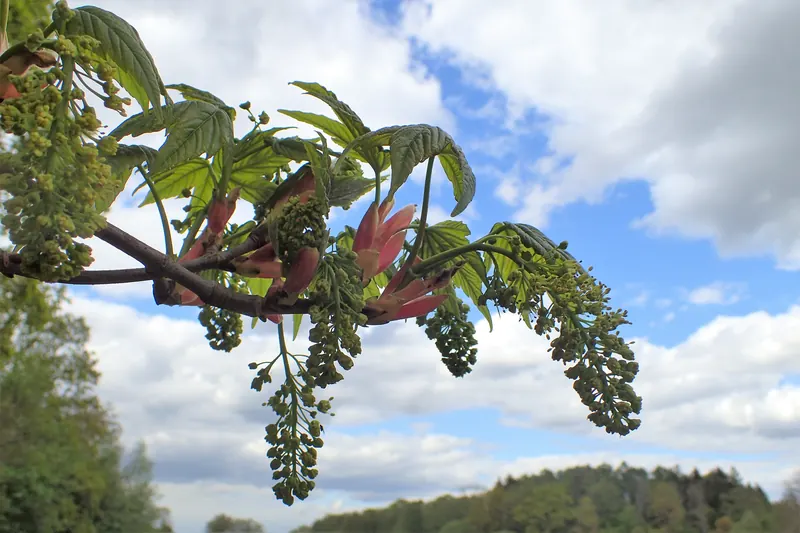
Sycamore maple is a tree of forests and mountain slopes that flowers in April and May, with hanging yellow green flower clusters. A Polish study found open nectar droplets with an average sugar content of 37 percent, and bee institutes also value it for honeydew. The Bavarian LWG rates it highly for nectar but calls it a loser of climate warming.
What we know
How to recognise it
When it flowers
Info Flora gives the flowering period of sycamore maple in Switzerland as April to May.
Confirmed fact[1]
Where it grows
In Switzerland it grows in forests and on mountain slopes, is often planted, and reaches the subalpine belt.
Confirmed fact[1]
What it offers bees
In a study from the University of Life Sciences in Lublin, Poland (2011 to 2013), nectar sugar content ranged from 23.5 to 50 percent, with an average of 37.3 percent.
Confirmed fact[2]Ten flowers yielded on average 16.54 mg of nectar in the same study.
Confirmed fact[2]Nectar collects as visible droplets on the nectary surface, so insects can reach it easily.
Confirmed fact[2]The Bavarian LWG rates sycamore maple 4 for nectar and 2 for pollen on its 1 to 4 scale.
Statistical estimate[3]LWG calls it a very good bee plant in May, shortly after apple, but notes it needs a top quality site.
Reported by the farm[3]
Honey
LWG notes that sycamore can give honeydew honey similar to Norway maple, and often flowers together with horse chestnut and rapeseed.
Reported by the farm[3]The Baden-Württemberg bee forage catalogue names sycamore maple among trees that offer both a blossom flow and a honeydew flow.
Reported by the farm[4]
Sources
- Info Flora. Acer pseudoplatanus L.. Online species page, Das nationale Daten- und Informationszentrum der Schweizer Flora (text from Flora Helvetica 2018). Link
- Dmitruk M. (2019) Flowering, nectar secretion, and structure of the nectary in the flowers of Acer pseudoplatanus L. Acta Agrobotanica 72(3): 1787. doi:10.5586/aa.1787 Link
- Bayerische Landesanstalt für Weinbau und Gartenbau (LWG), Institut für Erwerbs- und Freizeitgartenbau. Bienenbäume. 1. Auflage, Veitshöchheim, April 2019. Link
- Ministerium für Ländlichen Raum und Verbraucherschutz Baden-Württemberg. Bienenweidekatalog: Verbesserung der Bienenweide und des Artenreichtums. 6. aktualisierter Nachdruck, Stuttgart, Oktober 2019. Link
Last checked: 20 October 2026. Every statement on this page was compared with the source it cites.