Bee plant, Central Europe
Knautia arvensis
Field scabious
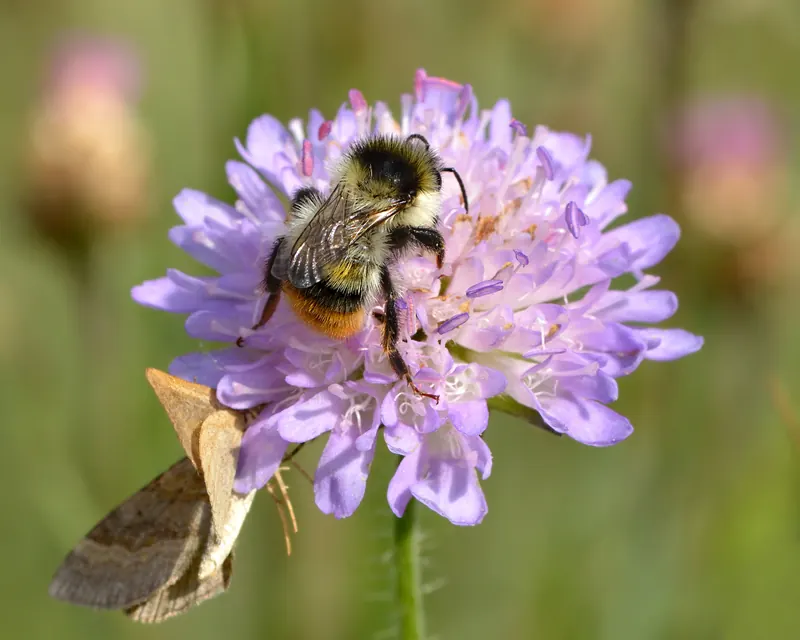
Field scabious is a meadow perennial with flat blue-violet flower heads, flowering from May to September in Switzerland. A Swedish study calls it the main pollen plant of the specialist mining bee Andrena hattorfiana in northern Europe and estimates that one nest of six cells needs pollen from about 72 flower heads.
What we know
Bees linked to this plant
- Andrena hattorfiana
pollen specialist on Dipsacaceae; Knautia arvensis is its major pollen source in northern Europe (Swedish study)
Confirmed fact[3]
How to recognise it
Plants are 30 to 100 cm tall, with bristly hairs of unequal length, with or without glands.
Confirmed fact[1]Lower leaves are mostly undivided and lance-shaped, while upper leaves are mostly deeply pinnately lobed.
Confirmed fact[1]The flat flower head is 2 to 4 cm across; flowers are blue to red-violet, and the outer flowers are larger than the inner ones.
Confirmed fact[1]
When it flowers
Where it grows
In Switzerland it grows in meadows, on banks and along paths, from the colline to the montane belt, sometimes subalpine.
Confirmed fact[1]
What it offers bees
Pladias lists bumblebees, solitary bees, hoverflies and butterflies as its main pollinator groups.
Reported by the farm[2]According to a Swedish study, the solitary bee Andrena hattorfiana specialises in collecting pollen from the scabious family (Dipsacaceae).
Confirmed fact[3]A Swedish study states that in northern Europe field scabious is the main pollen source of Andrena hattorfiana.
Confirmed fact[3]In a Swedish study, researchers estimated that one average nest with six cells needs pollen from about 72 flower heads, or 11 plants.
Statistical estimate[3]The British recording society states that scabious, especially field scabious, is a necessary requirement for Andrena hattorfiana.
Reported by the farm[4]In Britain, males of Andrena hattorfiana show a marked preference for field scabious flowers.
Observation[4]
Sources
- Info Flora, das nationale Daten- und Informationszentrum der Schweizer Flora. Species page: Knautia arvensis (L.) Coult.. Description text from Flora Helvetica (2018); habitat types from Delarze et al. (2015). Accessed 19 Oct 2026. Link
- Pladias, Database of the Czech Flora and Vegetation. Taxon data: Knautia arvensis. Accessed 19 Oct 2026. Link
- Larsson, M. & Franzén, M. (2007). Critical resource levels of pollen for the declining bee Andrena hattorfiana (Hymenoptera, Andrenidae). Biological Conservation 134(3): 405-414. Link
- Else, G. R. (2001). Andrena hattorfiana (Fabricius, 1775). Species account, Bees, Wasps and Ants Recording Society (BWARS). Link
Last checked: 20 October 2026. Every statement on this page was compared with the source it cites.