Bee plant, Central Europe
Trifolium repens
White clover
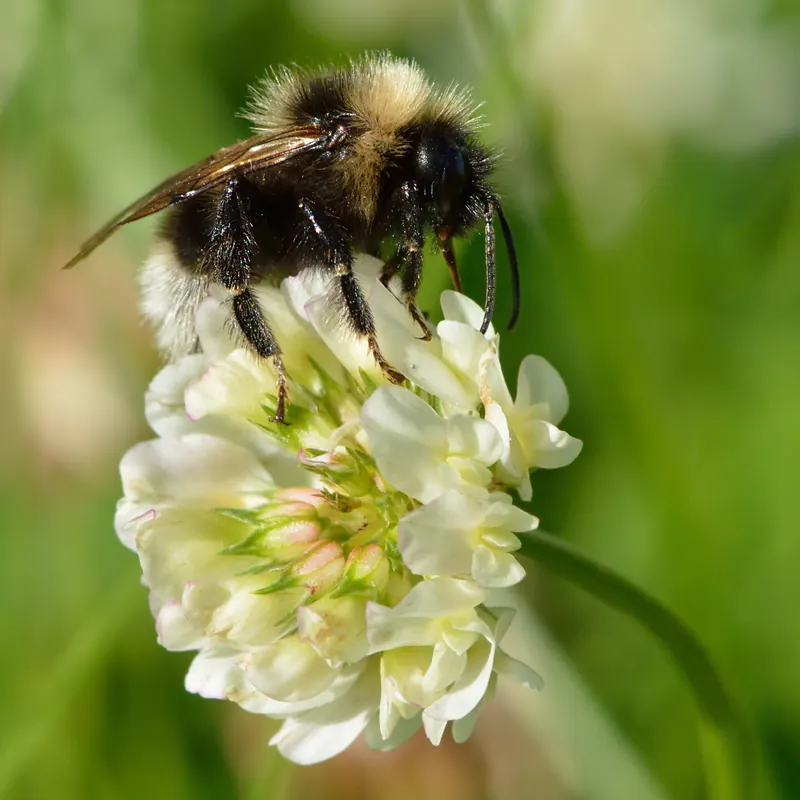
White clover is a creeping legume of meadows, pastures, lawns and paths that flowers from May to September. Its white flowers turn brownish and bend down after flowering. In Britain the bee Melitta leporina shows a marked preference for it, and in a US study of suburban lawns it was by far the most abundant spontaneous flower.
What we know
Bees linked to this plant
- Melitta leporina
marked preference for white clover; also visits other Fabaceae such as lucerne and melilot (British records, BWARS)
Confirmed fact[3]
How to recognise it
When it flowers
Info Flora gives the flowering period of white clover in Switzerland as May to September.
Confirmed fact[1]
Where it grows
What it offers bees
BWARS, which covers Britain, states that the bee Melitta leporina has a marked preference for white clover.
Observation[3]Citing an earlier study from Toronto, Canada, the US authors report that clover was the dominant pollen source in successful brood cells of two generalist bee species.
Reported by the farm[5]
In the garden
The Baden-Württemberg bee forage catalogue reports good results from a mix of white and crimson clover sown under cereals in spring.
Reported by the farm[4]In suburban lawns in Massachusetts, USA, white clover was by far the most abundant and widespread of 54 spontaneous flowering species.
Confirmed fact[5]In the same US study, lawns mown every two weeks had the most bees but the lowest bee species richness and evenness.
Confirmed fact[5]
Sources
- Info Flora. Trifolium repens L.. Online species page, Das nationale Daten- und Informationszentrum der Schweizer Flora (text from Flora Helvetica 2018). Link
- Marschner R. Trifolium repens, Weiß-Klee (Fabaceae). Species sheet, Qualifizierung Feldbotanik (Bronze), BayCEER, Universität Bayreuth. Link
- Bees, Wasps and Ants Recording Society (BWARS). Melitta leporina species account. Link
- Ministerium für Ländlichen Raum und Verbraucherschutz Baden-Württemberg. Bienenweidekatalog: Verbesserung der Bienenweide und des Artenreichtums. 6. aktualisierter Nachdruck, Stuttgart, Oktober 2019. Link
- Lerman SB, Contosta AR, Milam J, Bang C. (2018) To mow or to mow less: Lawn mowing frequency affects bee abundance and diversity in suburban yards. Biological Conservation 221: 160-174. Link
Last checked: 20 October 2026. Every statement on this page was compared with the source it cites.