Bee plant, Central Europe
Calluna vulgaris
Heather, Ling
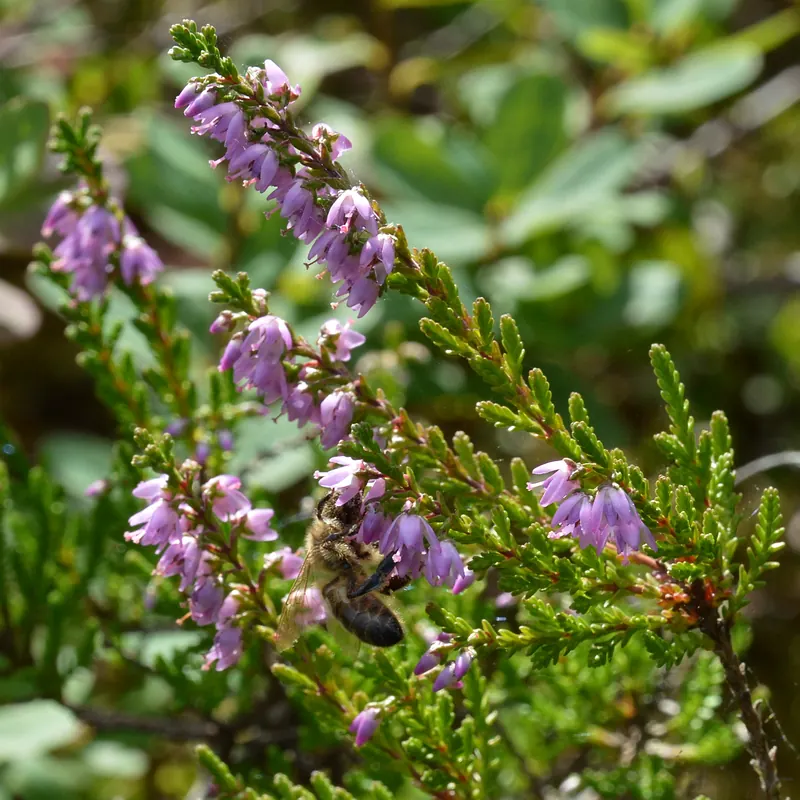
Heather is an evergreen dwarf shrub of heaths, bogs and poor pastures, flowering in late summer; the Celle bee institute gives early August to mid September as the normal flowering time. It can supply large amounts of nectar and pollen. Its honey is gel-like and thixotropic, so combs must be needled before extraction.
What we know
Bees linked to this plant
- Colletes succinctus
both sexes visit heather and heaths (UK)
Confirmed fact[4]
How to recognise it
When it flowers
Where it grows
In Switzerland it grows on dwarf-shrub heaths, in bogs and on poor pastures, from the colline to the alpine belt.
Confirmed fact[1]
What it offers bees
Honey
Left undisturbed, extracted heather honey has a gelatinous consistency.
Confirmed fact[2]The honey turns briefly fluid when needled and then sets again; this reversible behaviour is called thixotropy and separates heather from Erica honey.
Confirmed fact[2]Combs must be needled before extraction, otherwise the honey would not run out of the cells in the extractor.
Confirmed fact[2]Heather honey varies from reddish-brown to dark beige and has a typical tart, aromatic, sometimes slightly bitter taste.
Confirmed fact[2]
Sources
- Info Flora, das nationale Daten- und Informationszentrum der Schweizer Flora. Species page: Calluna vulgaris (L.) Hull. Description text from Flora Helvetica (2018); habitat types from Delarze et al. (2015). Accessed 19 Oct 2026. Link
- von der Ohe, W. & von der Ohe, K. (2020). Heidetracht und Heidehonig. LAVES Institut für Bienenkunde Celle (Niedersächsisches Landesamt für Verbraucherschutz und Lebensmittelsicherheit). Link
- Pladias, Database of the Czech Flora and Vegetation. Taxon data: Calluna vulgaris. Accessed 19 Oct 2026. Link
- Else, G. R. Colletes succinctus (Linnaeus, 1758). Species account, Bees, Wasps and Ants Recording Society (BWARS). Link
Last checked: 20 October 2026. Every statement on this page was compared with the source it cites.