Bee plant, Central Europe
Rubus idaeus
Raspberry, Himbeere
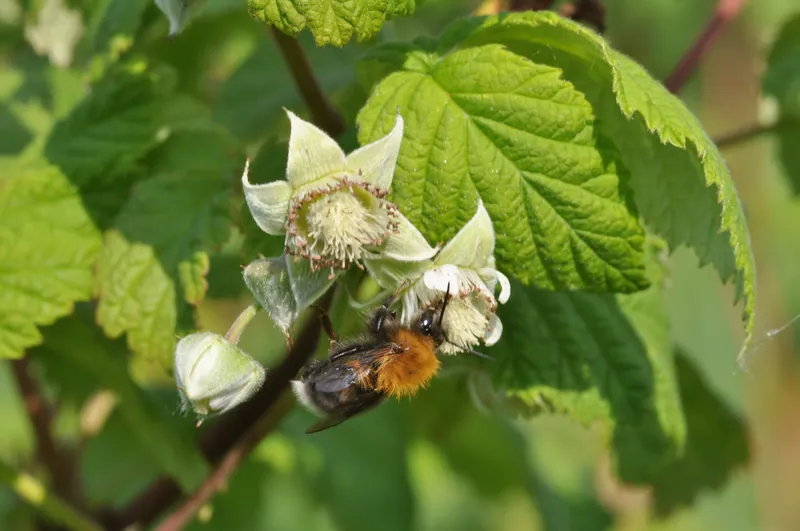
Raspberry is a native shrub of forest clearings and rocky scree that flowers from May to July in Switzerland. Six Polish cultivars gave 20 to 26 mg of nectar per flower. Bumblebees, honey bees, Andrena bees and hoverflies visit the flowers.
What we know
How to recognise it
The plant is 50 to 150 cm tall and deciduous, with round first-year canes that are bluish-bloomed at first and bear fine dark violet prickles up to 2 mm long.
Confirmed fact[1]The leaves are three-parted or, on the canes, pinnate with five or seven leaflets that are densely white-felted beneath; the flowers are white with narrow-oval petals about 5 mm long.
Confirmed fact[1]The red, roughly globular fruit about 1 cm across separates from the cone-shaped receptacle when picked.
Confirmed fact[1]
When it flowers
Info Flora gives the flowering time of raspberry in Switzerland as May to July.
Confirmed fact[1]
Where it grows
Info Flora lists raspberry as indigenous in Switzerland, growing in forest clearings and rocky scree from the hill to the subalpine and occasionally alpine zone.
Confirmed fact[1]
What it offers bees
The Czech Pladias database gives insect pollination and selfing, with honeybee and bumblebees listed first in the pollinator spectrum, followed by flies and butterflies.
Confirmed fact[2]In a Polish plantation study, six raspberry cultivars produced on average 20.2 to 26.4 mg of nectar per flower with a sugar concentration of 34.6 to 47.3 percent.
Confirmed fact[3]Expressed as sugar, these Polish cultivars secreted 6.9 to 12.2 mg of sugar per flower.
Confirmed fact[3]The same paper states that raspberry flowers are mainly visited by bumblebees, honeybees, solitary bees and flies.
Confirmed fact[3]A Scottish doctoral study of wild and cultivated raspberry found bumblebees responsible for about 60 percent of all flower visits, with honey bees, Andrena species and hoverflies making up most of the rest.
Confirmed fact[4]In that Scottish study, young raspberry flowers offered both nectar and pollen, while medium-aged and old flowers offered nectar only, in diminishing quantity.
Confirmed fact[4]
Honey
Citing earlier literature, the Polish authors give an estimated honey yield of 42.8 to 238.2 kg per hectare for raspberry.
Reported by the farm[3]
Sources
- Info Flora. Rubus idaeus L.. Online species page, Das nationale Daten- und Informationszentrum der Schweizer Flora (text from Flora Helvetica). Link
- Pladias: Database of the Czech Flora and Vegetation. Rubus idaeus, taxon data page. Link
- Kostryco M, Chwil M. (2022) Nectar Abundance and Nectar Composition in Selected Rubus idaeus L. Varieties. Agriculture 12(8): 1132. doi:10.3390/agriculture12081132 Link
- Bataw AAM. (1996) Pollination ecology of cultivated and wild raspberry (Rubus idaeus) and the behaviour of visiting insects. PhD thesis, University of St Andrews. Abstract read on the St Andrews Research Repository. Link
Last checked: 30 October 2026. Every statement on this page was compared with the source it cites.