Bee plant, Central Europe
Prunus spinosa
Blackthorn, Sloe
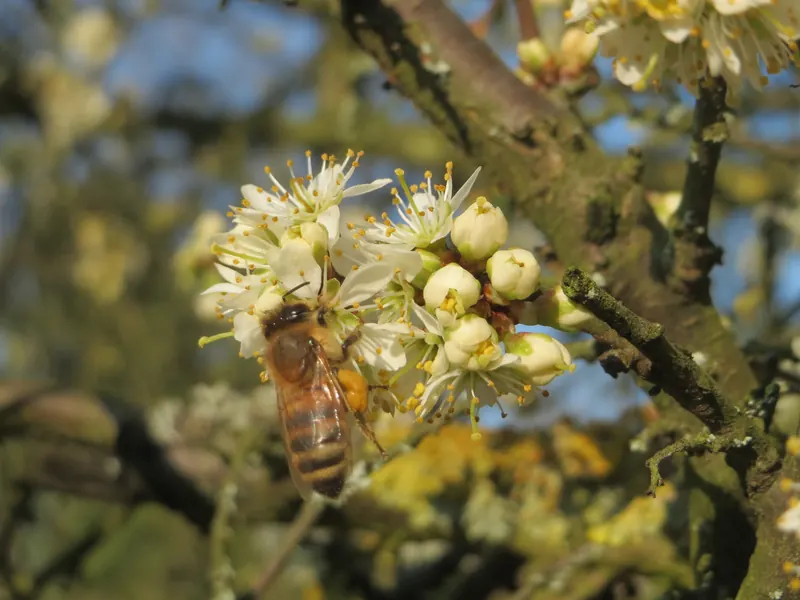
Blackthorn is a thorny shrub of hedges and woodland edges whose white flowers open in April, before the leaves. A Polish study measured 0.23 mg of protein rich pollen per flower and found honey bees were most of the visitors. Bee institutes list it among shrubs that support bees in spring.
What we know
Bees linked to this plant
- Colletes cunicularius
both sexes observed taking nectar at blackthorn in Brittany (BWARS)
Confirmed fact[5]
How to recognise it
When it flowers
Info Flora gives April as the flowering month of blackthorn in Switzerland.
Confirmed fact[1]
Where it grows
In Switzerland blackthorn grows in hedges and at woodland edges, from the colline to the montane belt.
Confirmed fact[1]
What it offers bees
In a study in south east Poland, blackthorn produced 0.23 mg of pollen per flower and 1.99 g per square metre of shrub surface.
Confirmed fact[2]The same study found that blackthorn pollen contains 22.1 to 34.2 percent protein.
Confirmed fact[2]Honey bees made up 68 to 72 percent of all insect visitors to blackthorn in both study years in Poland.
Observation[2]The Bavarian LWG names blackthorn among shrubs that accompany the early spring bee forage.
Reported by the farm[3]BWARS cites an observation from Brittany of both sexes of the plasterer bee Colletes cunicularius taking nectar at blackthorn.
Observation[5]
In the garden
The LAVES bee institute lists blackthorn among bee friendly shrubs.
Reported by the farm[4]
Sources
- Info Flora. Prunus spinosa L.. Online species page, Das nationale Daten- und Informationszentrum der Schweizer Flora (text from Flora Helvetica 2018). Link
- Dmitruk ME, Chrzanowska E, Strzałkowska-Abramek M, Stawiarz E. (2023) Prunus spinosa L. pollen: quantity and nutritional quality. Acta Agrobotanica 76: 174011. doi:10.5586/aa/174011 Link
- Bayerische Landesanstalt für Weinbau und Gartenbau (LWG), Institut für Erwerbs- und Freizeitgartenbau. Bienenbäume. 1. Auflage, Veitshöchheim, April 2019. Link
- Boecking O. (2010) Aktiver Bienenschutz: Verbesserung des Nahrungsangebotes für Bienen. LAVES Institut für Bienenkunde Celle. Link
- Bees, Wasps and Ants Recording Society (BWARS). Colletes cunicularius species account. Link
Last checked: 20 October 2026. Every statement on this page was compared with the source it cites.