Bee plant, Central Europe
Epilobium angustifolium
Fireweed, Rosebay willowherb
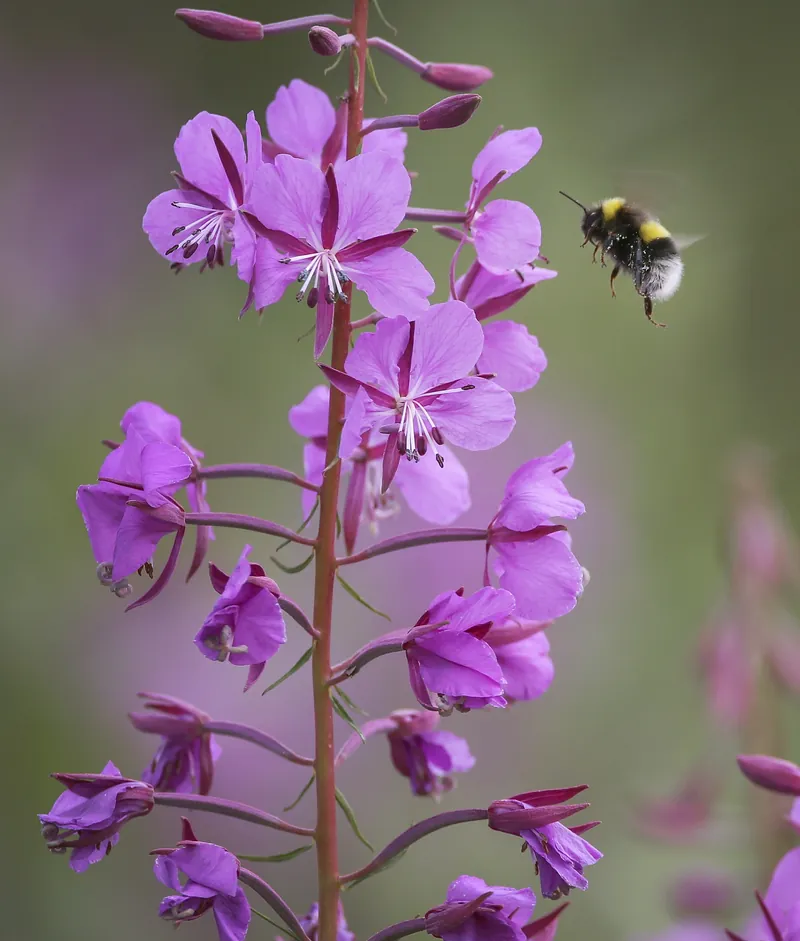
Fireweed is a tall native pioneer of forest clearings, clear cuts and rock debris, flowering pink to purple from June to August. Its protandrous flowers give nectar at about 47 percent sugar, more in the female phase; near Wuerzburg they produced about 2332 micrograms of sugar a day. The LWF calls it an important late summer nectar and pollen source.
What we know
Bees linked to this plant
- Bombus terrestris
workers observed visiting the flowers near Wuerzburg, Germany
Confirmed fact[4]
How to recognise it
When it flowers
Info Flora gives the flowering period of fireweed in Switzerland as June to August.
Confirmed fact[1]The Czech Pladias database records fireweed as insect pollinated with selfing, flowering June to September in Czechia.
Confirmed fact[2]Fireweed is protandrous: each flower passes through a male phase before a female phase, as a Canadian study of its pollen schedules notes.
Confirmed fact[7]
Where it grows
What it offers bees
In a Polish study the nectar sugar concentration stayed constant through anthesis at 47 percent on average.
Confirmed fact[3]The same study found that female phase flowers produced on average 1.4 times more nectar than male phase flowers, and the nectar shifted from sucrose rich to hexose rich.
Confirmed fact[3]Near Wuerzburg, Germany, fireweed flowers produced on average 2332 micrograms of sugar in 24 hours and were visited by Bombus terrestris workers.
Confirmed fact[4]The Bavarian forest institute LWF says fireweed is common on forest clearings and is an important nectar and pollen source in late summer.
Confirmed fact[5]
In the garden
The Bavarian forest institute LWF advises that smaller forest gaps should sometimes be left to themselves, so that plants such as fireweed can establish.
Reported by the farm[5]
Sources
- Info Flora (2018+). Epilobium angustifolium L.. Online flora of Switzerland (descriptions from Flora Helvetica 2018). Info Flora, Geneva/Bern. Link
- Pladias: Database of the Czech Flora and Vegetation. Taxon data for Epilobium angustifolium. Masaryk University Brno et al. Link
- Anton, S., Denisow, B., Komon-Janczara, E., Targonski, Z. (2017). Nectary and gender-biased nectar production in dichogamous Chamaenerion angustifolium (L.) Scop. (Onagraceae). Plant Species Biology 32(4): 380-391. doi:10.1111/1442-1984.12169 Link
- Raine, N. E., Chittka, L. (2007). Nectar production rates of 75 bumblebee-visited flower species in a German flora (Hymenoptera: Apidae: Bombus terrestris). Entomologia Generalis 30(2): 191-192. Link
- Kudernatsch, T. (2012). Vielfalt fuer die Honigbiene. LWF aktuell 91: 46-48. Online as 'Wie Waldbesitzer der Honigbiene helfen koennen', waldwissen.net, Bayerische Landesanstalt fuer Wald und Forstwirtschaft (LWF), 14.08.2013. Link
- BayCEER, University of Bayreuth. Zertifizierung Artenkenntnis / Qualifizierung Feldbotanik: Epilobium angustifolium (species sheet, text R. Marschner). Link
- Sargent, R. D. (2003). Seasonal changes in pollen-packaging schedules in the protandrous plant Chamerion angustifolium. Oecologia 135: 221-226. doi:10.1007/s00442-003-1187-6 Link
Last checked: 30 October 2026. Every statement on this page was compared with the source it cites.