Bee plant, Central Europe
Rubus fruticosus agg.
Bramble, Blackberry (aggregate)
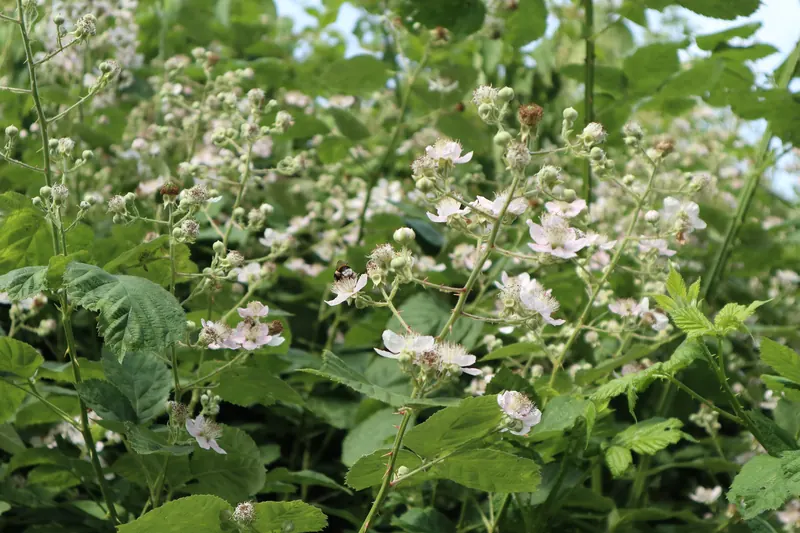
Bramble is an aggregate of many closely related shrubs with prickly arching shoots, flowering from May to August in Switzerland. A UK study notes it has been identified as a key pollen and nectar source for daytime pollinators. One taxon in the aggregate, Rubus armeniacus, is listed as invasive in Switzerland.
Invasive in parts of the region
Switzerland (Info Flora 2021, Liste der invasiven Neophyten), for the included taxon Rubus armeniacus only. The aggregate as a whole is not listed; it contains native and neophyte taxa, and Rubus armeniacus (Armenian blackberry) is on list 1 (invasive neophytes) of the Swiss list. EPPO records only the Swiss listing; R. armeniacus is not among the BfN neobiota plant portraits (invasive or potentially invasive) for Germany. Austrian, Czech and Polish status not confirmed. Do not recommend planting garden blackberries, which may be R. armeniacus.
Confirmed fact[2]What we know
Bees linked to this plant
- Macropis europaea
visits bramble as a nectar source (UK records)
Confirmed fact[5]
How to recognise it
Info Flora treats bramble as an aggregate that contains both native and neophyte taxa.
Confirmed fact[1]Plants grow up to 3 m tall, with prickly first-year shoots 1 to 6 m long that are upright, arching or creeping.
Confirmed fact[1]Leaves on first-year shoots have 3 to 5, rarely 7, leaflets and can be evergreen or summer-green.
Confirmed fact[1]A UK study describes bramble as an aggregate of around 300 microspecies of fruiting perennial shrubs native to Europe.
Reported by the farm[3]
When it flowers
Info Flora gives May to August as the flowering period in Switzerland.
Confirmed fact[1]
Where it grows
In Switzerland it grows in hedges, scrub, woodland edges and woods, from the colline to the subalpine belt.
Confirmed fact[1]
What it offers bees
The same study notes that bramble has been identified as a key source of pollen and nectar for daytime pollinators.
Reported by the farm[3]In this UK field study, 83 percent of all recorded flower visits happened during the day, by a range of insect groups.
Observation[3]In the same study, pollen deposition on bramble flowers was significantly higher at night than by day.
Observation[3]The Czech Pladias database lists bumblebees, hoverflies, beetles and thrips in its pollinator spectrum, with honeybee and solitary bees among the groups in brackets.
Reported by the farm[4]In Britain, the oil-collecting bee Macropis europaea has been seen visiting bramble flowers as a nectar source.
Observation[5]
Caution: invasive
Rubus armeniacus, the Armenian blackberry, which belongs to the aggregate, is on the Swiss list of invasive neophytes (Info Flora 2021).
Confirmed fact[2]
Sources
- Info Flora, das nationale Daten- und Informationszentrum der Schweizer Flora. Species page: Rubus fruticosus aggr.. Description text from Flora Helvetica (2018); habitat types from Delarze et al. (2015). Accessed 19 Oct 2026. Link
- Info Flora (2021). Liste der invasiven und potenziell invasiven Neophyten der Schweiz, Stand 20.12.2021 (based on the annex of BAFU, Gebietsfremde Arten in der Schweiz). Link
- Anderson, M., Rotheray, E. L. & Mathews, F. (2023). Marvellous moths! Pollen deposition rate of bramble (Rubus fruticosus L. agg.) is greater at night than day. PLoS ONE 18(3): e0281810. https://doi.org/10.1371/journal.pone.0281810 Link
- Pladias, Database of the Czech Flora and Vegetation. Taxon data: Rubus fruticosus agg.. Accessed 19 Oct 2026. Link
- Else, G. R. Macropis europaea Warncke, 1973. Species account, Bees, Wasps and Ants Recording Society (BWARS). Link
Last checked: 20 October 2026. Every statement on this page was compared with the source it cites.