Bee plant, Central Europe
Salix caprea
Goat willow, Pussy willow
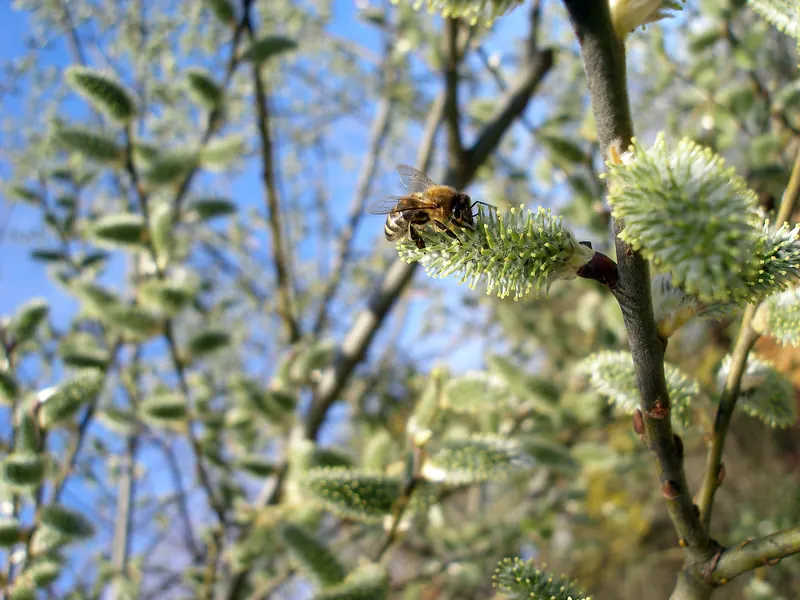
Goat willow is a dioecious tree or shrub of floodplain forests, clearings and gravel pits that flowers from March to May, before its leaves. Bee institutes rate it among the first important sources of pollen and nectar for honey bee colonies in spring. In Britain, some early mining bees are recorded foraging almost only on sallows, the willow group it belongs to.
What we know
Bees linked to this plant
How to recognise it
When it flowers
Info Flora gives the flowering period of goat willow in Switzerland as March to May.
Confirmed fact[1]
Where it grows
In Switzerland goat willow grows in floodplain forests, woodland clearings and gravel pits, up to the subalpine and sometimes alpine belt.
Confirmed fact[1]
What it offers bees
The Bavarian LWG rates goat willow 4 for nectar and 4 for pollen on its 1 to 4 scale, where 4 is the best value.
Statistical estimate[2]The LAVES bee institute in Celle calls goat willow the first important pollen and nectar source that honey bees use at the start of the bee season.
Reported by the farm[3]Once goat willow flowers, honey bees can bring in considerable pollen and nectar in good weather, according to LAVES.
Reported by the farm[3]LAVES notes that by the start of goat willow flowering, honey bee colonies have reared their first large batch of young bees.
Reported by the farm[3]BWARS, which covers Britain, reports that females of the mining bee Andrena praecox have only been seen visiting sallow catkins (Salix species in general, not goat willow alone).
Observation[5]BWARS, which covers Britain, states that the mining bee Andrena clarkella forages almost exclusively from sallow blossom (Salix species in general) in early spring.
Observation[6]
In the garden
The Baden-Württemberg bee forage catalogue suggests choosing several willow species that flower in succession from the last snow into fruit tree blossom.
Reported by the farm[4]
Sources
- Info Flora. Salix caprea L.. Online species page, Das nationale Daten- und Informationszentrum der Schweizer Flora (text from Flora Helvetica 2018). Link
- Bayerische Landesanstalt für Weinbau und Gartenbau (LWG), Institut für Erwerbs- und Freizeitgartenbau. Bienenbäume. 1. Auflage, Veitshöchheim, April 2019. Link
- Boecking O, Odemer F. Infobrief vom 04.03.2024: Mit dem Beginn der Blüte der Salweide wird die aktive Bienensaison 2024 eingeläutet. LAVES Institut für Bienenkunde Celle. Link
- Ministerium für Ländlichen Raum und Verbraucherschutz Baden-Württemberg. Bienenweidekatalog: Verbesserung der Bienenweide und des Artenreichtums. 6. aktualisierter Nachdruck, Stuttgart, Oktober 2019. Link
- Bees, Wasps and Ants Recording Society (BWARS). Andrena praecox species account. Link
- Bees, Wasps and Ants Recording Society (BWARS). Andrena clarkella species account. Link
Last checked: 20 October 2026. Every statement on this page was compared with the source it cites.