Bee plant, Central Europe
Salvia pratensis
Meadow clary, Meadow sage
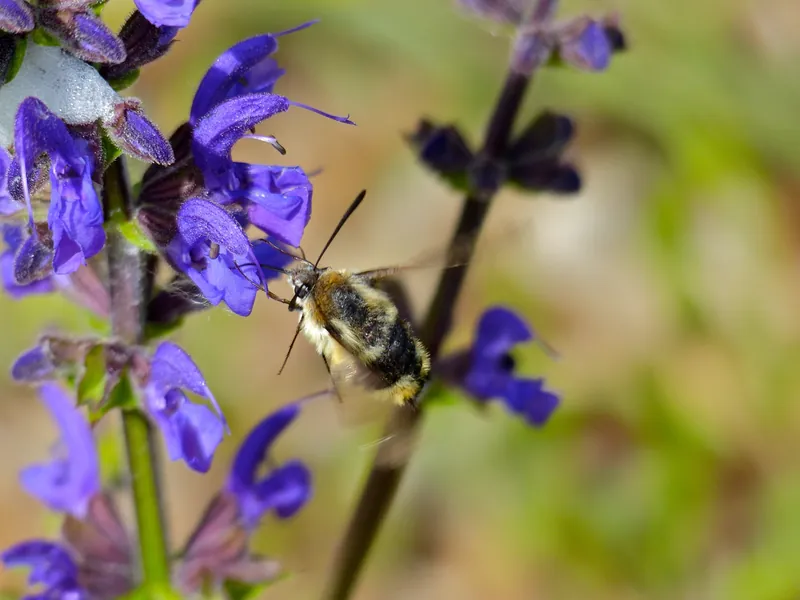
Meadow clary is a native perennial of dry meadows and sunny banks, flowering violet blue from May to August. Its two stamens form a lever: a bee probing for the plentiful nectar tips the anthers onto its back. Near Wuerzburg its flowers produced about 2120 micrograms of sugar a day and were visited by Bombus terrestris; it also feeds honeybees.
What we know
Bees linked to this plant
- Bombus terrestris
workers observed visiting the flowers near Wuerzburg, Germany
Confirmed fact[5]
How to recognise it
The plant is 30 to 60 cm tall, often branched and more or less hairy, with long stalked, heart shaped, wrinkled basal leaves.
Confirmed fact[1]The corolla is 2 to 2.5 cm long, violet blue, rarely reddish, with a high helmet shaped upper lip and a three lobed lower lip.
Confirmed fact[1]Like all Salvia species it has only two stamens.
Confirmed fact[1]
When it flowers
Where it grows
In Switzerland it grows in dry meadows and on sunny banks from the colline to the montane and sometimes subalpine belt.
Confirmed fact[1]
What it offers bees
A study in Annals of Botany describes the staminal lever of Salvia pratensis as a pollen dispensing device.
Confirmed fact[3]The lower lever arm has a small hole through which a bee pushes its proboscis into the corolla tube, so flower shape confines the posture of nectar probing bees.
Confirmed fact[3]When an insect pushes into the tube, the anthers swing down like a barrier and deposit a portion of pollen on its back, as Potsdam Botanic Garden explains.
Confirmed fact[4]Potsdam Botanic Garden describes the nectar as plentiful but reachable only by pushing the proboscis into the flower tube.
Confirmed fact[4]The same university page calls meadow clary a food plant for honeybees and colony forming bumblebees.
Confirmed fact[4]Near Wuerzburg, Germany, meadow clary flowers produced on average 2120 micrograms of sugar in 24 hours and were visited by Bombus terrestris workers.
Confirmed fact[5]
Sources
- Info Flora (2018+). Salvia pratensis L.. Online flora of Switzerland (descriptions from Flora Helvetica 2018). Info Flora, Geneva/Bern. Link
- Pladias: Database of the Czech Flora and Vegetation. Taxon data for Salvia pratensis. Masaryk University Brno et al. Link
- Reith, M., Baumann, G., Classen-Bockhoff, R., Speck, T. (2007). New insights into the functional morphology of the lever mechanism of Salvia pratensis (Lamiaceae). Annals of Botany 100(2): 393-400. doi:10.1093/aob/mcm031 Link
- Botanischer Garten der Universitaet Potsdam. Pflanze des Monats (Archiv): Salvia pratensis, Wiesen-Salbei. Link
- Raine, N. E., Chittka, L. (2007). Nectar production rates of 75 bumblebee-visited flower species in a German flora (Hymenoptera: Apidae: Bombus terrestris). Entomologia Generalis 30(2): 191-192. Link
Last checked: 30 October 2026. Every statement on this page was compared with the source it cites.