Bee plant, Central Europe
Lysimachia vulgaris
Yellow loosestrife
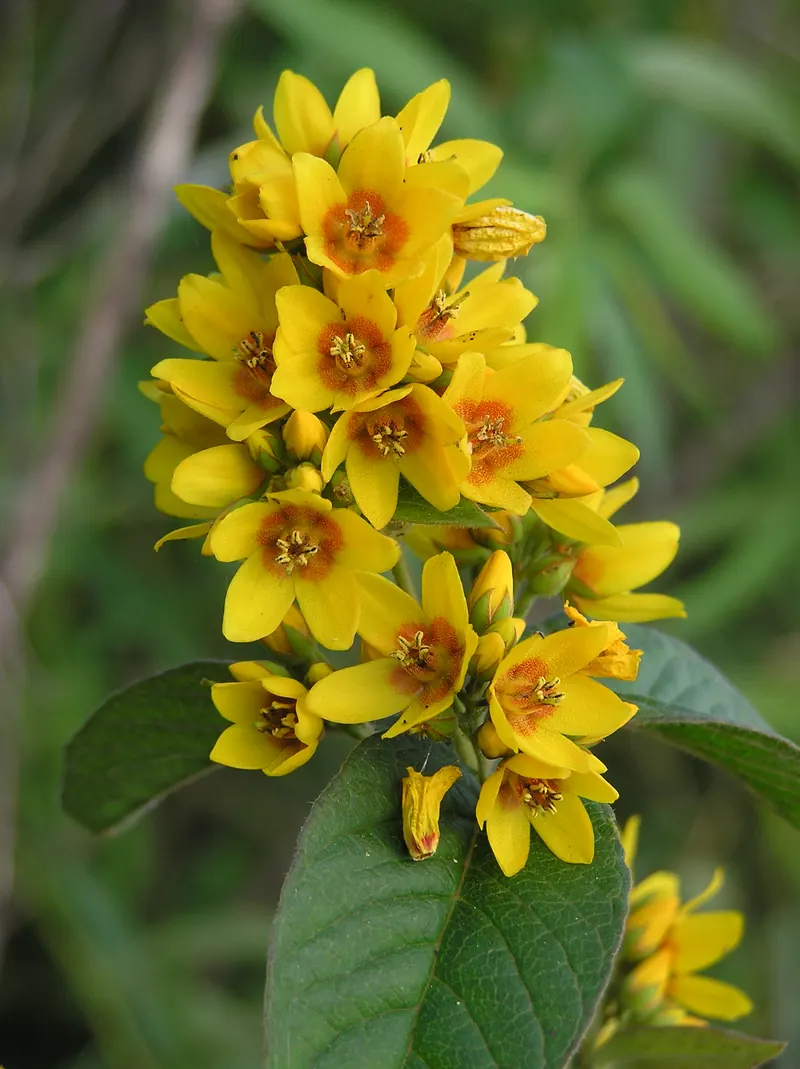
Yellow loosestrife is a tall yellow-flowered perennial of wet meadows and floodplain woods, flowering from June to August in Switzerland. It is one of the oil-producing Lysimachia species; across the genus these are pollinated almost only by Macropis bees, which collect the floral oil and pollen for their larvae.
What we know
Bees linked to this plant
- Macropis europaea
in Britain, yellow loosestrife is its main forage plant; females provision nests with floral oils in addition to pollen
Confirmed fact[3]
How to recognise it
Plants are 40 to 130 cm tall, often branched and short-haired.
Confirmed fact[1]Leaves are opposite or in whorls of 3 to 4, egg- to lance-shaped, 2 to 5 times as long as wide.
Confirmed fact[1]The yellow corolla is divided almost to the base, with lobes 7 to 12 mm long that bear glandular hairs inside.
Confirmed fact[1]
When it flowers
Info Flora gives June to August as the flowering period in Switzerland.
Confirmed fact[1]
Where it grows
In Switzerland it grows in floodplain forests and wet meadows, from the colline to the montane belt.
Confirmed fact[1]
What it offers bees
Species of Lysimachia are the only oil flowers in the Holarctic region.
Confirmed fact[2]A Bayreuth study of oil-collecting bees treats Lysimachia vulgaris as one of the oil-producing Lysimachia species.
Confirmed fact[2]Across the genus, the oil-producing Lysimachia species, which include yellow loosestrife, are pollinated almost exclusively by oil-collecting bees of the genus Macropis.
Confirmed fact[2]All 16 Macropis species collect oil and pollen only from oil-producing Lysimachia species.
Confirmed fact[2]Oil-collecting bees in general use the floral oil as food for their larvae, and some species also line their nest cells with it.
Confirmed fact[2]Adult Macropis bees visit a variety of other plants to get nectar for themselves.
Confirmed fact[2]In Britain, Macropis europaea lives at wetland sites with yellow loosestrife, its main forage plant.
Reported by the farm[3]
Sources
- Info Flora, das nationale Daten- und Informationszentrum der Schweizer Flora. Species page: Lysimachia vulgaris L.. Description text from Flora Helvetica (2018); habitat types from Delarze et al. (2015). Accessed 19 Oct 2026. Link
- Schäffler, I. (2012). Bionomy and host plant finding in oil collecting bees. Doctoral thesis, Universität Bayreuth. urn:nbn:de:bvb:703-epub-1670-7 Link
- Else, G. R. Macropis europaea Warncke, 1973. Species account, Bees, Wasps and Ants Recording Society (BWARS). Link
Last checked: 20 October 2026. Every statement on this page was compared with the source it cites.