Bee plant, Central Europe
Aesculus hippocastanum
Horse chestnut, Rosskastanie
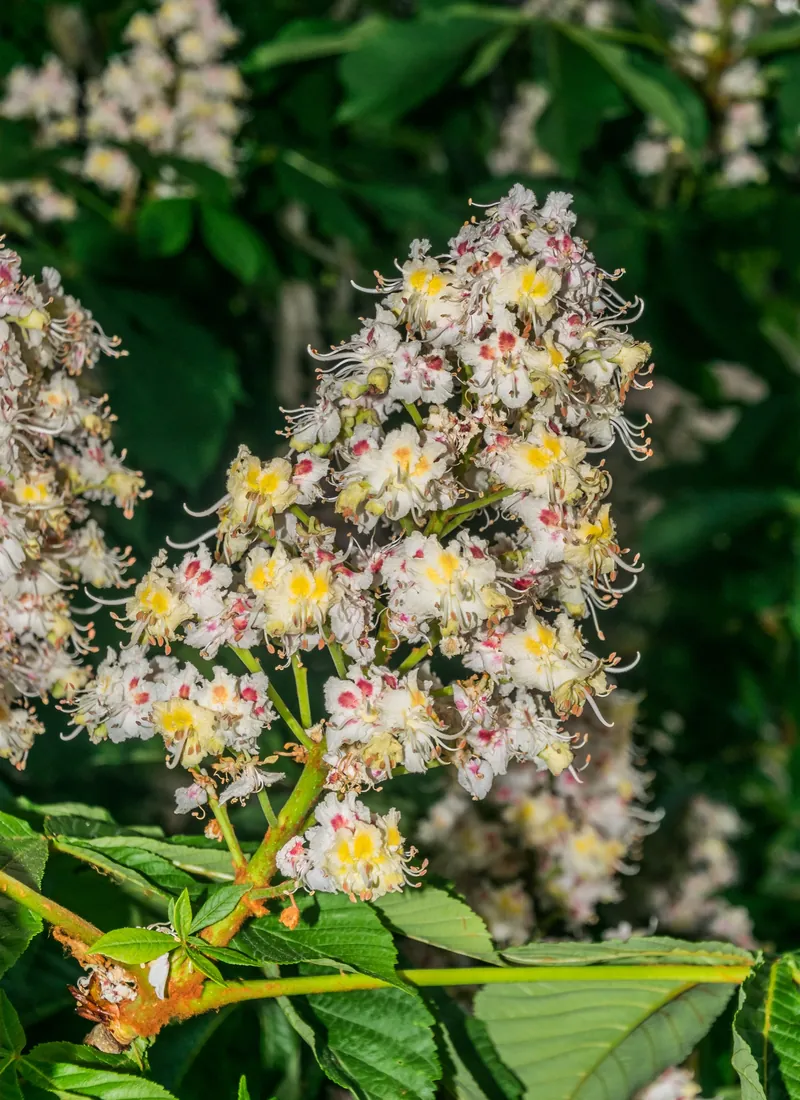
Horse chestnut is a Balkan tree cultivated in Central Europe since the late 16th century and flowers in April and May. Honey bees and bumblebees pollinate it; a flower secretes about 2.6 mg of nectar and its yellow guide spot turns red once pollinated. The Bavarian LWG rates it 3 of 4 for nectar and pollen.
What we know
When it flowers
Where it grows
The species is native to the mountains of the Balkans in south east Europe; the Bavarian LWF describes this natural range as small and strongly disjunct, a relict of its former distribution.
Confirmed fact[4]
What it offers bees
The pollinators are honey bees and bumblebees; solitary bees such as Osmia and Andrena and hoverflies also visit the flowers.
Confirmed fact[4]Yellow guide spots on the petals attract pollinators; after pollination the spots turn red, which insects find unattractive.
Confirmed fact[4]In Poland a flower secretes on average 2.64 mg of nectar, with a comparatively low sugar content of about 25 to 32 percent, of which about 90 percent is sucrose.
Confirmed fact[4]An inflorescence produces a total of about 1 mg of pollen, at a rate of 0.5 mg per day.
Confirmed fact[4]The Bavarian LWG rates horse chestnut 3 of 4 for nectar and 3 of 4 for pollen, calling it a good April and May pollen source with highly concentrated nectar.
Confirmed fact[5]LWG notes that the buds supply bees with much propolis resin and that horse chestnuts are bumblebee pastures.
Confirmed fact[5]
Caution: invasive
LWF finds no concrete evidence that horse chestnut is an invasive problem neophyte, although seedlings establish near plantings.
Confirmed fact[3]
People
Horse chestnut is a neophyte in Central Europe: Clusius received the first seeds from Constantinople in Vienna in 1576, and the tree has been cultivated here since the end of the 16th century.
Confirmed fact[3]The horse chestnut leaf miner Cameraria ohridella is one of the main pests and diseases affecting the tree in Europe; seeds of infested trees are 40 to 50 percent smaller.
Confirmed fact[4]The EU forest atlas reports the species as near threatened at the European scale and vulnerable in Greece and Bulgaria; unprocessed seeds are poisonous.
Confirmed fact[6]
Sources
- Pladias: Database of the Czech Flora and Vegetation. Aesculus hippocastanum (jírovec maďal), taxon data page. Link
- Kudernatsch T (2012) Vielfalt für die Honigbiene. LWF aktuell 91, Bayerische Landesanstalt für Wald und Forstwirtschaft (hosted by LfL Bayern). Table 1. Link
- Aas G, Lauerer M. Die Gemeine Rosskastanie (Aesculus hippocastanum) als Neubürger in unserer Flora. LWF Wissen 48, Bayerische Landesanstalt für Wald und Forstwirtschaft (hosted by LfL Bayern), pp. 17-18. Link
- Thomas PA, Alhamd O, Iszkuło G, Dering M, Mukassabi TA (2019) Biological Flora of the British Isles: Aesculus hippocastanum. Journal of Ecology 107(2): 992-1030. doi:10.1111/1365-2745.13116 Link
- Bayerische Landesanstalt für Weinbau und Gartenbau (LWG), Institut für Erwerbs- und Freizeitgartenbau (2019) Bienenbäume, 1. Auflage. Table 3 Frühtracht. Link
- Ravazzi C, Caudullo G (2016) Aesculus hippocastanum in Europe: distribution, habitat, usage and threats. In: San-Miguel-Ayanz J et al. (eds) European Atlas of Forest Tree Species. Publications Office of the EU, Luxembourg, e017fc3+. Link
Last checked: 30 October 2026. Every statement on this page was compared with the source it cites.