Bee plant, Central Europe
Origanum vulgare
Wild marjoram, Oregano
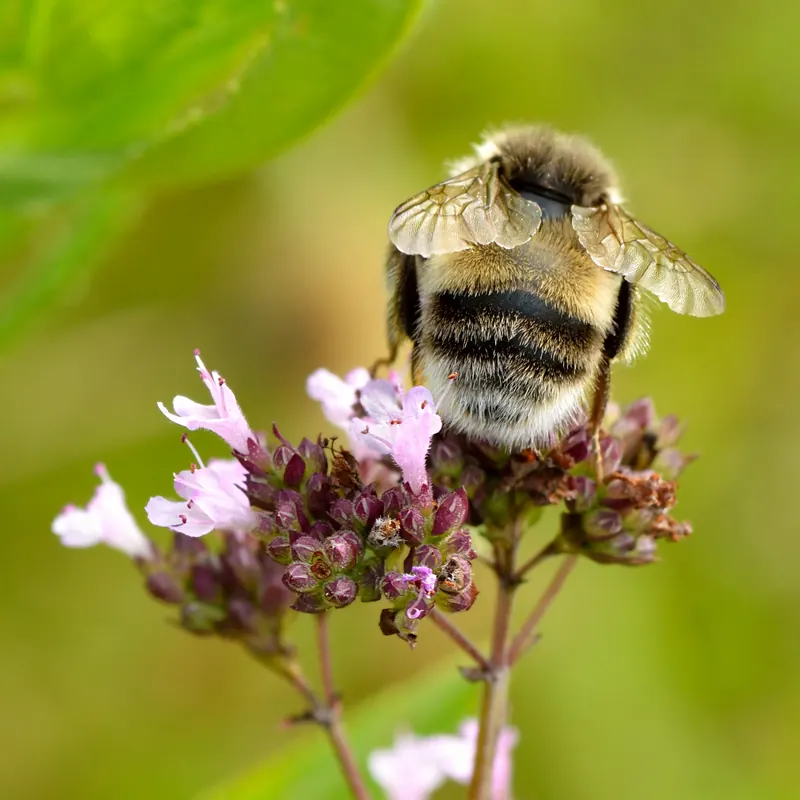
Wild marjoram is an aromatic perennial of dry grassland, scrub and woodland edges, flowering from July to September in Switzerland. Honeybees, bumblebees and hoverflies are its main pollinators, and it is an important nectar and caterpillar food plant for demanding, endangered butterflies.
What we know
How to recognise it
Plants are 20 to 60 cm tall, branched at the top and aromatic.
Confirmed fact[1]Leaves are egg-shaped, 1 to 4 cm long and short-stalked, with smooth or toothed edges.
Confirmed fact[1]Small pale pink flowers, 4 to 7 mm long, sit in the axils of purple bracts and are crowded into heads at the shoot tips.
Confirmed fact[1]
When it flowers
Where it grows
What it offers bees
Pladias names honeybee, bumblebees and hoverflies as the main pollinator groups.
Reported by the farm[2]In a collection of bee plants at Pulawy, Poland, honeybees made up almost all insects seen visiting wild marjoram.
Observation[3]A BOKU Vienna plant profile notes that the lipped flowers are visited by numerous insect species during summer.
Observation[5]
In the garden
The BOKU profile recommends it mainly for natural gardens, because it spreads readily.
Reported by the farm[5]
People
It is an important nectar and caterpillar food plant for many demanding and endangered butterflies, including two blue butterflies.
Reported by the farm[4]
Sources
- Info Flora, das nationale Daten- und Informationszentrum der Schweizer Flora. Species page: Origanum vulgare L.. Description text from Flora Helvetica (2018); habitat types from Delarze et al. (2015). Accessed 19 Oct 2026. Link
- Pladias, Database of the Czech Flora and Vegetation. Taxon data: Origanum vulgare. Accessed 19 Oct 2026. Link
- Bożek, M. (2000). Flower-pollinating insects of 32 species from Lamiaceae family. Pszczelnicze Zeszyty Naukowe 44(2): 293-303. Link
- Ministerium für Umwelt, Landwirtschaft, Ernährung, Weinbau und Forsten Rheinland-Pfalz (2012). Steckbrief Pflanzen: Wilder Majoran oder Gewöhnlicher Dost (Origanum vulgare). Partnerbetrieb Naturschutz Rheinland-Pfalz. Link
- Universität für Bodenkultur Wien (BOKU), Institut für Landschaftsbau, Pflanzenverwendung (S. Plenk). Stauden Garten Grundsortiment: Origanum vulgare. Plant profile. Link
Last checked: 20 October 2026. Every statement on this page was compared with the source it cites.