Bee plant, Central Europe
Helianthus annuus
Sunflower, Sonnenblume
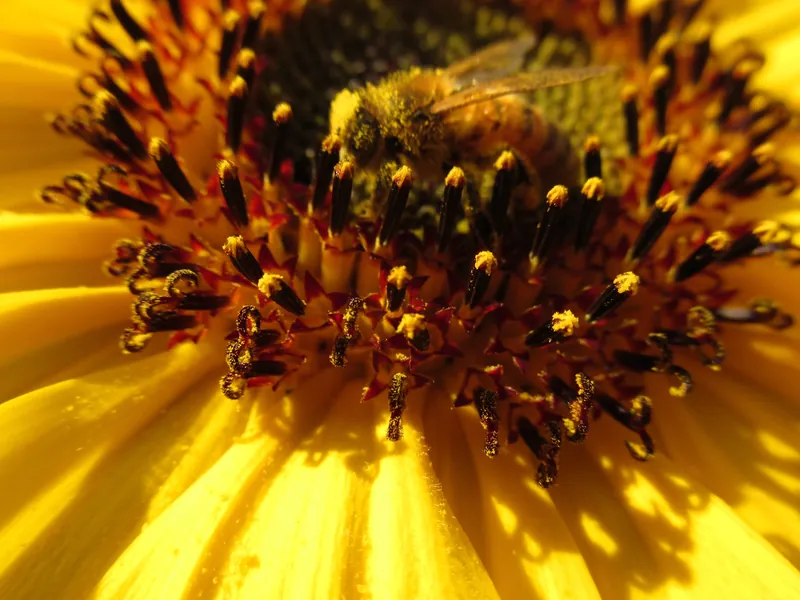
The sunflower is a North American plant grown as an oil crop and garden plant; in Switzerland it is a cultivated neophyte flowering from July to September. It gives bees nectar and pollen, but its pollen is low in protein. Sunflower honey is bright yellow and crystallises quickly.
What we know
How to recognise it
The plant is 0.5 to 2.5 m tall, little branched and rough-haired, with nodding flower heads 10 to 40 cm across borne singly or in small numbers.
Confirmed fact[1]
When it flowers
Where it grows
What it offers bees
In a French trial of 34 oilseed hybrid cultivars, mean nectar sugar secreted per floret ranged from 101 to 216 micrograms, varying by up to 100 percent among cultivars.
Confirmed fact[3]The same French paper reports that an average of 0.2 bees per head is sufficient to maximise sunflower seed yield and oil content.
Reported by the farm[3]An analysis by researchers at the University of Pretoria, South Africa, found the protein content of sunflower pollen relatively low compared with other important bee forage plants.
Confirmed fact[4]The authors conclude that although sunflower offers abundant and accessible pollen, its quality may hinder bee development when it is the exclusive pollen source.
Confirmed fact[4]In a North American study, a sunflower pollen diet dramatically and consistently reduced Crithidia bombi infection in the bumble bee Bombus impatiens.
Confirmed fact[5]
Honey
Unifloral sunflower honey is bright yellow of medium colour intensity and crystallises quickly and often hard because of its high glucose content.
Confirmed fact[6]
In the garden
The Bavarian 'Bienenweide Bayern' seed mix for flower areas includes sunflower at 8.5 percent and specifies an open-flowered, pollen-bearing variety.
Confirmed fact[7]
Sources
- Info Flora. Helianthus annuus L.. Online species page, Das nationale Daten- und Informationszentrum der Schweizer Flora (text from Flora Helvetica). Link
- Pladias: Database of the Czech Flora and Vegetation. Helianthus annuus, taxon data page. Link
- Chabert S, Sénéchal C, Fougeroux A, et al., Vaissière BE. (2020) Effect of environmental conditions and genotype on nectar secretion in sunflower (Helianthus annuus L.). OCL 27: 51. doi:10.1051/ocl/2020040 Link
- Nicolson SW, Human H. (2013) Chemical composition of the 'low quality' pollen of sunflower (Helianthus annuus, Asteraceae). Apidologie 44(2): 144-152. doi:10.1007/s13592-012-0166-5. Abstract read on the University of Pretoria repository. Link
- Giacomini JJ, Leslie J, Tarpy DR, Palmer-Young EC, Irwin RE, Adler LS. (2018) Medicinal value of sunflower pollen against bee pathogens. Scientific Reports 8: 14394. doi:10.1038/s41598-018-32681-y Link
- Persano Oddo L, Piro R. (2004) Main European unifloral honeys: descriptive sheets. Apidologie 35 (Suppl. 1): S38-S81. Sunflower sheet pp. S62-S63. Link
- Bayerische Landesanstalt für Landwirtschaft (LfL), Institut für Ökologischen Landbau, Bodenkultur und Ressourcenschutz. (2020) B48/B61 Blühflächen an Waldrändern und in der Feldflur: Mischung 'Bienenweide Bayern', species list dated 02.12.2020. Link
Last checked: 30 October 2026. Every statement on this page was compared with the source it cites.