The beekeeping year in Central Europe
How a honey bee colony and its apiary move through the seasons in Germany and neighbouring countries, and why weather keeps shifting the dates.
Applies to: Apis mellifera (western honey bee) kept in hives; the two-population pattern of summer and winter bees is described for honey bees in temperate climates. Region: Central Europe: the months and tasks below come from state bee institutes in Bavaria (LWG Veitshöchheim), Lower Saxony (LAVES Celle) and Hesse (Bieneninstitut Kirchhain), plus Swiss (Agroscope) and Czech (Brno) research. They shift with altitude, latitude and each year's weather.
Weather sets the calendar
The Bavarian state bee centre stresses that weather and the forage on offer have a great influence on how colonies develop.Confirmed fact, source 1 In temperate climates a honey bee colony consists of two different populations across the year: short-lived summer bees and long-lived winter bees.Confirmed fact, source 2 Swiss researchers at Agroscope report that summer honey bees live 3 to 6 weeks, while winter bees can live 3 to 6 months.Confirmed fact, source 3 LWG Bayern treats August, not January, as the start of the beekeeping year.Confirmed fact, source 1
Winter: December to February
LWG Bayern notes that in winter honey bees reduce their activity to what is strictly necessary and sit tightly packed in a winter cluster to save energy.Confirmed fact, source 1 In Bavaria a wintering colony holds roughly 8,000 to 12,000 bees.Statistical estimate, source est. 1 In a study near Brno, Czech Republic, honey bees from October to March were counted as the long-lived winter population.Observation, source obs. 2 Brood rearing can restart in midwinter: in a newsletter of 7 February 2020, after a mild January, the Kirchhain bee institute (Hesse) told beekeepers that their colonies were already rearing brood.Observation, source obs. 4 The same 2020 Kirchhain newsletter warned that the growing brood nest was consuming noticeably more of the stored food.Confirmed fact, source 4
Early spring: March and April
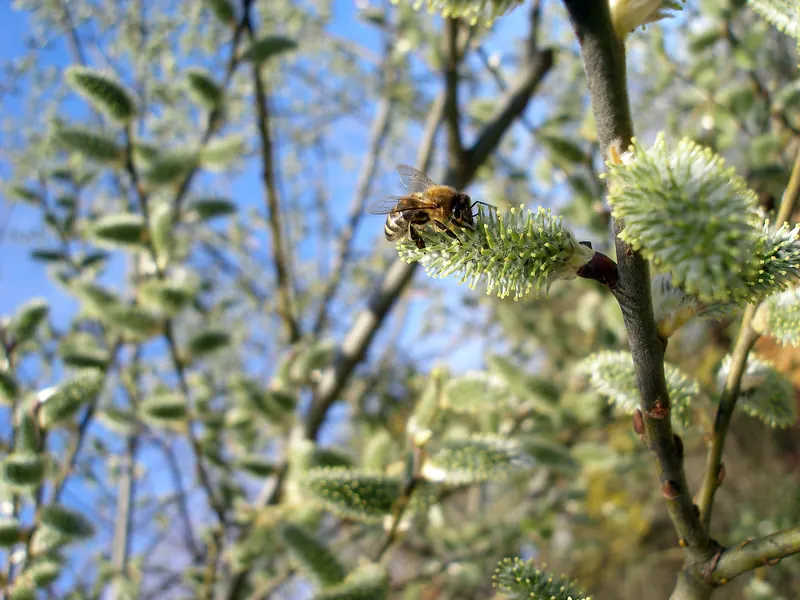
In Bavaria, beekeepers make their first checks only after the bees' first cleansing flight of the year.Confirmed fact, source 5 LWG Bayern advises that it should be warmer than 12 °C when a hive is opened for those first checks.Confirmed fact, source 5 Food is the key spring check: in Bavaria a colony should still hold at least 8 kg of winter stores in early March.Confirmed fact, source 5 In March 2022, LAVES Celle (Lower Saxony) expected the flowering of goat willow in the Celle area, forecast for mid-March, to mark the start of that year's active bee season.Observation, source obs. 6 LAVES Celle notes that once goat willow flowers, honey bees can bring in substantial pollen and nectar, but only in good weather.Confirmed fact, source 6
Late spring: build-up and swarming
LWG Bayern notes that colony strength grows steeply in spring.Confirmed fact, source 1 Swarming, the colony's natural way of multiplying, usually peaks in May in Bavaria.Confirmed fact, source 1 In mid-April 2024, LAVES Celle reported that in northern Germany the first swarms had already left here and there.Observation, source obs. 7 LAVES Celle advises checking colonies for swarm preparations every seven days during the swarming season.Confirmed fact, source 7 In April 2024, LAVES Celle hoped that a late cold snap would not set back the explosive spring growth of plants, adding that bee colonies themselves are fairly little affected by it.Confirmed fact, source 7
Summer: peak strength and honey flows
In summer a colony in Bavaria can reach up to 50,000 bees, its maximum strength.Statistical estimate, source est. 1 In Bavaria the summer honey flow from raspberry, clover and lime trees comes around mid-July.Confirmed fact, source 1 Honeydew from spruce, sometimes silver fir and broadleaf trees can be collected from mid-June to early August in Bavaria.Confirmed fact, source 1 As forage ends in July, one of the most important periods of the honey bee year begins, according to LWG Bayern.Confirmed fact, source 8
Late summer and autumn: raising the winter bees
In Bavaria, newly emerged winter bees eat a lot of pollen in late summer.Confirmed fact, source 8 Honey bee winter bees have an enlarged fat body, the tissue that stores nutrients and energy.Confirmed fact, source 2 In Bavaria, winter bees must survive the cold months until March and April.Confirmed fact, source 8 LWG Bayern warns that once forage ends, open combs must not be left lying around the apiary, because they risk triggering robbing between colonies.Confirmed fact, source 8 In Bavaria, feeding colonies their winter stores should be finished in September.Confirmed fact, source 1
Sources
- Fischer, J. Das Bienenjahr (slide presentation). Bayerische Landesanstalt für Weinbau und Gartenbau (LWG), Fachzentrum Bienen, Veitshöchheim (file dated 2022). Link
- Kunc, M., Dobeš, P., Hurychová, J., Vojtek, L., Beani Poiani, S., Danihlík, J., Havlík, J., Titěra, D. & Hyršl, P. (2019). The Year of the Honey Bee (Apis mellifera L.) with Respect to Its Physiology and Immunity: A Search for Biochemical Markers of Longevity. Insects 10(8): 244. doi:10.3390/insects10080244 Link
- Agroscope, Swiss Bee Research Centre (Zentrum für Bienenforschung). Longevity (web page). Link
- Dreher, C. (LLH Bieneninstitut Kirchhain). Bienen im Winter. Infobrief Bienen@Imkerei 2020_02, 7 February 2020, joint newsletter of the German state bee institutes (DLR Mayen, LWK NRW, LWG, LLH Kirchhain, Hohenheim, Hohen Neuendorf). Link
- Bayerische Landesanstalt für Weinbau und Gartenbau (LWG), Fachzentrum Bienen, Veitshöchheim. Frühjahrsarbeiten (information sheet, undated). Link
- LAVES Institut für Bienenkunde Celle. Beginn der Salweidenblüte läutet Bienensaison ein. Infobrief, 4 March 2022. Link
- Boecking, O. & Odemer, F. (LAVES Institut für Bienenkunde Celle). Bienenvölker durch die Schwarmzeit führen. Infobrief, 18 April 2024. Link
- Bayerische Landesanstalt für Weinbau und Gartenbau (LWG), Fachzentrum Bienen, Veitshöchheim. Spätsommerpflege (information sheet, undated). Link
Last checked: 20 October 2026. Every statement in this article was compared with the source it cites. Spotted an error? Report it.