Unifloral honey
Thyme honey
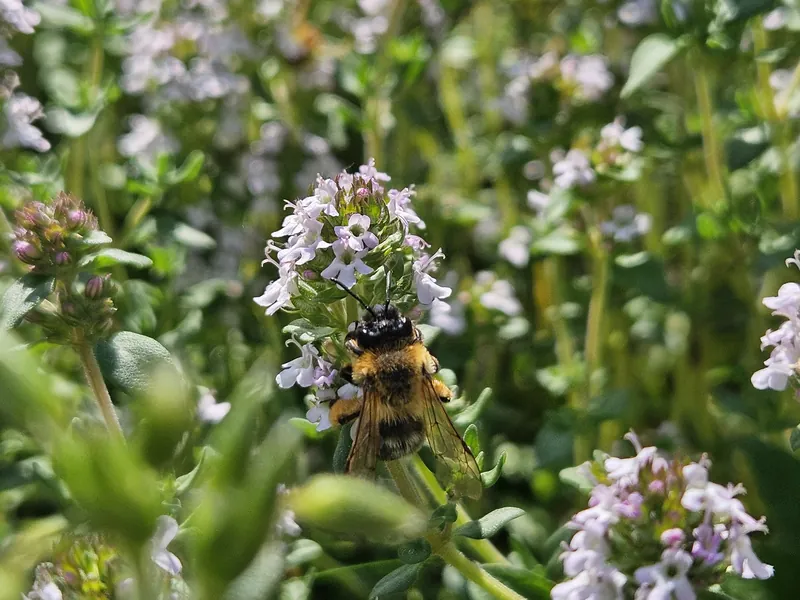
Thyme honey comes from several Thymus species found around the Mediterranean: mainly Thymus capitatus in Italy, a variety of Thymus species and other mint-family plants in Greece, and Thymus vulgaris in Spain and France. It is medium to dark in colour, averages 53.1 mm Pfund, crystallises at a moderate rate, and shows high proline, fructose and acidity.
What we know
Origin and plant
Different species of thyme grow in the Mediterranean countries.
Confirmed fact[1]In Italy unifloral thyme honey comes mainly from Thymus capitatus, in Greece from a variety of Thymus species and other plants of the mint family (Labiatae), and in Spain and France mainly from Thymus vulgaris.
Confirmed fact[1]A Greek study describes Hymettus honey, the best known Greek thyme honey, as produced mainly from Thymus capitatus, Thymus serpyllum and Satureja species.
Confirmed fact[2]
How to recognise it
Thyme pollen tends to be under-represented in Italian samples, with about 10,100 pollen grains per 10 g and 26.6 percent Thymus pollen, while Greek samples vary widely.
Confirmed fact[1]In a Greek study, 14 of 20 thyme honeys had Thymus as predominant pollen at 45 to 85.1 percent; samples with under 35 percent were rejected.
Confirmed fact[2]Colour is medium to dark with a normal honey tone, averaging 53.1 ± 10.8 mm Pfund.
Confirmed fact[1]In sensory analysis of Thymus capitatus honey, odour is of medium intensity and described as woody, chemical, fresh and floral.
Observation[1]Sensory panels rate sweetness medium, acidity medium, bitterness absent, aroma medium to strong, and the aftertaste of medium persistence.
Observation[1]
Composition
Unifloral thyme honey shows quite high diastase and high proline, fructose and acidity, which causes a quick rise in HMF; its specific rotation shows the lowest values among the European unifloral honeys surveyed.
Confirmed fact[1]Among Greek unifloral honeys, thyme honey was among those with the highest HMF values, together with sunflower, orange and cotton honeys.
Reported by the farm[2]
Crystallisation and storage
Thyme honey crystallises at a moderate rate.
Confirmed fact[1]
Standards and rules
Under the Codex standard a honey may be designated by its floral source only if it comes wholly or mainly from that source and has the matching properties.
Confirmed fact[3]
Honey Odyssey describes composition, origin and tradition. It does not give medical advice or health claims.
Continue
Sources
- Persano Oddo L., Piro R. (2004) Main European unifloral honeys: descriptive sheets. Apidologie 35 (Suppl. 1): S38-S81, Thyme sheet pp. S74-S75. doi:10.1051/apido:2004049 Link
- Thrasyvoulou A., Manikis J. (1995) Some physicochemical and microscopic characteristics of Greek unifloral honeys. Apidologie 26(6): 441-452 Link
- Codex Alimentarius Commission. Revised Codex Standard for Honey, CODEX STAN 12-1981, Rev.1 (1987), Rev.2 (2001). FAO/WHO Link
Last checked: 30 October 2026. Every statement on this page was compared with the source it cites.