Unifloral honey
Sunflower honey
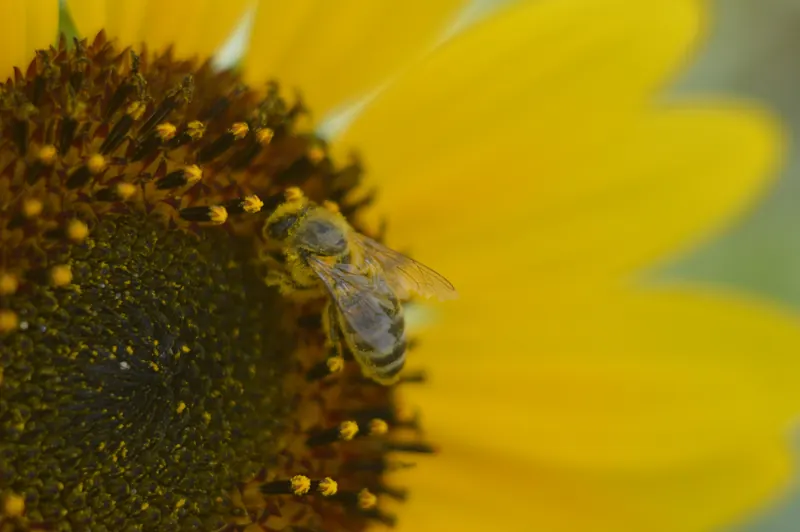
Sunflower is grown for oil seed in many European countries, above all in Eastern and Southern Europe, where it is an important source of nectar and pollen for bees. Its honey is bright yellow and crystallises quickly, often hard, because of its high glucose content. Its sunflower pollen share varies widely.
What we know
Origin and plant
How to recognise it
Sunflower pollen content in the honey varies greatly, from less than 20% to more than 90%.
Observation[1]In the European data, Helianthus pollen averaged 56.7% (SD 24.2, n = 229), with a reported range of 12.0 to 92.0% that the authors present as covering 95% of samples.
Observation[1]Sensory analysis describes its colour tone as bright yellow.
Observation[1]Colour averaged 52.4 mm Pfund (SD 9.0, n = 189), with a reported range of 35.0 to 70.1 mm Pfund that the authors present as covering 95% of samples.
Observation[1]Its odour and aroma are both described as floral and fresh fruit (fruity), warm and vegetal.
Observation[1]
Composition
Electrical conductivity averaged 0.34 mS/cm (SD 0.08, n = 272), with a reported range of 0.23 to 0.51 mS/cm that the authors present as covering 95% of samples.
Observation[1]Glucose averaged 37.4 g/100 g (SD 1.5, n = 177), with a reported range of 34.5 to 40.4 g/100 g that the authors present as covering 95% of samples.
Observation[1]Fructose averaged 39.2 g/100 g (SD 1.6, n = 178), with a reported range of 36.1 to 42.4 g/100 g that the authors present as covering 95% of samples.
Observation[1]The glucose to water ratio averaged 2.10 (SD 0.13, n = 153), with a reported range of 1.84 to 2.35 that the authors present as covering 95% of samples.
Observation[1]
Crystallisation and storage
The honey crystallises quickly and often hard, because of its high glucose content.
Confirmed fact[1]
Honey Odyssey describes composition, origin and tradition. It does not give medical advice or health claims.
Continue
Sources
- Persano Oddo L., Piro R. (2004) Main European unifloral honeys: descriptive sheets. Apidologie 35 (Suppl. 1), S38-S81. Link
Last checked: 20 October 2026. Every statement on this page was compared with the source it cites.