Unifloral honey
Buckwheat honey
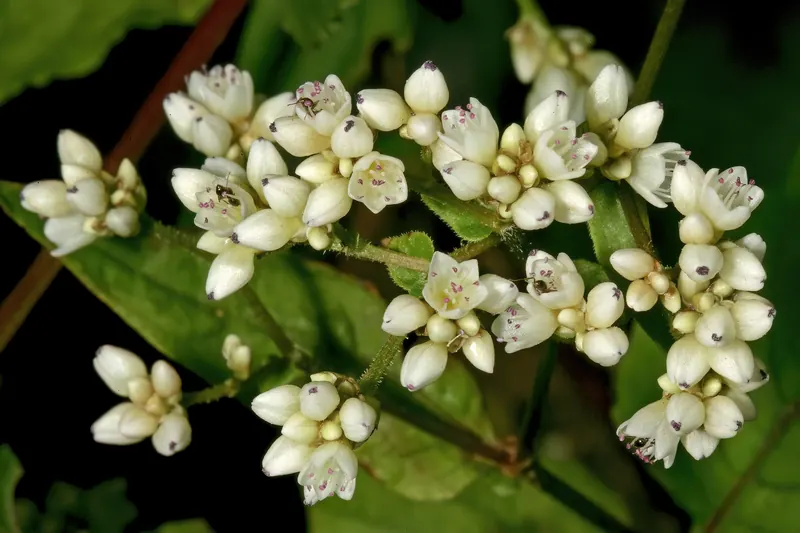
Buckwheat honey comes from an annual plant of the Polygonaceae family and is described as dark purple, almost black. Pollen analysis and physicochemical tests showed that some honeys labelled as buckwheat did not fit the type, and volatile compounds such as 3-methylbutanal and butanoic acid have been proposed as potential markers.
What we know
Origin and plant
How to recognise it
The same study describes buckwheat honey as dark purple in colour, almost black.
Reported by the farm[1]In that study, dominant pollen meant more than 45% of the pollen grains counted, and samples with 45.5% to 52% buckwheat pollen were classified as monofloral.
Confirmed fact[1]Three samples labelled as buckwheat honey had very little buckwheat pollen and had to be classified as multifloral.
Observation[1]The authors suggest these volatile compounds could serve as potential variety markers for botanical determination.
Statistical estimate[1]Electrical conductivity, optical rotation, pH and sugar composition showed that some of the honeys declared as buckwheat by beekeepers were not pure enough to fit the buckwheat type.
Observation[2]In one study, dark buckwheat honey had a lightness value (L*) of 30.84 and a high free acidity of 44.5 mval/kg.
Observation[3]
Composition
Among the volatile compounds identified, 3-methylbutanal, butanoic acid, pentanoic acid and isovaleric acid were considerably greater in the buckwheat honey samples from the Alps.
Observation[1]Apart from many furfural derivatives, 3-methylbutanoic acid was the main volatile compound in most of the honeys studied.
Observation[2]The phenolic profile was similar across samples, with p-hydroxybenzoic and p-coumaric acids as the main components.
Observation[2]
Production
Panseri and colleagues note that buckwheat cultivation in Italy has strongly declined and today survives only in a few alpine valleys.
Reported by the farm[1]
Honey Odyssey describes composition, origin and tradition. It does not give medical advice or health claims.
Continue
Sources
- Panseri S., Manzo A., Chiesa L.M., Giorgi A. (2013) Melissopalynological and volatile compounds analysis of buckwheat honey from different geographical origins and their role in botanical determination. Journal of Chemistry 2013, Article ID 904202. Link
- Pasini F., Gardini S., Marcazzan G.L., Caboni M.F. (2013) Buckwheat honeys: screening of composition and properties. Food Chemistry 141(3), 2802-2811. doi:10.1016/j.foodchem.2013.05.102 Link
- Kędzierska-Matysek M., Teter A., Stryjecka M., Skałecki P., Domaradzki P., Rudaś M., Florek M. (2021) Relationships linking the colour and elemental concentrations of blossom honeys with their antioxidant activity: a chemometric approach. Agriculture 11(8), 702. doi:10.3390/agriculture11080702 Link
Last checked: 20 October 2026. Every statement on this page was compared with the source it cites.