Unifloral honey
Alfalfa honey
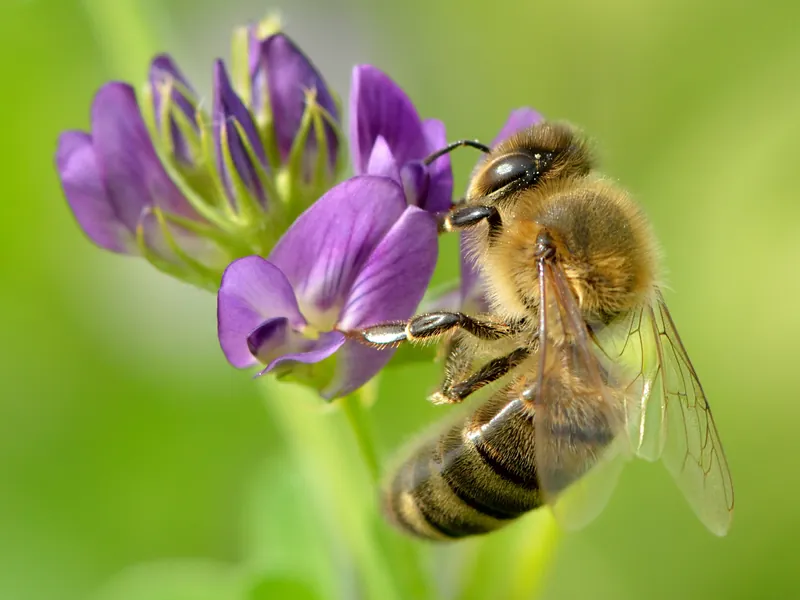
Alfalfa honey comes from a forage legume whose flowers must be tripped to release pollen; nectar-collecting honey bees trip few blossoms. A 1920 survey called alfalfa the most important honey plant west of the Missouri and described the Colorado and Idaho honey as very light and readily granulating. EU and Codex rules allow it up to 10 g/100 g sucrose.
What we know
Origin and plant
Michigan State University lists alfalfa, also called lucerne, as Medicago sativa in the family Fabaceae.
Confirmed fact[1]In his 1920 survey of American honey plants, Pellett called alfalfa the most important honey plant west of the Missouri river and of little value to beekeepers east of it.
Reported by the farm[3]
How to recognise it
Pellett described alfalfa honey from Colorado and Idaho as very light in colour with a spicy, mild flavour, and honey from the Imperial Valley of California as much darker.
Reported by the farm[3]Medicago pollen is under-represented in honey: harmonised melissopalynology gives a relative frequency of only 1 to 10 percent in unifloral alfalfa honeys.
Confirmed fact[6]
Crystallisation and storage
Alfalfa honey was reported to granulate readily while being generally regarded as a high quality honey.
Reported by the farm[3]
Production
Pellett reported that alfalfa seldom yields nectar to any extent in humid climates, and that with enough moisture at the roots the hotter and drier the air, the better the yield.
Reported by the farm[3]Where alfalfa is cut for hay it loses much of its value to bees, while fields grown for seed give a much longer blooming period.
Reported by the farm[3]
Standards and rules
EU Directive 2001/110/EC (Annex II, unchanged by the 2014 and 2024 amendments) sets a general sucrose limit of 5 g/100 g but allows up to 10 g/100 g for alfalfa (Medicago sativa) honey, alongside false acacia, Menzies banksia, French honeysuckle, red gum, leatherwood and citrus honeys.
Confirmed fact[4]The Codex honey standard likewise lists alfalfa among the honeys whose sucrose content may reach 10 g/100 g instead of the general 5 g/100 g.
Confirmed fact[5]
People and tradition
A 1946 study found that nectar-collecting honey bees usually trip few alfalfa blossoms, and that tripping in the fields was proportional to the number of pollen-collecting visitors.
Confirmed fact[2]The same study reported that the alfalfa flower is adapted to insect pollination and that practically no tripping occurred on plants from which bees were excluded.
Confirmed fact[2]
Honey Odyssey describes composition, origin and tradition. It does not give medical advice or health claims.
Continue
Sources
- Huang Z. (2020) Summer flower 12: Alfalfa. Bee the Best! (bees.msu.edu), Michigan State University Link
- Vansell G.H., Todd F.E. (1946) Alfalfa tripping by insects. Journal of the American Society of Agronomy 38(6), 470-488 (abstract on FAO AGRIS record) Link
- Pellett F.C. (1920) American Honey Plants, together with those which are of special value to the beekeeper as sources of pollen. American Bee Journal, Hamilton, Illinois (Project Gutenberg edition) Link
- Council Directive 2001/110/EC of 20 December 2001 relating to honey. Official Journal L 10, 12.1.2002, p. 47-52, Annex II Link
- Codex Alimentarius. Standard for Honey, CODEX STAN 12-1981 (rev. 1987, 2001), section 3.5.2 Link
- von der Ohe W., Persano Oddo L., Piana M.L., Morlot M., Martin P. (2004) Harmonized methods of melissopalynology. Apidologie 35 (Suppl. 1), S18-S25. doi:10.1051/apido:2004050 Link
Last checked: 30 October 2026. Every statement on this page was compared with the source it cites.