Unifloral honey
Strawberry tree honey
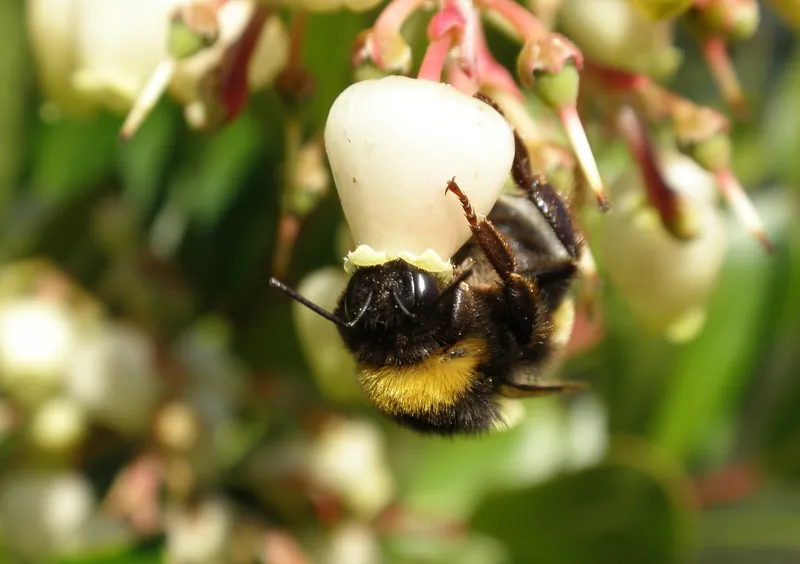
Strawberry tree honey comes from the autumn flowering of an evergreen Mediterranean shrub and is produced above all in Sardinia. Published descriptions (Floris, Satta and Ruiu 2007, as reported in Floris et al. 2021) call it decidedly bitter, amber in colour, with a rapid, often irregular crystallisation; European data give a mean colour of 70.1 mm Pfund. Homogentisic acid, found in the nectar, serves as its chemical marker.
What we know
Origin and plant
The strawberry tree is an evergreen species, usually a shrub, that grows wild mainly around the Mediterranean basin.
Confirmed fact[1]Kew's Plants of the World Online accepts Arbutus unedo L. in the family Ericaceae and describes it as a shrub or tree native to the Mediterranean.
Confirmed fact[2]Sardinia is probably the region with the most significant production in the world; the honey is also produced in Corsica, Portugal, Spain, Albania, Croatia and Turkey.
Reported by the farm[1]
How to recognise it
Arbutus pollen is under-represented in honey: harmonised melissopalynology lists a relative frequency of only 8 to 20 percent in unifloral strawberry tree honeys.
Confirmed fact[3]Because homogentisic acid was not detected in any other monofloral honey tested, it was proposed as a chemical marker of strawberry tree honey.
Confirmed fact[4]As reported by Floris, Satta and Ruiu (2007), cited in Floris et al. 2021, the flavour is not very sweet at first and then decidedly bitter, normally or decidedly acidic, and astringent.
Observation[1]The same reported description gives a medium to very intense, pungent smell recalling burnt leather, bitter herbs and especially coffee (Floris, Satta and Ruiu 2007, cited in Floris et al. 2021).
Observation[1]The same reported description says the honey is amber when liquid and takes on a hazelnut to light brown colour when crystallised, and that crystallisation is rapid and often irregular (Floris, Satta and Ruiu 2007, cited in Floris et al. 2021).
Observation[1]
Composition
The main organic acid of strawberry tree honey was identified as homogentisic acid, averaging 378 ± 92 mg/kg, and nectar analysis confirmed its floral origin.
Confirmed fact[4]European data give colour 70.1 ± 10.0 mm Pfund, electrical conductivity 0.74 ± 0.10 mS/cm, fructose 37.6 ± 1.5 and glucose 32.7 ± 1.2 g/100 g, and fructose to glucose ratio 1.15 ± 0.05.
Confirmed fact[5]
Production
The honey comes from the autumn flowering of the strawberry tree, whose flowering period runs from October to January.
Confirmed fact[1]
Standards and rules
Strawberry tree honey is listed among types whose water content can exceed the 20 g/100 g limit (maximum 21.0 recorded) and whose diastase can fall below 3 Schade units.
Confirmed fact[5]
Honey Odyssey describes composition, origin and tradition. It does not give medical advice or health claims.
Continue
Sources
- Floris I., Pusceddu M., Satta A. (2021) The Sardinian Bitter Honey: From Ancient Healing Use to Recent Findings. Antioxidants 10(4), 506. doi:10.3390/antiox10040506 Link
- Royal Botanic Gardens, Kew. Plants of the World Online: Arbutus unedo L. (taxon record urn:lsid:ipni.org:names:326526-1) Link
- von der Ohe W., Persano Oddo L., Piana M.L., Morlot M., Martin P. (2004) Harmonized methods of melissopalynology. Apidologie 35 (Suppl. 1), S18-S25. doi:10.1051/apido:2004050 Link
- Cabras P., Angioni A., Tuberoso C., Floris I., Reniero F., Guillou C., Ghelli S. (1999) Homogentisic acid: a phenolic acid as a marker of strawberry-tree (Arbutus unedo) honey. Journal of Agricultural and Food Chemistry 47(10), 4064-4067. doi:10.1021/jf990141o Link
- Persano Oddo L., Piro R. (2004) Main European unifloral honeys: descriptive sheets. Apidologie 35 (Suppl. 1), S38-S81. doi:10.1051/apido:2004049 Link
Last checked: 30 October 2026. Every statement on this page was compared with the source it cites.