Unifloral honey
Rhododendron honey (mad honey)
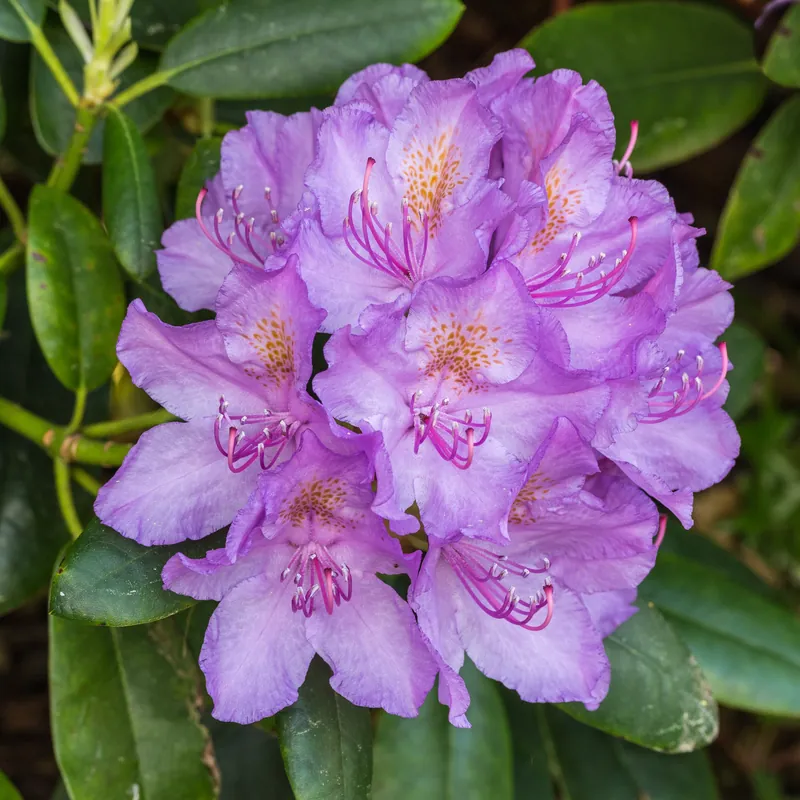
Rhododendron honey from the Black Sea region of Turkey comes from the nectar of Rhododendron ponticum and Rhododendron luteum and contains grayanotoxins, diterpenes that bind to voltage-gated sodium channels. Poisoning cases have been documented from Xenophon in 401 BC to a review of 1199 modern cases. A separate, very light alpine rhododendron honey from R. ferrugineum and R. hirsutum is produced in the Alps and Pyrenees.
What we know
Origin and plant
Mad honey from Rhododendron ponticum nectar is produced in large quantity in the western Black Sea region of Turkey.
Confirmed fact[1]Many Ericaceae, including Rhododendron, contain diterpene grayanotoxins; honey contamination occurs mainly in the eastern Black Sea region of Turkey, from R. ponticum and R. luteum nectar.
Confirmed fact[2]
How to recognise it
A different, very light rhododendron honey comes from Rhododendron ferrugineum, R. hirsutum and their hybrids in the Alps and Pyrenees, with a colour of 12.4 ± 4.0 mm Pfund and under-represented pollen.
Confirmed fact[4]Harmonised melissopalynology gives a relative frequency of 15 to 77 percent for Rhododendron pollen in unifloral rhododendron honeys, a type that can be under-represented in some cases.
Confirmed fact[5]
Composition
Grayanotoxins are diterpenes, polyhydroxylated cyclic hydrocarbons, and more than 25 isoforms have been isolated from Rhododendron.
Confirmed fact[2]Grayanotoxin 1 and 3 are currently thought to be the principal toxic isomers, and grayanotoxin 1 and 2 have been found in the honey, leaves and flowers of Rhododendron ponticum.
Confirmed fact[2]The toxicity of grayanotoxin is attributed to its ability to bind to the group II receptor site in voltage-gated sodium channels.
Confirmed fact[2]In Turkish mad honey from three consecutive years, mean grayanotoxin I and III contents were 20.4 ± 1.69 and 8.20 ± 1.93 mg/kg, unchanged after six months of storage.
Confirmed fact[1]
People and tradition
A systematic review of 1199 cases reported between 1981 and 2014 found that the most common complaints were dizziness, nausea and presyncope, and that no deaths were reported.
Confirmed fact[3]The review attributes the poisonings to honey made from the nectar of Rhododendron ponticum and Rhododendron luteum flowers.
Confirmed fact[3]Symptoms of grayanotoxin poisoning most often occur within 20 minutes to 3 hours after ingestion and remain for 1 to 2 days; in humans the intoxication is rarely lethal.
Confirmed fact[2]Grayanotoxin-containing honey, called mad honey, was already recorded by Xenophon in 401 BC in his Anabasis; old and recent cases of wild honey poisoning are also reported from Nepal.
Confirmed fact[2]
Honey Odyssey describes composition, origin and tradition. It does not give medical advice or health claims.
Continue
Sources
- Kurtoglu A.B., Yavuz R., Evrendilek G.A. (2014) Characterisation and fate of grayanatoxins in mad honey produced from Rhododendron ponticum nectar. Food Chemistry 161, 47-52. doi:10.1016/j.foodchem.2014.03.127 Link
- Jansen S.A., Kleerekooper I., Hofman Z.L.M., Kappen I.F.P.M., Weinzinger A., van der Heyden M.A.G. (2012) Grayanotoxin poisoning: 'mad honey disease' and beyond. Cardiovascular Toxicology 12(3), 208-215. doi:10.1007/s12012-012-9162-2 Link
- Silici S., Atayoglu A.T. (2015) Mad honey intoxication: A systematic review on the 1199 cases. Food and Chemical Toxicology 86, 282-290. doi:10.1016/j.fct.2015.10.018 Link
- Persano Oddo L., Piro R. (2004) Main European unifloral honeys: descriptive sheets. Apidologie 35 (Suppl. 1), S38-S81. doi:10.1051/apido:2004049 Link
- von der Ohe W., Persano Oddo L., Piana M.L., Morlot M., Martin P. (2004) Harmonized methods of melissopalynology. Apidologie 35 (Suppl. 1), S18-S25. doi:10.1051/apido:2004050 Link
Last checked: 30 October 2026. Every statement on this page was compared with the source it cites.