Unifloral honey
Orange blossom honey
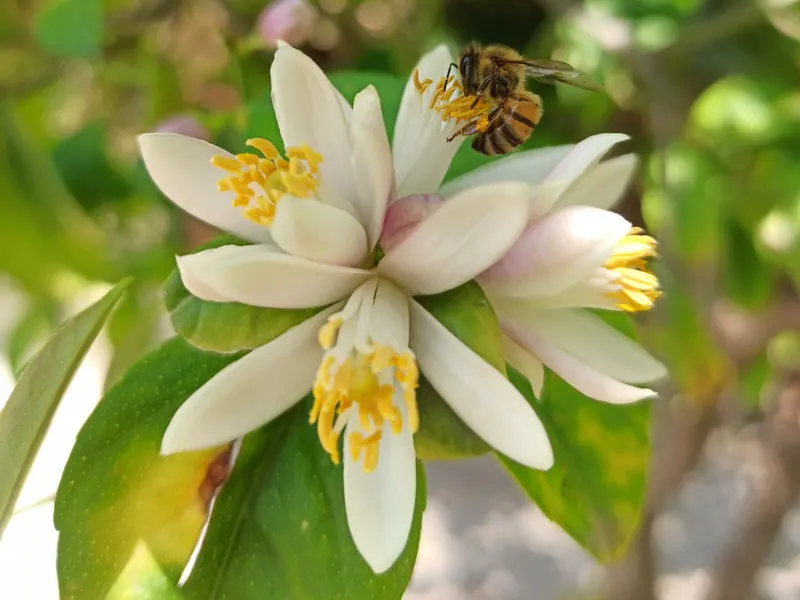
Citrus honey is a floral honey produced in large amounts mainly in Spain and Italy. Citrus pollen is under-represented in it, and methyl anthranilate is used as a chemical marker. Colour, electrical conductivity and enzyme values are low.
What we know
Origin and plant
Persano Oddo and Piro treat all Citrus species as one honey class because their physicochemical characteristics are similar.
Confirmed fact[1]Citrus species attract bees strongly and give large amounts of unifloral honey, mainly in Spain and Italy.
Confirmed fact[1]Outside Europe the main producers of citrus honey are Israel, the USA (California), Brazil and Mexico.
Confirmed fact[1]
How to recognise it
Citrus pollen is under-represented in the honey, to a greater or lesser extent depending on species and cultivar.
Confirmed fact[1]In the data from Greek and Italian laboratories, Citrus pollen averaged 18.6% of the pollen (SD 12.0, n = 192). The authors' range of 2.3 to 42.2% is meant to cover 95% of samples, not to set absolute limits.
Observation[1]Colour averaged 15.0 mm Pfund (SD 6.6, n = 172), with a reported range of 5.0 to 28.1 mm Pfund that the authors present as covering 95% of samples.
Observation[1]Methyl anthranilate is a chemical marker for unifloral citrus honey.
Confirmed fact[1]German laboratories consider at least 2 mg/kg of methyl anthranilate typical of authentic unifloral citrus honey.
Confirmed fact[1]In sensory analysis the odour is described as floral, within the floral and fresh fruit family.
Observation[1]The aroma in the mouth is described as fresh (anise) and floral, within the floral and fresh fruit family.
Observation[1]
Composition
The honey shows low values of colour, electrical conductivity and enzymes, and a slightly high sucrose content.
Confirmed fact[1]Electrical conductivity averaged 0.19 mS/cm (SD 0.06, n = 250), with a reported range of 0.11 to 0.31 mS/cm that the authors present as covering 95% of samples.
Observation[1]
Honey Odyssey describes composition, origin and tradition. It does not give medical advice or health claims.
Continue
Sources
- Persano Oddo L., Piro R. (2004) Main European unifloral honeys: descriptive sheets. Apidologie 35 (Suppl. 1), S38-S81. Link
Last checked: 20 October 2026. Every statement on this page was compared with the source it cites.