Unifloral honey
Linden (lime) honey
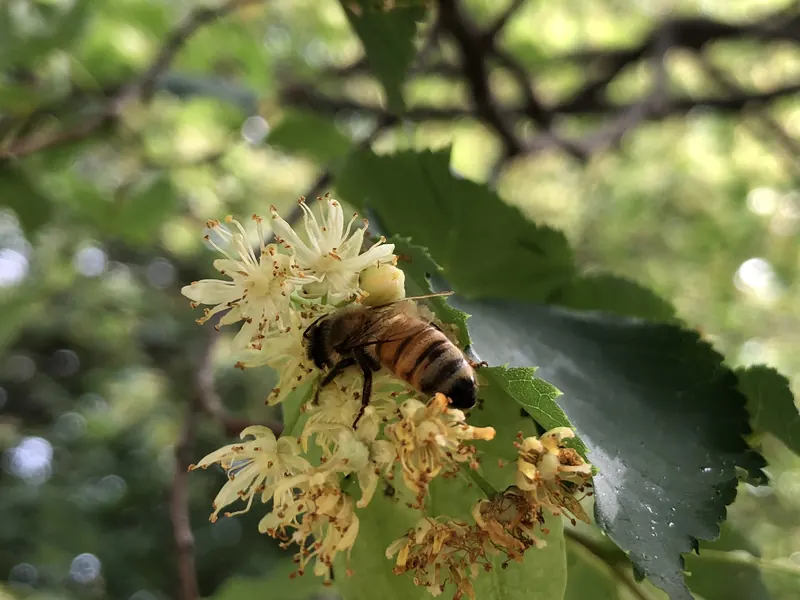
Linden honey comes from several Tilia species, mainly large-leaved and small-leaved lime, and is produced mostly in Central and Eastern Europe. It is light to medium yellow with a strong, fresh odour in sensory analysis, and has unusually high electrical conductivity for a nectar honey.
What we know
Origin and plant
How to recognise it
Lime pollen is under-represented in the honey, sometimes extremely, partly because some cultivated lime varieties are sterile.
Confirmed fact[1]Colour is light to medium with a bright yellow tone, averaging 33.3 ± 13.1 mm Pfund.
Confirmed fact[1]In sensory analysis the odour is strong, described as woody, chemical and fresh.
Observation[1]Sensory panels rate sweetness medium, acidity weak, bitterness absent to medium, and the aftertaste long.
Observation[1]
Composition
For most chemical and physical measurements, linden honey sits close to the average of European unifloral honeys.
Confirmed fact[1]Its electrical conductivity is quite high for a honey made from nectar.
Confirmed fact[1]Some linden honeys have glucose plus fructose values below 60 g/100 g, which the sheets say can be explained by honeydew; lime trees can also provide honeydew after attack by certain insects.
Reported by the farm[1]
Crystallisation and storage
Linden honey crystallises at a moderate rate.
Confirmed fact[1]
Standards and rules
Honey Odyssey describes composition, origin and tradition. It does not give medical advice or health claims.
Continue
Sources
- Persano Oddo L., Piro R. (2004) Main European unifloral honeys: descriptive sheets. Apidologie 35 (Suppl. 1): S38-S81. doi:10.1051/apido:2004049 Link
- Council Directive 2001/110/EC of 20 December 2001 relating to honey. Official Journal of the European Communities L 10, 12.1.2002, p. 47 Link
- Codex Alimentarius Commission. Revised Codex Standard for Honey, CODEX STAN 12-1981, Rev.1 (1987), Rev.2 (2001). FAO/WHO Link
Last checked: 20 October 2026. Every statement on this page was compared with the source it cites.