Unifloral honey
Manuka honey
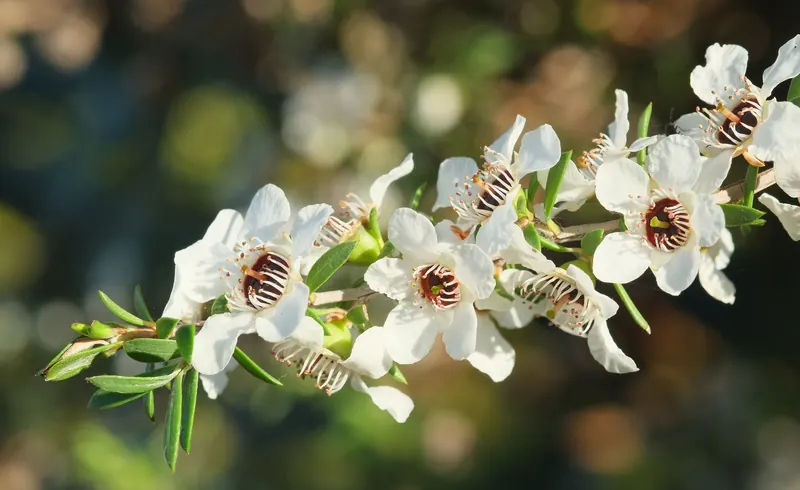
Manuka honey comes from bees collecting nectar of the manuka plant in New Zealand. Since December 2017 New Zealand defines it scientifically by four nectar chemicals and one pollen DNA marker. Its methylglyoxal forms from dihydroxyacetone, a compound found in manuka nectar.
What we know
Origin and plant
How to recognise it
For monofloral manuka honey, MPI requires 3-phenyllactic acid at 400 mg/kg or more.
Confirmed fact[2]The monofloral test also requires 2'-methoxyacetophenone at 5 mg/kg or more.
Confirmed fact[2]For multifloral manuka honey, 3-phenyllactic acid must be at least 20 mg/kg but below 400 mg/kg.
Confirmed fact[2]Both tests require DNA from manuka pollen below a qPCR cycle threshold of Cq 36, which MPI equates to roughly 3 fg/µL.
Confirmed fact[2]
Composition
Crystallisation and storage
When manuka honeys were stored at 37 degrees C, their dihydroxyacetone content fell while methylglyoxal rose.
Observation[4]
Standards and rules
In December 2017 the New Zealand Ministry for Primary Industries (MPI) finalised a scientific definition of manuka honey.
Confirmed fact[1]The MPI definition combines five attributes: four chemicals that come from nectar and one DNA marker from manuka pollen.
Confirmed fact[1]All honey labelled as manuka for export from New Zealand must be tested by a laboratory recognised by MPI.
Confirmed fact[1]
Honey Odyssey describes composition, origin and tradition. It does not give medical advice or health claims.
Continue
Sources
- Ministry for Primary Industries (New Zealand). Mānuka honey (web page). Link
- Ministry for Primary Industries (New Zealand). Mānuka Honey Science Definition. July 2018. Link
- New Zealand Plant Conservation Network. Leptospermum scoparium var. scoparium, species fact sheet (prepared by P.J. de Lange, 2004). Link
- Adams C.J., Manley-Harris M., Molan P.C. (2009) The origin of methylglyoxal in New Zealand manuka (Leptospermum scoparium) honey. Carbohydrate Research 344(8), 1050-1053. doi:10.1016/j.carres.2009.03.020 Link
- Adams C.J., Boult C.H., Deadman B.J., Farr J.M., Grainger M.N.C., Manley-Harris M., Snow M.J. (2008) Isolation by HPLC and characterisation of the bioactive fraction of New Zealand manuka (Leptospermum scoparium) honey. Carbohydrate Research 343(4), 651-659. doi:10.1016/j.carres.2007.12.011 Link
Last checked: 20 October 2026. Every statement on this page was compared with the source it cites.