Unifloral honey
Eucalyptus honey
In Europe eucalyptus honey comes from trees introduced from Australia, Eucalyptus camaldulensis being one of the most important, and is produced mainly in Italy, Spain and Portugal. Its pollen is over-represented. The honey is medium to dark with a greyish tone, 54.2 mm Pfund on average, and crystallises at a moderate rate.
What we know
Origin and plant
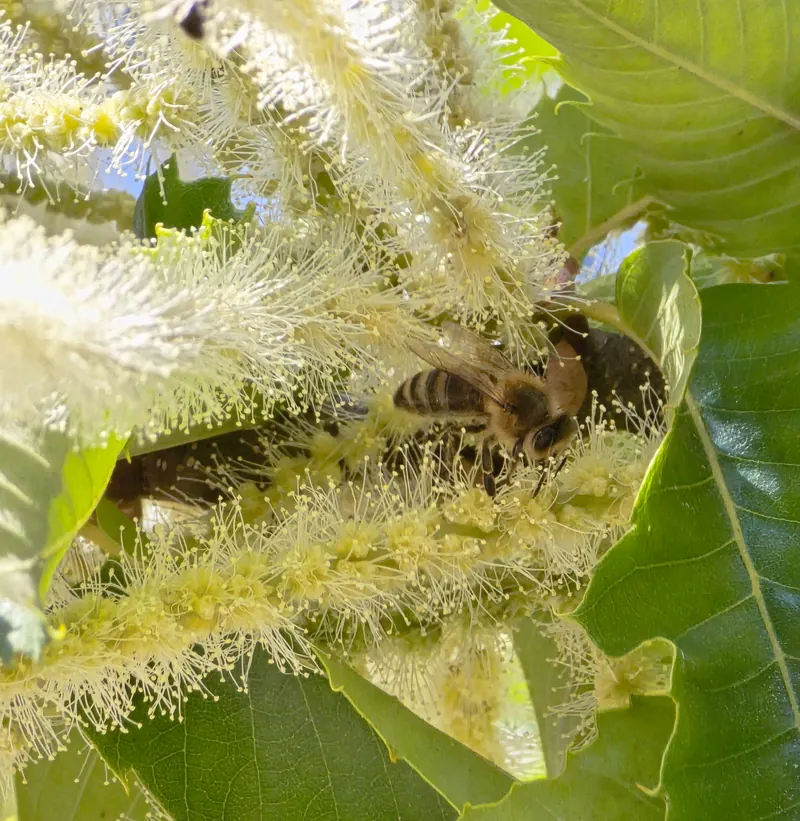
European eucalyptus honey comes from various Eucalyptus species introduced from Australia at the beginning of the twentieth century, Eucalyptus camaldulensis being one of the most important.
Confirmed fact[1]Within Europe, unifloral eucalyptus honey production is important in Italy, Spain and Portugal.
Confirmed fact[1]Outside Europe, the sheet says, large amounts of eucalyptus honey are produced in Australia and in countries where the trees were introduced, such as North and South Africa, Israel and Central and South America.
Confirmed fact[1]
How to recognise it
Eucalyptus camaldulensis pollen is over-represented, and Italian laboratories usually expect at least 90 percent specific pollen in authentic eucalyptus honey.
Confirmed fact[1]Colour is medium to dark, a normal honey colour with a dull greyish tone, averaging 54.2 ± 9.4 mm Pfund.
Confirmed fact[1]In sensory analysis the odour is medium to strong and described as warm and spoiled; sweetness is medium, acidity weak, bitterness absent, and the aftertaste medium.
Observation[1]
Composition
Unifloral eucalyptus honey has slightly high diastase, invertase and glucose to water ratio, the latter because of low water rather than high glucose.
Confirmed fact[1]In samples collected by the International Honey Commission the highest electrical conductivity was about 0.6 mS/cm, and no sucrose value exceeded 5 g/100 g.
Confirmed fact[1]Mean electrical conductivity is 0.48 ± 0.06 mS/cm, fructose 39.1 ± 2.2 and glucose 33.0 ± 1.9 g/100 g, with a fructose to glucose ratio of 1.19 ± 0.09.
Confirmed fact[1]
Crystallisation and storage
Eucalyptus honey crystallises at a moderate rate.
Confirmed fact[1]
Standards and rules
Honey Odyssey describes composition, origin and tradition. It does not give medical advice or health claims.
Continue
Sources
- Persano Oddo L., Piro R. (2004) Main European unifloral honeys: descriptive sheets. Apidologie 35 (Suppl. 1): S38-S81, Eucalyptus sheet pp. S60-S61. doi:10.1051/apido:2004049 Link
- Council Directive 2001/110/EC of 20 December 2001 relating to honey, Annex II points 1.2 and 4. Official Journal of the European Communities L 10, 12.1.2002, p. 47 Link
Last checked: 30 October 2026. Every statement on this page was compared with the source it cites.