Unifloral honey
Dandelion honey
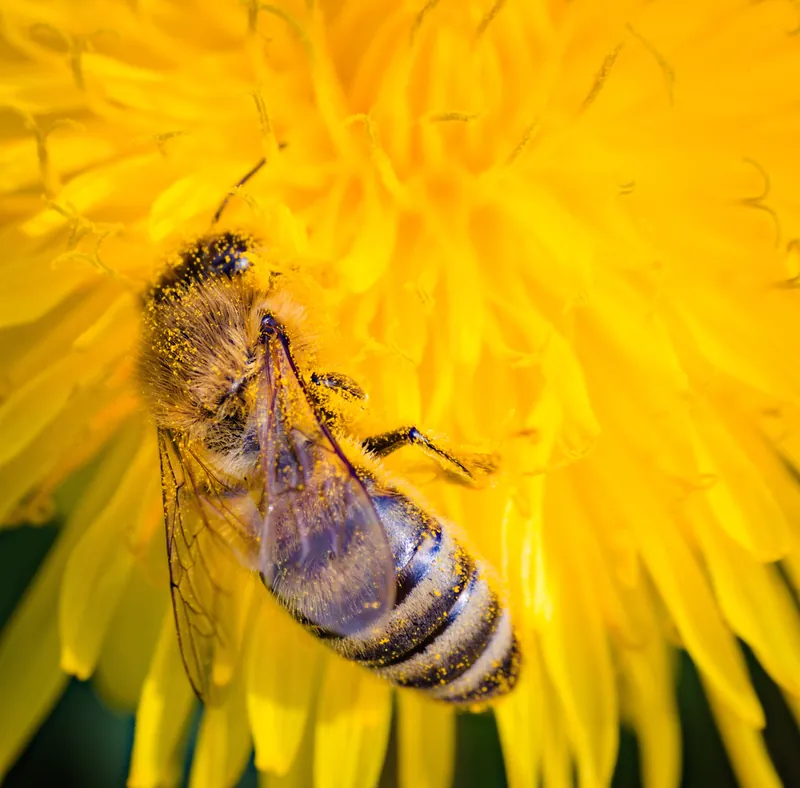
Dandelion honey comes from the Taraxacum officinale group, a variable group of plants widespread in Europe, mainly the central countries, and one of the earlier nectar sources of the season. The honey is bright yellow, about 56.6 mm Pfund on average, high in glucose, and crystallises quickly into very small crystals. Its pollen rarely exceeds 50 percent of the count.
What we know
Origin and plant
How to recognise it
With about 33,600 pollen grains per 10 g, dandelion pollen does not seem under-represented, yet it rarely exceeds 50 percent of the count.
Confirmed fact[1]Dandelion pollen is often outnumbered by pollen of associated plants such as willow or crucifers.
Confirmed fact[1]Colour is of medium intensity with a bright yellow tone, averaging 56.6 ± 10.4 mm Pfund; the table notes a typical yellow hue.
Confirmed fact[1]In sensory analysis the odour is strong and described as spoiled; the aroma is strong, woody and spoiled, with a long aftertaste.
Observation[1]Sensory panels rate sweetness medium, acidity medium and bitterness absent to weak.
Observation[1]
Composition
Dandelion honey shows low acidity and a low fructose to glucose ratio, with high glucose, high total fructose plus glucose, and a high glucose to water ratio.
Confirmed fact[1]Mean glucose is 38.0 ± 2.8 and fructose 37.4 ± 1.8 g/100 g, giving a fructose to glucose ratio of 0.99 ± 0.07; electrical conductivity averages 0.51 ± 0.07 mS/cm.
Confirmed fact[1]In some Italian samples the diastase value fell below the limit of 8 set in the EU honey directive.
Reported by the farm[1]
Crystallisation and storage
Because of its high glucose content dandelion honey crystallises rapidly and is often found crystallised with very small crystals.
Confirmed fact[1]
Production
Unifloral dandelion honey is mostly sold in the areas where it is produced.
Confirmed fact[1]
Honey Odyssey describes composition, origin and tradition. It does not give medical advice or health claims.
Continue
Sources
- Persano Oddo L., Piro R. (2004) Main European unifloral honeys: descriptive sheets. Apidologie 35 (Suppl. 1): S38-S81, Dandelion sheet pp. S72-S73. doi:10.1051/apido:2004049 Link
Last checked: 30 October 2026. Every statement on this page was compared with the source it cites.