Hive product
Comb honey
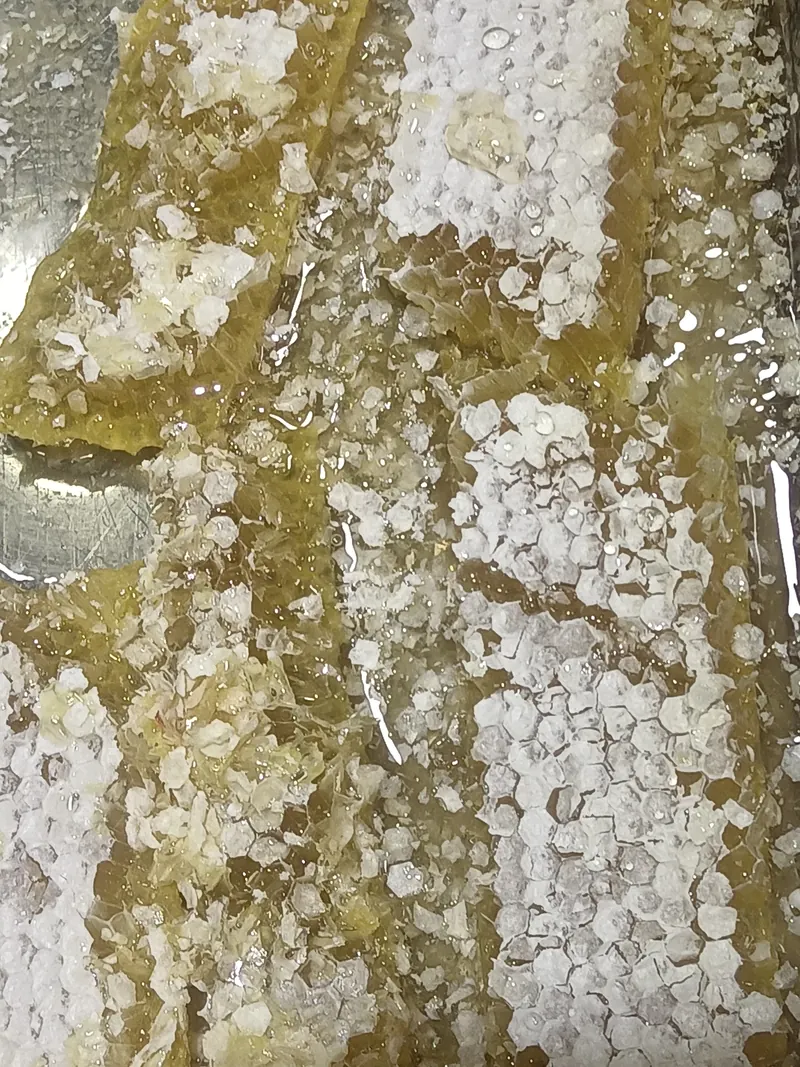
Comb honey is honey sold still sealed in the wax comb the bees built. Codex and EU rules define comb honey and chunk honey, honey containing pieces of comb, and require these styles to be named on the label. Producing it needs special colony management and very thin or no wax foundation.
What we know
Crystallisation and storage
FAO recommends light-coloured honey that stays liquid until eaten for comb honey, and says honey in chunk honey jars should not crystallise before consumption.
Confirmed fact[1]Comb honey products do not tolerate long transport in warm conditions or long storage; in the sun, wax cappings can quickly turn transparent.
Confirmed fact[1]
Production
Section comb honey is a small piece of completely sealed comb built of new, virgin beeswax.
Confirmed fact[1]For section honey, colonies are given round, square or hexagonal wood or plastic frames with a very thin foundation sheet, which they fill with comb and honey.
Confirmed fact[1]Cut comb honey can be made in regular frames or top-bar hives; any foundation must be particularly thin, with no wires or reinforcement in the comb.
Confirmed fact[1]Cut pieces are drained on a wire rack to let honey run from the cut cells, keeping bees away, before packing in clear containers.
Confirmed fact[1]Honey sold in complete comb needs a particular type of colony management; FAO notes that section comb honey in particular requires more intensive management and better planning.
Confirmed fact[1]
Standards and rules
The EU Honey Directive defines comb honey as honey stored by bees in freshly built, broodless combs or thin foundation sheets made only of beeswax, sold in sealed whole combs or sections.
Confirmed fact[2]The EU Directive defines chunk honey, or cut comb in honey, as honey which contains one or more pieces of comb honey.
Confirmed fact[2]In the EU, the simple name 'honey' may replace most product names, but not for comb honey or chunk honey, which must be named as such.
Confirmed fact[2]The Codex Alimentarius honey standard similarly defines comb honey as honey stored by bees in freshly built broodless combs, sold in sealed whole combs or sections.
Confirmed fact[3]Codex defines cut comb in honey, or chunk honey, as honey containing one or more pieces of comb honey, and requires these styles to be declared on the label.
Confirmed fact[3]
Honey Odyssey describes composition, origin and tradition. It does not give medical advice or health claims.
Continue
Sources
- Krell, R. (1996). Value-added products from beekeeping. FAO Agricultural Services Bulletin 124. Rome: Food and Agriculture Organization of the United Nations. Chapter 2: Honey, section 2.12.3. Link
- Council Directive 2001/110/EC of 20 December 2001 relating to honey. Official Journal of the European Communities, L 10, 12.1.2002, pp. 47 to 52 (Annex I and Article 2). Link
- Codex Alimentarius Commission. Standard for Honey, CXS 12-1981 (adopted 1981, revised 1987 and 2001, later amended), sections 6.1.9 and 6.1.11. Rome: FAO/WHO. Link
Last checked: 20 October 2026. Every statement on this page was compared with the source it cites.