Hive product
Royal jelly
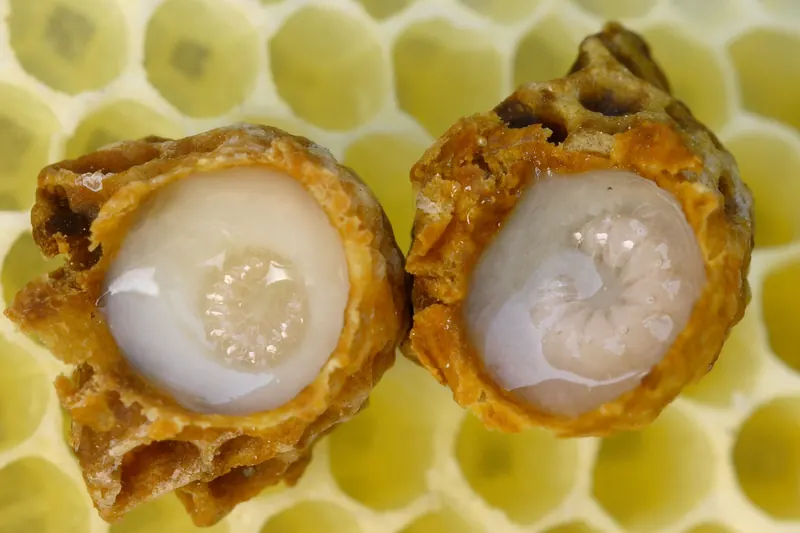
Royal jelly is a secretion of the hypopharyngeal and mandibular glands of young nurse bees. All larvae receive it in their first three days, but only queen larvae and the queen go on being fed it. It is mostly water, with proteins, sugars and lipids, and its quality is specified in ISO 12824:2016.
What we know
How to recognise it
The fatty acid 10-HDA, (2E)-10-hydroxydec-2-enoic acid, is an unsaturated fatty acid found only in royal jelly.
Confirmed fact[2]FAO describes royal jelly as a fairly fluid paste, whitish with yellow or beige tinges, with a pungent phenolic odour and a characteristic sour flavour.
Reported by the farm[1]
Composition
A 2017 study, citing earlier work, gives royal jelly as 60 to 70% water, with proteins at 27 to 41% of the dry matter, carbohydrates up to 30% and lipids 3 to 8%; FAO gives wider ranges.
Confirmed fact[2]The lipid fraction of royal jelly is 80 to 90% free fatty acids by dry weight.
Confirmed fact[1]In a study of five royal jelly samples from Osijek-Baranja County, Croatia, 10-HDA content ranged from 1.56% to 3.78%.
Observation[2]
Crystallisation and storage
FAO says royal jelly must always be kept at or below 5 °C in storage, and individual queen cells harvested for it should hold at least 200 mg.
Confirmed fact[1]
Production
Royal jelly is a secretion of both the hypopharyngeal and mandibular glands of nurse worker bees.
Confirmed fact[3]Young nurse bees feed royal jelly to worker, drone and queen larvae for their first three days; after that only queen larvae and the queen receive it.
Confirmed fact[2]Bees do not store royal jelly; it is always fed directly to the queen or larvae as it is secreted.
Confirmed fact[1]
Standards and rules
A 2017 Croatian study states that, according to ISO and the International Honey Commission, fresh and genuine royal jelly should contain at least 1.4% 10-HDA.
Confirmed fact[2]ISO 12824:2016 sets production and sanitary requirements for royal jelly, and organoleptic and chemical test methods to control its quality.
Confirmed fact[4]The ISO standard also covers transport, storage, packaging and marking, but does not apply to products in which royal jelly is mixed with other foods.
Confirmed fact[4]
Honey Odyssey describes composition, origin and tradition. It does not give medical advice or health claims.
Continue
Sources
- Krell, R. (1996). Value-added products from beekeeping. FAO Agricultural Services Bulletin 124. Rome: Food and Agriculture Organization of the United Nations. Chapter 6: Royal jelly. Link
- Flanjak, I., Jakovljević, M., Kenjerić, D., Cvijetić Stokanović, M., Primorac, Lj., & Bilić Rajs, B. (2017). Determination of (2E)-10-hydroxydec-2-enoic acid in Croatian royal jelly by high-performance liquid chromatography. Croatian Journal of Food Science and Technology, 9(2), 152 to 157. https://doi.org/10.17508/CJFST.2017.9.2.10 Link
- Su, S., Albert, S., Chen, S., & Zhong, B. (2005). Molecular cloning and analysis of four cDNAs from the heads of Apis cerana cerana nurse honeybees coding for major royal jelly proteins. Apidologie, 36, 389 to 401. https://doi.org/10.1051/apido:2005026 Link
- International Organization for Standardization. ISO 12824:2016 Royal jelly: Specifications. Edition 1, published September 2016, confirmed 2021. Link
Last checked: 20 October 2026. Every statement on this page was compared with the source it cites.